
Power Lines as Frontlines: Why the Grid Is Modern War's Centre of Gravity
When $600 drones can black out cities and AI target-generators run on vast grids, warfare's calculus has shifted. The Energy-Security Nexus explains why national security is now measured in blackouts avoided as much as borders defended.
By Sayonsom Chanda
When a $600 drone can cripple infrastructure worth hundreds of millions, and the AI systems that choose targets need vast power grids to run, the fundamental calculus of warfare has shifted. From Ukraine's darkened cities to Iran's burning refineries, from Chinese sleeper malware to Israeli AI platforms, advanced weapons have turned energy infrastructure into the decisive battlefield — exposing a paradox in which our most sophisticated military capabilities depend on the very infrastructure that has become warfare's primary target. Understanding this Energy-Security Nexus is no longer academic; for a growing number of nations, survival now depends on blackouts avoided as much as borders protected.
The New Geography of Conflict #
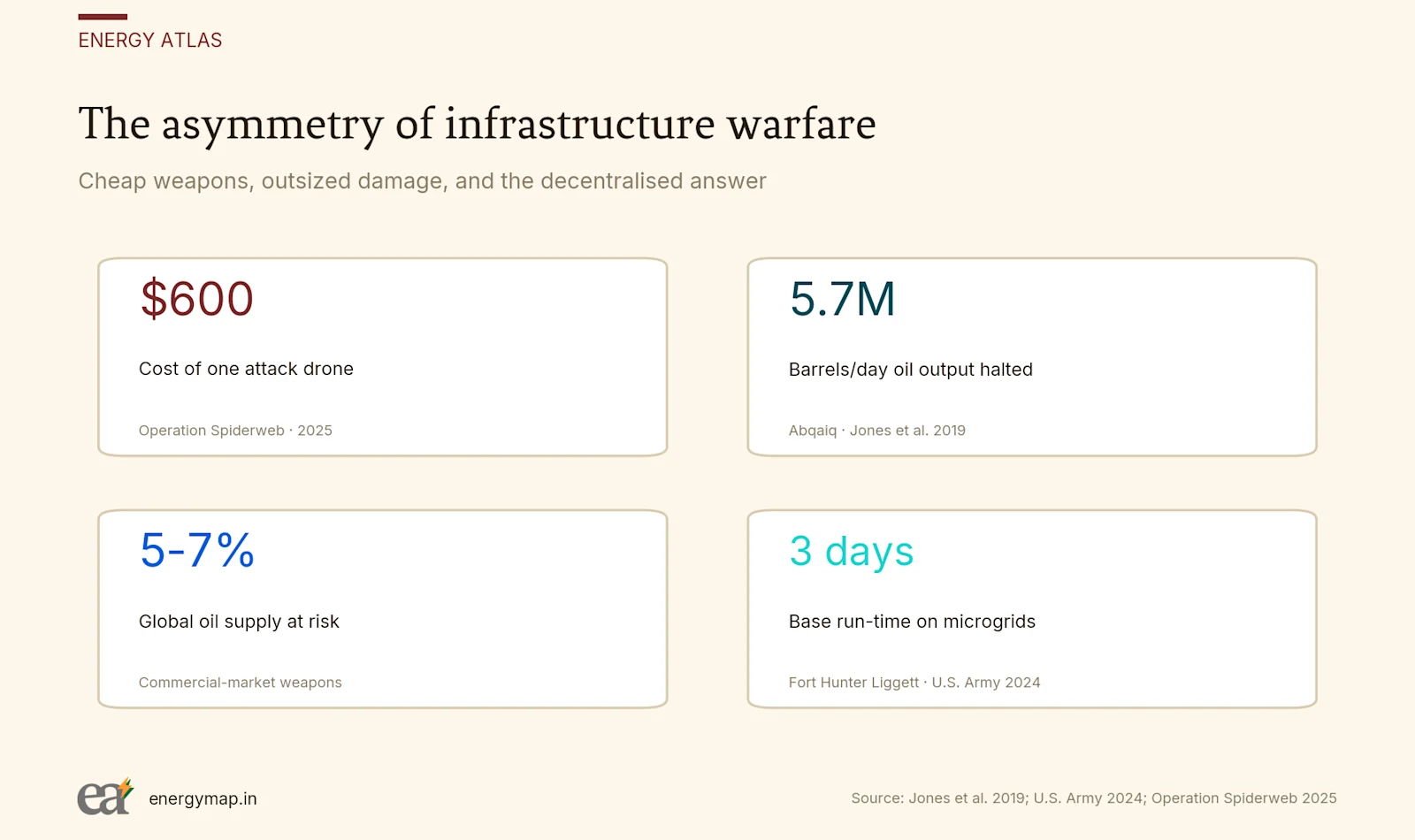
"Operation 'Spiderweb' showed what modern war really looks like and why it is so important to stay ahead with technology," Ukrainian President Volodymyr Zelensky posted after Ukraine smuggled a swarm of drones into Russia and, on June 1, 2025, unleashed them in a surprise attack on airfields deep inside Russian territory — from eastern Siberia to the western border. The cost-effectiveness — $600 drones striking infrastructure worth hundreds of millions — both exemplifies and exposes a grand asymmetry in modern warfare.
Five days later, Russia retaliated with drone attacks on power grids in Lviv, Ternopil, Lutsk, and Khmelnytskyi, plunging entire regions into darkness with an efficiency conventional operations could never achieve. This is not collateral damage from kinetic operations gone awry.
While defence establishments pour billions into hypersonic missiles, quantum computing arrays, and AI-enabled autonomous systems, the most consequential battles of our time are being fought over mundane targets: power plants, transformer stations, and electrical substations. Today's active conflicts — Israel-Iran, Ukraine-Russia, India-Pakistan, Israel-Gaza — show repeatedly that by innovating on the choice of weapons (cheap drones) and targets (substations, nuclear plants, oil pipelines), the entire outcome of a war can be overturned.
The Energy-Security Nexus: A Framework for Modern Vulnerability #
Given the diffusion of risk from military to civilian spheres, it makes sense to add two new dimensions — energy security and compute resources — to the classic trinity of armies, capitals, and alliances (Jordan et al., 2015). This updated model helps policymakers and defence strategists think more clearly about how energy dependencies reshape strategic calculations in ways our existing Clausewitzian models inadequately capture (Alcaraz & Zeadally, 2015).
That addition must reckon with a paradox: as military systems become more sophisticated — more networked, more automated, more dependent on real-time data — they become exponentially more vulnerable to energy disruption. Our most advanced weapons, precisely because they rely on data and an uninterrupted supply of large amounts of electricity, are often our most fragile.
Energy infrastructure also exhibits unique network effects, where localised failures trigger disproportionate systemic collapse. Unlike traditional military assets, which degrade linearly with damage, power grids can suffer catastrophic failure from seemingly minor disruptions. To capture these cyber-physical dimensions, a new framework is needed. Call it the Energy-Security Nexus.
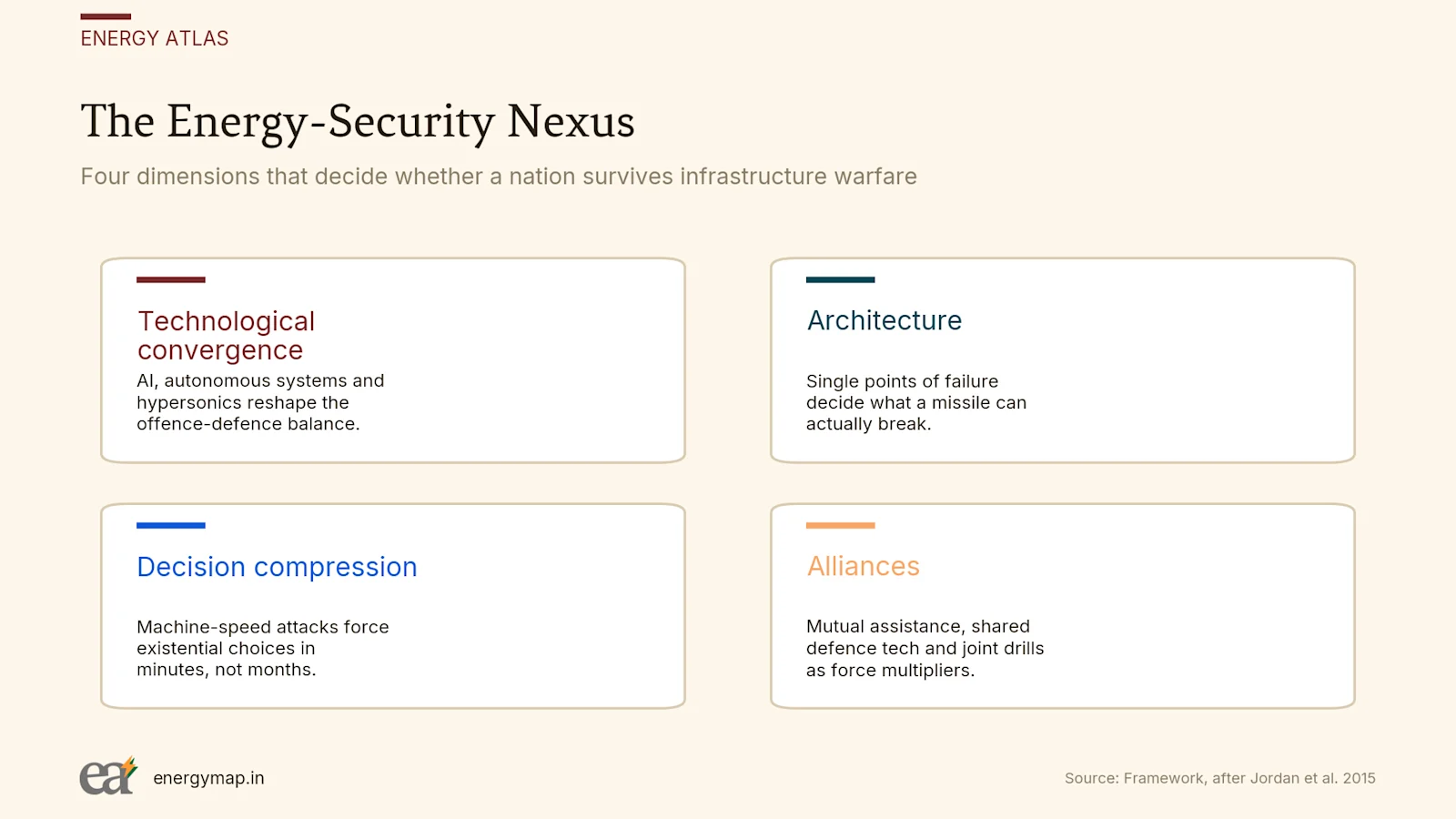
The Energy-Security Nexus is a dynamic, multi-dimensional relationship in which energy infrastructure, military capabilities, and societal resilience interact through feedback loops that reshape traditional concepts of strategic vulnerability and national power. It operates across four critical dimensions.
Technological convergence #
First is the way artificial intelligence, autonomous systems, and hypersonic weapons reshape the offence-defence balance. Metrics can quantify how far military capability rests on energy: an Energy Intensity Ratio (military energy consumption per unit of combat capability), a Digital Dependency Index (the share of weapons systems requiring real-time data connectivity), and a Grid Coupling Coefficient (how long operations can continue without external power).
Architecture #
Then there is the architecture itself — the share of energy supply that flows through single points of failure, and what sits at highest risk when the missiles fly.
Decision compression #
When infrastructure warfare moves at machine speed — and it does, in the era of AI-generated target lists and hypersonic missiles — governments make existential decisions in minutes, not months. Inter-agency coordination and the ability to compress decision times become essential.
Alliances #
And, perhaps most critically, alliances: the speed of mutual assistance during energy crises, the sharing of defence technologies, and the success of joint energy-security exercises. NATO's early-warning systems and the European Union's energy-solidarity mechanisms are only the first generation of what will become far more sophisticated collaborative defence architectures (NATO, 2021).
Put rigorously into formula, these parameters make it possible to build nation-specific models that predict which states are most vulnerable to successful infrastructure attacks, most likely to suffer cascading societal failure, and slowest to recover — and how they might prepare.
Learning from History's Laboratory #
Infrastructure warfare is as old as warfare itself, but the modern story begins with the strategic bombing campaigns of World War II. Allied air marshals wrestled with targeting priorities — Wehrmacht formations, or the factories producing their weapons? The results were frustratingly ambiguous. German industrial production actually increased under bombardment until late 1944, and debates about the effect on civilian morale continue among historians today. Infrastructure proved more resilient than expected; populations, more adaptable than planners had assumed.
In the 1980s "Tanker Wars" between Iran and Iraq, both sides systematically targeted oil tankers and terminals, aiming at economic strangulation rather than military defeat (Maridi, 1985). More than 500 vessels were damaged, disrupting global oil supplies and establishing templates for resource-denial strategies that echo in today's campaigns. The innovation was conceptual as much as tactical: warfare aimed not at defeating enemy forces but at undermining societal sustainability.
Desert Storm marked another leap. In 1991, coalition forces disabled Iraq's electrical grid within hours using carbon-fibre filaments and precision munitions — achieving in a single night what had taken months in World War II (Longhurst, 2018). Yet a paradox emerged that haunts us still: surgical precision in degrading infrastructure normalised such targeting by reducing visible destruction. Clean wars against power plants seemed more palatable than messy battles against armies.
Russia's methodical campaign against Ukraine's energy infrastructure — over 1,000 precision strikes and counting — represents infrastructure warfare's current apotheosis (Givens et al., 2023). The restraint is calculated: enough devastation to break societal cohesion while staying below thresholds that might trigger NATO's Article 5. Moscow has learned history's lessons too well, turning infrastructure attacks from a crude bludgeon into a precise instrument of coercion.
The Democratisation of Destruction #
The June 2025 escalation in the Israel-Iran war exemplifies the Energy-Security Nexus through cyber-kinetic operations against nuclear energy infrastructure. Iran's drone and missile strikes on Israeli targets in April 2024 — calibrated to demonstrate vulnerability while avoiding massive escalation — prompted determined Israeli strikes on multiple Iranian nuclear enrichment sites.
The Yemen conflict shows how non-state actors can leverage commercial drone technology for asymmetric infrastructure warfare. The September 2019 Abqaiq-Khurais attacks should have been a wake-up call: Houthi forces, operating with Iranian assistance but hardly a peer military, temporarily eliminated 5.7 million barrels of daily oil production using drones that cost less than a luxury car (Jones et al., 2019). Saudi Arabia's Abqaiq facilities, with their centralised architecture and limited cyber-physical defence integration, created exploitable asymmetries. Weapons purchasable on the commercial market can disrupt 5-7% of the international oil supply.
The economics are stark. Traditional air-defence systems — Patriot batteries, Iron Dome interceptors — cost millions of dollars per engagement, while the incoming threat might cost hundreds or thousands. That is unsustainable, as Ukraine discovered when its pleas for more air defence reflected not just tactical need but economic exhaustion. Defending every power plant, substation, and transformer against cheap drones is a recipe for bankruptcy before defeat.
Yet innovation emerges from necessity. Ukraine's evolving resilience shows an ability to adapt under technological pressure: AI-assisted damage assessment enables rapid grid reconstitution, while distributed microgrids blunt hypersonic weapons through target dispersal. Western technical assistance increasingly folds in AI-driven predictive maintenance and real-time threat detection. Fort Hunter Liggett's ability to operate for three days on renewable microgrids is a pragmatic recognition that decentralising capability neutralises entire categories of attack (U.S. Army, 2024). When a base can disconnect from the grid and keep operating, enemy strikes on centralised infrastructure become irrelevant.
Digital Arrows, Physical Wounds #
The fusion of cyber operations with kinetic strikes is the most sophisticated evolution in infrastructure warfare, and Russia's progression from experimental probes to integrated campaigns illustrates it with disturbing clarity.
About a decade ago, BlackEnergy attacks briefly darkened portions of Ukraine. Many dismissed them as nuisances — proof-of-concept operations more annoying than strategic (Cherepanov & Lipovsky, 2022). By 2022, Industroyer2 had evolved into something far more sinister: a synchronisation mechanism that degraded defensive systems in the milliseconds before missiles arrived (CISA et al., 2024). Cyber intrusions that might once have caused only temporary disruption become force multipliers for physical destruction when properly sequenced.
China's Volt Typhoon campaign reveals even greater strategic patience. For nearly ten years, operatives have methodically compromised operational technology across American critical infrastructure — not through exotic zero-day exploits that might trigger detection, but through "living-off-the-land" techniques that abuse legitimate system functions (CISA et al., 2024). These digital sleeper agents lurk within SCADA systems controlling everything from generation to transmission, pre-positioned for activation during some future Taiwan crisis. The logic is elegant: why risk carrier battle groups in the Taiwan Strait when dormant code could plunge California into darkness?
Artificial intelligence promises to revolutionise warfare while creating new vulnerabilities. Israel's "Gospel" AI platform reportedly generated over 100 bombing targets a day in Gaza, against perhaps 50 a year under human analysts (Human Rights Watch, 2024). It ran on Microsoft Azure cloud infrastructure, with usage spiking 200-fold during active operations. The computational infrastructure required to wage modern war has become so energy-intensive that it creates strategic vulnerabilities of its own.
The Pentagon's $3 billion budget request for AI-enabled autonomous systems reflects recognition of AI's transformative potential (GAO, 2023). Yet each system — from Project Maven's intelligence analysis to JADC2's battle management — demands massive computational resources that translate directly into electrical load. We are building military capabilities that a simple power interruption could neutralise. DARPA's neuromorphic computing initiatives, promising 4- to 16-fold reductions in energy consumption, are attempts to escape the trap. But even efficient systems need stable power, and the paradox only deepens.
Speed, Precision, and the Compression of Decision #
Hypersonic weapons add another layer. When weapons travel faster than Mach 5 with unpredictable flight paths, the comfortable decision cycles of Cold War deterrence are obsolete. Detection-to-impact windows of 15 to 30 minutes mean that by the time an incoming strike on a nuclear plant or transmission hub is confirmed, it is too late to do anything but brace for impact.
The South China Sea is a distinct infrastructure battlefield, where China's quantum-communication satellites and AI-enabled surveillance build an "infrastructure of control" over disputed waters. Taiwan's "porcupine strategy," meanwhile, emphasises distributed energy resilience and communications redundancy to survive an infrastructure-centric attack during a blockade or invasion (Gregson & Dotson, 2023).
Russia's deployment of Kinzhal, Zircon, and Avangard systems is not about prestige weapons; it is about altering the defender's calculus (Speier et al., 2017). Ukraine claims 25% interception rates against hypersonic missiles — but stopping a single weapon can require all 32 launchers of a Patriot battery to engage at once. The economics are ruinous, the tactics unsustainable. Static infrastructure cannot be defended against hypersonic attack through traditional interception. The only viable defence is radical decentralisation: if critical functions are distributed across microgrids, the loss of any single node becomes survivable.
Policy Imperatives for an Infrastructure-Centric Era #
Human factors, political will, and international support still decide the outcome of wars. But a nation's ability to keep the lights on for its economy has become a yardstick of success in its own right. The centralised grid that efficiently powers an economy in peacetime has become a wartime liability in an age of drone-based infrastructure warfare and cyberattack. Decentralised minigrids and microgrids are the future-proof answer, and energy resilience must become a design principle rather than an afterthought.
Three commitments would begin to close the gap:
All critical infrastructure should be required to sustain operations independently for at least 72 hours.
Utilities should reach 40 per cent distributed generation by 2030.
EMP-hardened construction must shift from niche to norm.
A blackout caused by code should trigger the same clarity as one caused by cruise missiles. As public infrastructure like power lines becomes the new frontline, NATO's Article 5 and its response protocols must reflect the shift. A new Geneva Protocol on infrastructure warfare is overdue — one that draws clear red lines, defines what counts as an armed attack in the age of electrons and data-driven intelligence, and establishes mechanisms to verify protections for civilian lifelines.
In this new era, national security will be measured not only in missiles stockpiled but in megawatts secured; not only in borders defended but in blackouts prevented. If Operation 'Spiderweb' and Russia's retaliation showed what modern war really looks like, nations must adapt quickly to the Energy-Security Nexus — to quantify their preparedness and guide the investments that will minimise the lethality of the advanced weapons their adversaries now hold.
Sources #
Alcaraz, C., & Zeadally, S. (2015). Critical infrastructure protection: Requirements and challenges for the 21st century. International Journal of Critical Infrastructure Protection, 8, 53–66.
Cherepanov, A., & Lipovsky, R. (2022). Industroyer2: Industroyer reloaded. ESET Research.
Cybersecurity and Infrastructure Security Agency, National Security Agency, & Federal Bureau of Investigation. (2024). PRC state-sponsored actors compromise and maintain persistent access to U.S. critical infrastructure (Cybersecurity Advisory AA24-038A).
Givens, A. D., Gorbachevsky, M., & Biernat, A. C. (2023). How Putin's cyberwar failed in Ukraine. Journal of Strategic Security, 16(4), 42–67.
Government Accountability Office. (2023). Artificial intelligence: Actions needed to improve DOD's workforce management (GAO-24-105645).
Gregson, W., & Dotson, J. (2023). Porcupine or honey badger? The "Overall Defense Concept" and asymmetry in Taiwan's defense strategy. Global Taiwan Brief, 8(15). Global Taiwan Institute.
Human Rights Watch. (2024). Gaza: AI targeting systems risk civilian harms — Q&A on the Israeli military's use of digital tools.
Jones, S. G., Bermudez Jr., J. S., Newlee, D., & Harrington, N. (2019). Iran's threat to Saudi critical infrastructure. Center for Strategic and International Studies.
Jordan, D., Kiras, J., Lonsdale, D., Speller, I., Tuck, C., & Walton Dale, C. (2015). Understanding Modern Warfare (2nd ed.). Cambridge University Press.
Longhurst, K. A. (2018). Germany and the Use of Force. Manchester University Press.
Maridi Nahas. (1985). State-systems and revolutionary challenge: Nasser, Khomeini, and the Middle East. International Journal of Middle East Studies, 17(4).
NATO. (2021). Energy security in the era of hybrid warfare. NATO Review.
Speier, R. H., Nacouzi, G., Lee, C., & Moore, R. M. (2017). Hypersonic missile nonproliferation: Hindering the spread of a new class of weapons (RR-2137). RAND Corporation.
U.S. Army. (2024). Fort Hunter Liggett celebrates completion of groundbreaking renewable energy microgrid. Army News Service.