
Dreams and Debts: The Belt and Road "Debt Trap" That Wasn't
An empty Montenegrin highway, a packed Laotian railway, and nearly a trillion dollars of Belt and Road lending. The evidence points away from "debt-trap diplomacy" and toward developing countries negotiating hard.
By Sayonsom Chanda
Two Chinese-built projects — an empty highway in Montenegro and a packed railway in Laos — bookend nearly a trillion dollars of Belt and Road lending. Drawing on my own study of a dozen mega-projects, the evidence points away from Washington's "debt-trap diplomacy" and toward something more interesting: recipient countries have learned to negotiate hard, play great powers against each other, and turn infrastructure finance into a buyer's market.
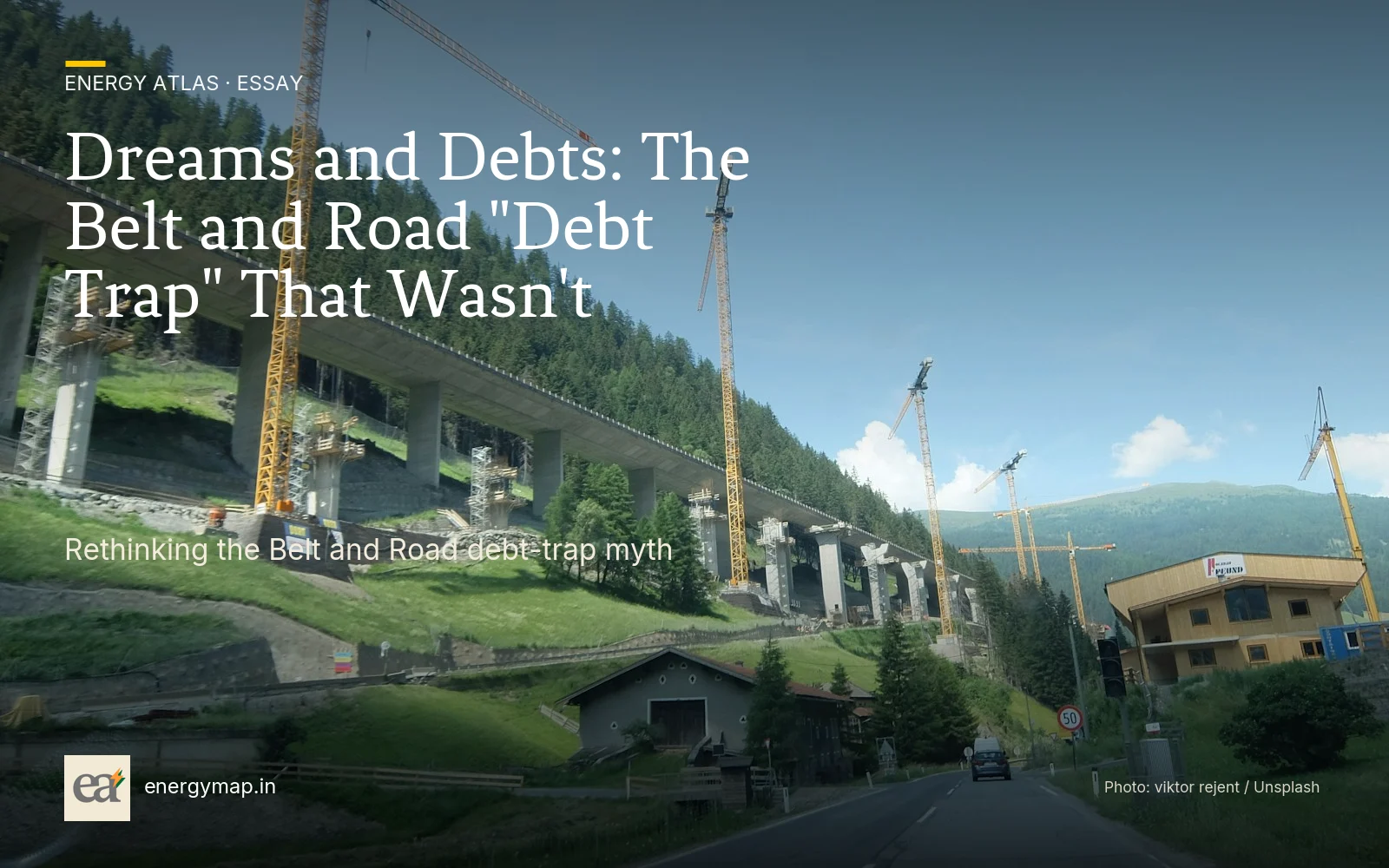
Drive the Bar-Boljare highway in Montenegro and you get forty-one kilometres of serene mountains, four pristine lanes, and almost no traffic. At the Smokovac exit, a toll collector scrolls on his phone, glancing up at the occasional car. In economic terms, this billion-dollar Belt and Road highway needs twenty-two thousand vehicles a day to break even. It gets six thousand (Shepard, 2024; Hillman, 2021).
Now fly fifteen hundred kilometres east to Laos, and you cannot get a seat on the Chinese-built train to Vientiane. Forty times more tourists arrived last year than before the railway opened (KPL, 2024). Same lenders, same Belt and Road Initiative — radically different outcomes.
Washington would have you believe Montenegro fell into a debt trap while Laos got lucky.
Several months of research into dozens of major Chinese development projects worth nearly a trillion dollars point to a different conclusion: "debt-trap diplomacy" is a narrative that lets Washington avoid an uncomfortable truth — the rise of the Global South (Jones & Hameiri, 2020; Brautigam & Rithmire, 2021). The real story of the Belt and Road Initiative is not Chinese predation. It is the democratisation of infrastructure finance, in which developing countries have learned to play major powers against each other with remarkable sophistication (Jones & Hameiri, 2020).
Indonesia and the lessons of history #
History rarely repeats, but it rhymes with events from eight centuries ago. Central Asian intermediaries — Sogdians, Tang-era brokers — built dynasties on a simple principle: never let one power dominate the roads. Their strategic descendants now run ministries in Kuala Lumpur and Nairobi, playing Beijing against Washington with the same instinct as the original Silk Road merchants (Hillman, 2021).
In 1969, Japanese loans built Indonesia's Asahan aluminium smelter on terms Jakarta's negotiators called "colonial": Japanese contractors, Japanese equipment, Japanese profits. Thailand's Eastern Seaboard, financed by Tokyo in 1982, required Japanese firms for every major contract (Hillman, 2021). The Marcos regime in the Philippines complained of "development aggression." Over time, recipients would extract technology transfers, local-content requirements, and grant elements Beijing can only dream of today. Tokyo learned the hard lesson: when recipients have options, lenders adapt or lose. Japan now markets itself as the "quality infrastructure" alternative to China, apparently forgetting its own controversial past.
What changed was not Japanese virtue but the rising capability of the Global South. Thailand built advanced project-evaluation systems. Indonesia learned to coordinate multiple donors. Malaysia established specialised negotiation teams. By the 1990s these countries no longer depended on Japanese largesse; they ran competitive bidding processes in which Tokyo had to provide real value.
The pattern says something profound about the present. Infrastructure finance has always involved power asymmetries — but those asymmetries are unstable. Recipients learn. Donors adapt. Competition emerges. The claim that China has invented a novel neo-colonialism through infrastructure lending misreads both history and the evidence. Beijing has revived an ancient game with modern characteristics, and developing countries are proving adept players (Carmody & Wainwright, 2022).
Malaysia: negotiation is everything #
Malaysia's East Coast Rail Link reveals more about modern power than most theoretical frameworks. When Mahathir Mohamad returned to power in 2018, he inherited a sixteen-billion-dollar Chinese rail project signed by his predecessor. The debt-trap script would predict Malaysian submission. Instead, Mahathir ran a masterclass in two-level negotiation.
At home, he launched parliamentary investigations that exposed inflated costs and corruption, manufacturing political pressure that strengthened his hand abroad. He suspended the project, unsettling Chinese contractors already mobilised. He courted Japanese alternatives, signalling that Malaysia had options — while keeping diplomatic courtesy, visiting Beijing and praising the BRI's vision even as he questioned its terms. The result: China cut costs by five billion dollars — a thirty-three per cent reduction — raised local-employment requirements, and agreed to a joint venture giving Malaysia fifty per cent operational control (Prime Minister's Office of Malaysia, 2019; Malaysia Rail Link, n.d.).
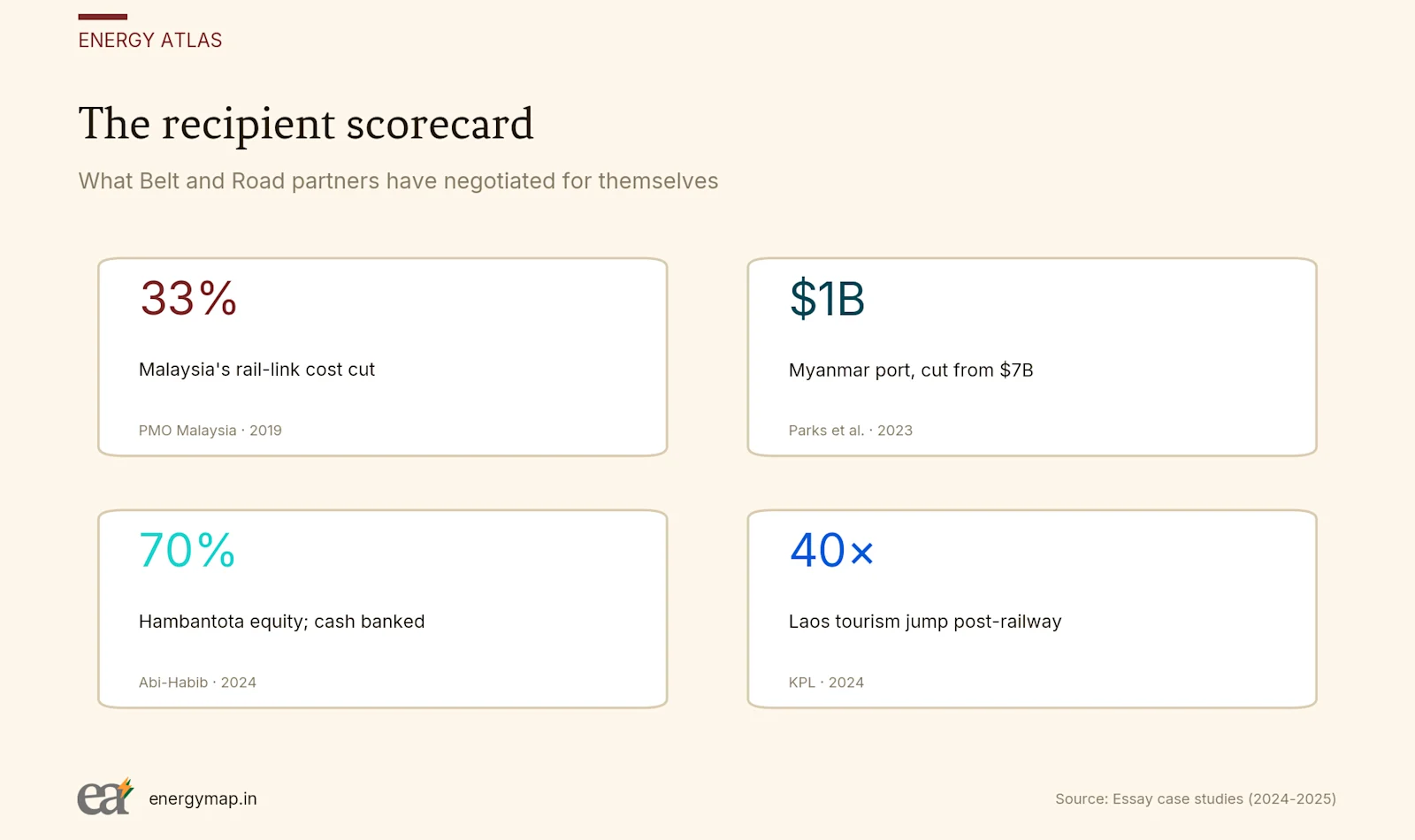
This was not a Malaysian exception but an emerging pattern. Myanmar scaled Kyaukphyu port down from seven billion dollars to one billion while securing more than government ownership. Kenya used World Bank analysis to press China on Standard Gauge Railway terms. Even Pakistan, hopelessly dependent on Beijing, has extracted concessions on power and tariffs (Parks et al., 2023).
Robert Putnam's two-level game theory finds perfect expression here. Leaders who can credibly claim domestic constraints — parliamentary opposition, public outcry, institutional requirements — paradoxically gain international leverage. Malaysia could say, "Our parliament won't approve these terms." Pakistan's military government could not. The difference was worth billions.
What successful renegotiations share is a clear playbook:
Establish specialised negotiating teams with genuine technical expertise.
Create transparency that enables domestic public pressure.
Maintain diplomatic relations while driving a hard commercial bargain.
Coordinate with multilateral institutions for analytical ammunition.
Above all, develop real alternatives — or at least their credible appearance.
China may hold the money, but recipients increasingly set the terms.
Sri Lanka: commerce, not strategy #
The debt-trap narrative assumes a strategic coherence that does not exist. After analysing thirteen thousand Chinese development projects worth $843 billion, researchers from Johns Hopkins, Harvard, and Boston University reached a consistent conclusion: China's development-finance system is too fragmented, too commercially driven, and too responsive to recipient demands to run a coordinated debt-trap strategy (Brautigam, 2020; Parks et al., 2023).
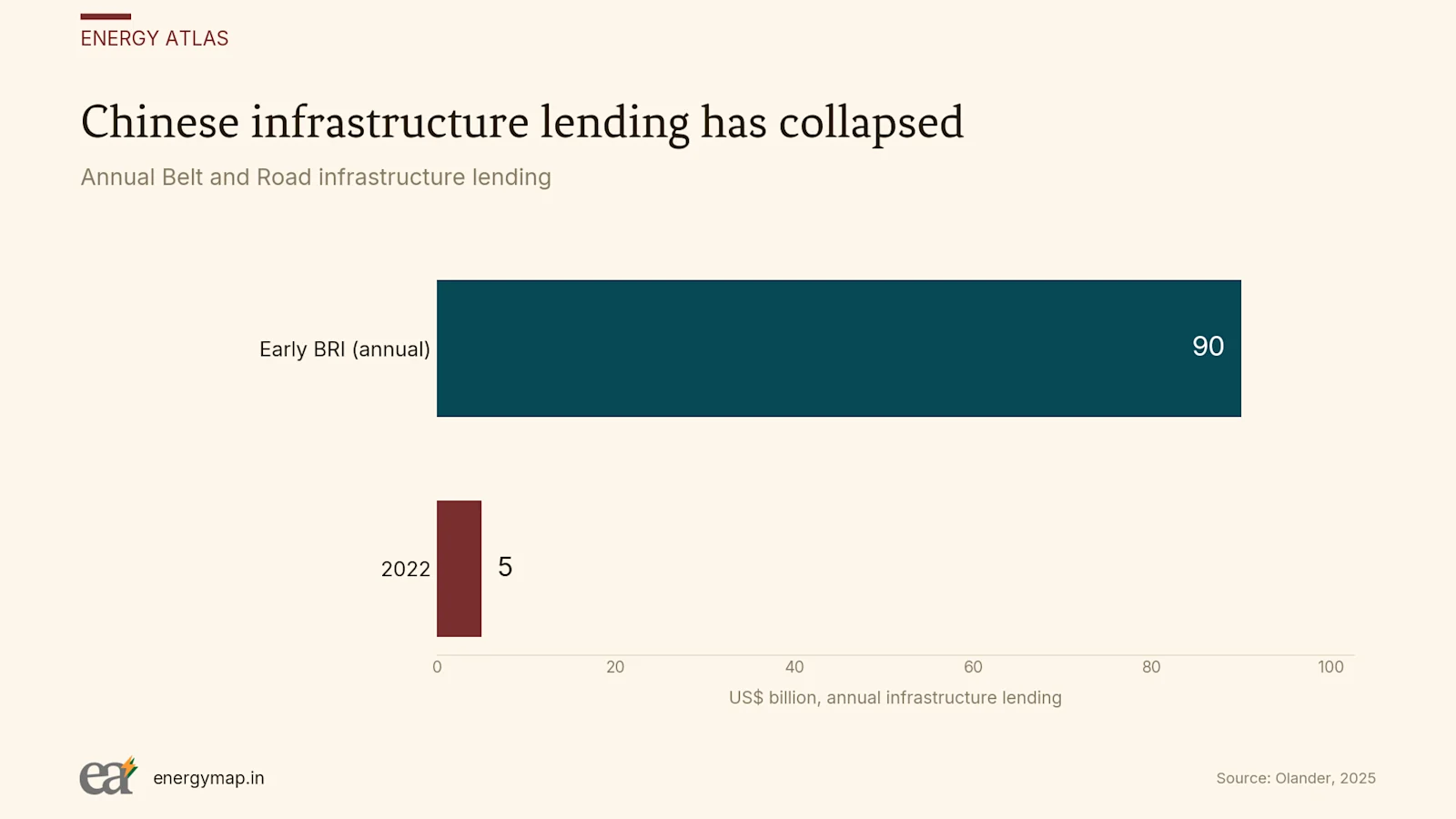
The numbers tell a story of commercial logic. Chinese state-owned enterprises compete against one another for projects, often underbidding to win contracts they then struggle to complete profitably. The fall from ninety billion dollars in annual infrastructure lending in the BRI's early years to just five billion in 2022 reflects commercial learning, not strategic recalibration (Olander, 2025). When sixty-nine per cent of current Chinese lending goes to emergency rescue loans at five per cent interest — higher than the two per cent charged on infrastructure loans — the profit motive is hard to miss.
Sri Lanka's Hambantota Port, the debt-trap case everyone cites, actually undercuts the story it is meant to prove. President Rajapaksa proposed the port after Canadian and Danish feasibility studies; India and the United States declined to finance it. When China acquired seventy per cent equity in 2017, Sri Lanka used the payment to strengthen its foreign reserves rather than repay Chinese debt — and the deal lost money for China Merchants Port Holdings, hardly the asset seizure Washington describes (Abi-Habib, 2024). An academic review of Hambantota and seven other supposed debt-trap cases found no evidence of deliberate entrapment (Moramudali & Panduwawala, 2022; Jones & Hameiri, 2020).
The fragmentation runs deep. The Chinese Communist Party, State Council, Ministry of Commerce, Export-Import Bank, China Development Bank, and numerous state-owned enterprises all pursue different goals. Provincial governments lobby for local champions. The Ministry of Foreign Affairs often learns of troubled projects only through complaints from recipient countries. That diversity of Chinese actors creates negotiating openings experienced recipients exploit (AidData, 2023).
Even China's pivot to resource-backed lending reflects commercial rather than strategic logic. Swapping infrastructure for future oil or mineral deliveries reduces default risk while securing commodity supplies — business hedging, not debt-trap plotting. When Chinese firms accept haircuts on troubled projects, as they have across more than seventy-eight billion dollars of ongoing renegotiations, they behave like commercial lenders, not strategic predators.
The competition illusion #
Washington's response to the BRI reveals more about American anxiety than Chinese strategy. The Partnership for Global Infrastructure has mobilised sixty billion dollars toward a two-hundred-billion-dollar target. Japanese and EU Global Gateway initiatives together exceed one trillion dollars, approaching the BRI's scale. Yet their impact remains slight. Why?
Western alternatives struggle because they are designed to counter a threat that does not exist. They stress transparency against supposed Chinese opacity — but BRI contracts are increasingly public (Hillman, 2021; Parks et al., 2023). They emphasise debt sustainability against alleged Chinese predation — but Chinese terms often match or beat multilateral development banks. They promise speed — but their enhanced safeguards make them slower than the institutions they aim to replace (Hillman, 2021).
Developing countries do not lack standards; they lack capital. When you need power generation urgently and China offers financing today while a Western programme offers certification eventually, the choice makes itself.
What Western initiatives have actually achieved is to strengthen recipients' leverage over China. Indonesia used Japanese-quality infrastructure as a bargaining chip against Chinese speed on its high-speed rail, extracting concessions from both (Bradsher, 2024). Kenya deploys World Bank analysis against Chinese lenders. Vietnam leans on American security ties to preserve infrastructure independence. Competition does not replace Chinese financing; it improves Chinese terms.
That dynamic explains the BRI's resilience. Developing countries do not want to choose between Washington and Beijing; they want to maximise benefit from both. When the United States frames infrastructure as a loyalty test, it misreads recipient priorities. These countries need roads, ports, and power plants, and they will take them from whoever offers the best mix of speed, cost, and conditions. China usually wins not through predatory lending but through risk tolerance and rapid deployment that Western institutions cannot match.
Three forces will shape the next decade — none of them debt traps #
First, a wall of maturing debt will force creative restructuring. With sixty per cent of BRI recipients in debt distress, 2025–2027 will bring unprecedented renegotiations. China's choice is not between forgiving debt and seizing assets; it is between restructuring debt and watching projects fail. Commercial logic favours restructuring.
Second, institutional learning is accelerating on all sides. China now requires the feasibility studies, environmental assessments, and corruption controls that early BRI projects lacked. Malaysia's playbook has become required reading from Islamabad to Addis Ababa. Even failures teach: Montenegro's highway changed how Balkan governments evaluate Chinese proposals (Shepard, 2024).
Third, the financing ecosystem is growing more tangled. The World Bank is partnering with the Asian Infrastructure Investment Bank on projects first floated for BRI funding. Japanese "quality" infrastructure incorporates Chinese supply chains; US-led development finance leverages Chinese-built infrastructure. These hybrid arrangements, unthinkable five years ago, show commercial pragmatism beating geopolitical rhetoric.
The real question is not whether debt-trap diplomacy is real — the evidence overwhelmingly says no. To admit that developing countries benefit from Chinese infrastructure finance, whatever its flaws, would mean admitting that American development finance has failed to meet global need (Peel & Kynge, 2024). To recognise recipient agency would mean accepting that developing countries are not pawns but players.
Conclusion: dreams and debts #
Return to those two highways — Montenegro's empty lanes and Laos's crowded railway. They represent not Chinese success and failure but the spectrum of outcomes when developing countries engage global finance. Montenegro miscalculated. Laos triumphed. Neither was trapped. Both chose, based on development priorities, institutional capability, and risk tolerance. Their contrasting fortunes reflect not Chinese strategy but the quality of their own decisions.
The debt-trap narrative serves everyone except the countries it claims to protect. It gives Washington a framework for competing with Beijing. It gives China cover for commercial failures by attributing strategic purpose to chaotic outcomes. It gives academics compelling questions. But for developing countries balancing infrastructure needs against fiscal limits, the narrative obscures more than it reveals (Carmody et al., 2022).
What these countries have discovered — what Malaysia demonstrated, what Myanmar proved, what even struggling Pakistan attempts — is that infrastructure finance has become a buyer's market. China needs projects to deploy excess capacity. The West needs to show an alternative model. Japan needs regional relevance. In that competition, recipients hold more cards than any single financier. They can demand better terms, environmental standards, and technology transfer — not from anyone's altruism but from competition itself.
The Belt and Road Initiative's true legacy will not be debt traps that never sprang or strategic assets that were never seized. It will be the democratisation of infrastructure finance — the transformation of developing countries from passive recipients into active negotiators. In teaching them to exploit great-power competition, the BRI has achieved what neither Chinese strategists nor American critics expected: it has made them players rather than pawns. That is not a trap. It is a kind of liberation — the freedom of every developing nation to balance its own dreams and debts.
Sources #
Jones, L., & Hameiri, S. (2020). Debunking the myth of 'debt-trap diplomacy'. Chatham House.
Hillman, J. E. (2021). The emperor's new road: China and the project of the century. Yale University Press.
Parks, B. C., Malik, A. A., Escobar, B., Zhang, S., Fedorochko, R., Solomon, K., Wang, F., Vlasto, L., Walsh, K., & Goodman, S. (2023). Belt and Road Reboot: Beijing's bid to de-risk its global infrastructure initiative. AidData at William & Mary.
AidData. (2023). AidData's Global Chinese Development Finance Dataset (GCDF), Version 3.0.
Carmody, P., & Wainwright, J. (2022). Contradiction and restructuring in the Belt and Road Initiative: Reflections on China's pause in the "Go World." Third World Quarterly, 43(12), 2830–2851.
Brautigam, D., & Rithmire, M. (2021). The Chinese "debt trap" is a myth. The Atlantic.
Prime Minister's Office of Malaysia. (2019). Press statement by the Prime Minister on the ECRL.
Malaysia Rail Link Sdn Bhd. (n.d.). ECRL partnership: Malaysia and China share risks and rewards (50:50 O&M JV).
Moramudali, U., & Panduwawala, T. (2022). Evolution of Chinese lending to Sri Lanka since the mid-2000s (SAIS-CARI Briefing Paper No. 8). China Africa Research Initiative, Johns Hopkins SAIS.
KPL (Lao News Agency). (2024). Laos–China Railway boosts growth of regional trade and tourism.