
Energy Poverty as a Human Rights Crisis: The Rohingya Camps of Cox's Bazar
Nearly a million stateless Rohingya live on 24 km2 with almost no energy access. This is not a footnote to the crisis — it is a human rights violation in its own right.
By Sayonsom Chanda
Nearly one million stateless people live packed onto 24 square kilometres of Bangladeshi hillside. We count their food, their water, their shelter. We almost never count their energy — and that omission is itself a human rights violation.
The Rohingya displacement crisis, now in its eighth year, is one of the most prolonged refugee emergencies in contemporary history. Beyond the widely reported problems of food scarcity and violence lies a critically overlooked dimension: energy deprivation. This essay argues that the persistent denial of adequate energy access in the Cox's Bazar settlements is a multifaceted human rights violation — one that touches security, public health, gender equality, and ecological survival. Using the energy justice framework, it shows how distributional, recognition-based, and procedural inequities compound the vulnerability of nearly a million stateless people, and it closes with practical recommendations for the Bangladeshi government, UNHCR, and the wider international community.
Introduction #
Examining the Rohingya settlements in Cox's Bazar serves a dual purpose: first, to reconceptualise energy access not as a humanitarian amenity but as a foundational condition for the realisation of numerous established human rights; and second, to advance specific interventions that honour both refugee dignity and the legitimate interests of host populations.
Energy extends far beyond cooking a meal or lighting a shelter. It is the unseen foundation beneath other rights. In its absence, women face danger reaching sanitation facilities after dark. Children breathe harmful fumes from burning biomass. Food spoils and medicines lose their potency. Energy deprivation therefore belongs squarely within the structure of international human rights law, and neglecting it perpetuates a pattern of marginalisation that contradicts the world's stated commitment to "leaving no one behind."
Background #
The Rohingya, a predominantly Muslim ethnic community from Myanmar's Rakhine State, have endured systematic persecution for decades. The 1982 Citizenship Act stripped them of legal nationality, rendering them stateless and setting the stage for one of this century's gravest humanitarian catastrophes. In August 2017, military operations that United Nations investigators characterised as bearing genocidal hallmarks forced more than 700,000 Rohingya across the border into Bangladesh within weeks (UNHCR, 2018). They joined tens of thousands who had fled earlier waves of violence.
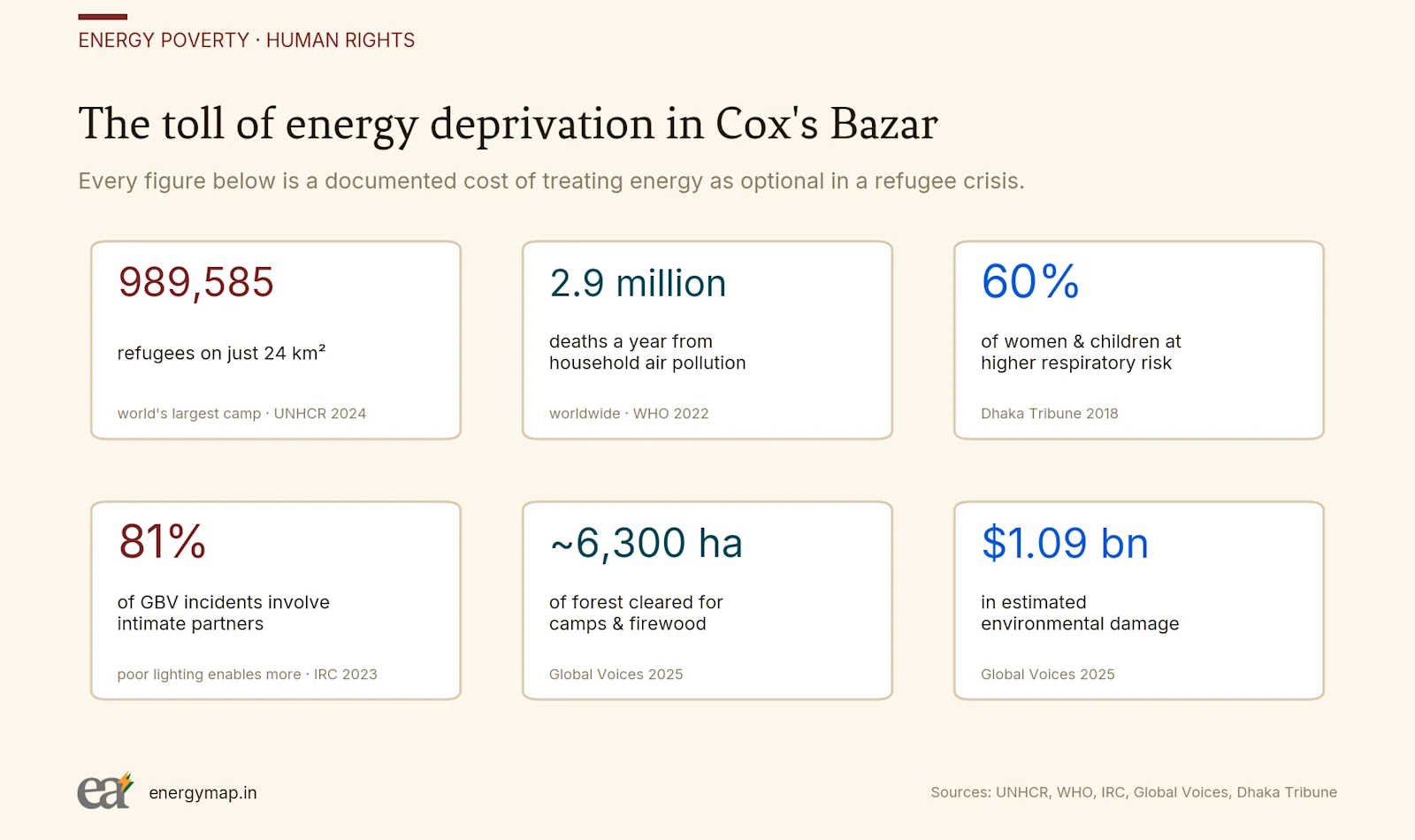
Today, Cox's Bazar hosts approximately 989,585 refugees across 33 camps (UNHCR, 2024) — the largest and most densely populated refugee settlement on Earth. These camps occupy just 24 square kilometres, roughly the footprint of a small town, while sheltering a population approaching one million. Bangladesh has not ratified the 1951 Refugee Convention, so the Rohingya hold no formal refugee status under domestic law. They are instead classified as "Forcibly Displaced Myanmar Nationals" — an administrative label that does little to change the reality of statelessness and dependence on aid.
An Energy Justice Analysis #
Scholarship has developed the concept of "energy justice" to examine how the benefits and burdens of energy systems are distributed across populations (Heffron & McCauley, 2017). Applied to the Rohingya, this lens exposes three distinct but interconnected injustices: distributional, recognition-based, and procedural (Islam et al., 2024). Each carries substantial human rights implications.
Distributional Injustice #
The most visible form of energy deprivation is the inequitable allocation of resources. Before major intervention programmes began, roughly 80% of refugee households relied on firewood for cooking — an astonishing 700 metric tonnes of wood burned every day (Amin et al., 2021). The consequences were severe. Women and children, who bear primary responsibility for gathering fuel, spent hours each day crossing surrounding forests, exposing themselves to harassment, assault, and the hazards of denuded, landslide-prone hillsides.
Indoor air pollution from biomass combustion is the leading cause of respiratory illness in the camps. According to the World Health Organization, household air pollution from solid fuels causes 2.9 million deaths worldwide each year — and the cramped, poorly ventilated shelters of Cox's Bazar represent an extreme exposure scenario (WHO, 2022). An estimated 60% of camp women and children face heightened susceptibility to respiratory conditions (Dhaka Tribune, 2018). The right to health, codified in Article 12 of the International Covenant on Economic, Social and Cultural Rights (ICESCR), is thus fundamentally compromised by the absence of clean cooking alternatives.
Inadequate lighting deepens these vulnerabilities. Médecins Sans Frontières has documented that many camp areas remain dark and dangerous, creating conditions conducive to gender-based violence after nightfall (MSF, 2024). The International Rescue Committee reports that 81% of gender-based violence incidents in the camps involve intimate partners, while poor illumination in communal areas enables further forms of assault, including abduction and trafficking (IRC, 2023). Here energy deprivation connects directly to the right to personal security under Article 3 of the Universal Declaration of Human Rights.
Recognition Injustice #
A second dimension of energy injustice concerns recognition — or, more precisely, its absence. For years, humanitarian responses prioritised food, water, and shelter while treating energy as secondary. This reflects a broader pattern in refugee assistance, where cooking fuel rarely features in standard relief packages despite being essential to daily survival (Lahn & Grafham, 2015). The energy needs of the Rohingya were effectively invisible within the prevailing humanitarian paradigm.
That invisibility had concrete consequences. Without official recognition of energy as a basic necessity, funding stayed chronically inadequate. Camp-related deforestation — more than 4,937 hectares of protected woodland cleared for settlement, plus an additional 1,200–1,600 hectares stripped for firewood — produced environmental damage valued at roughly USD 1.09 billion (Global Voices, 2025). The right to a healthy environment, increasingly recognised in international law, was sacrificed to institutional inertia.
Procedural Injustice #
Finally, procedural injustice describes the exclusion of affected communities from decision-making. The Rohingya have had minimal influence over the design and implementation of energy programmes in their own settlements. This is not mere protocol; it is about effectiveness. Top-down solutions routinely ignore cultural practices, household structures, and the particular constraints of camp life. When refugees are treated as passive beneficiaries rather than active participants, programmes falter and dignity erodes.
The Legal Framework #
No international treaty explicitly establishes a "right to energy." Yet the deprivations above intersect with numerous recognised human rights, and the legal case for treating energy access as a crosscutting obligation is strong.
The Universal Declaration of Human Rights sets out the foundations. Article 3 guarantees the right to life, liberty, and security of person — rights that cannot be meaningfully exercised when darkness renders public spaces dangerous. Article 25 recognises the right to an adequate standard of living, including food, housing, and medical care. Energy is the enabling infrastructure for each: without it, food cannot be properly cooked or preserved, shelter remains substandard, and clinics cannot function.
The ICESCR builds on these principles. Article 11 obliges states to recognise "the right of everyone to an adequate standard of living," and Article 12 the right to "the highest attainable standard of physical and mental health." The Committee on Economic, Social and Cultural Rights has interpreted these to include the underlying determinants of health — clean water, sanitation, and, by reasonable extension, clean cooking energy (CESCR, 2000).
The Convention on the Elimination of All Forms of Discrimination Against Women is especially relevant, given that women and girls make up over 52% of the refugee population and bear disproportionate energy-poverty burdens. The gendered dimensions of firewood collection — time poverty, exposure to violence, respiratory illness from cooking smoke — are clear violations of these protections. The Convention on the Rights of the Child applies as well: camp children suffer disproportionately from indoor air pollution, their developing lungs acutely sensitive to biomass particulates.
Although Bangladesh has not acceded to the 1951 Refugee Convention, it has ratified the core human rights instruments, which apply to everyone within a state's jurisdiction regardless of citizenship. And Sustainable Development Goal 7 commits the international community to "access to affordable, reliable, sustainable and modern energy for all" by 2030. The Rohingya, among the most marginalised people on Earth, are a critical test of whether that pledge means anything.
What Progress Looks Like — and What Comes Next #
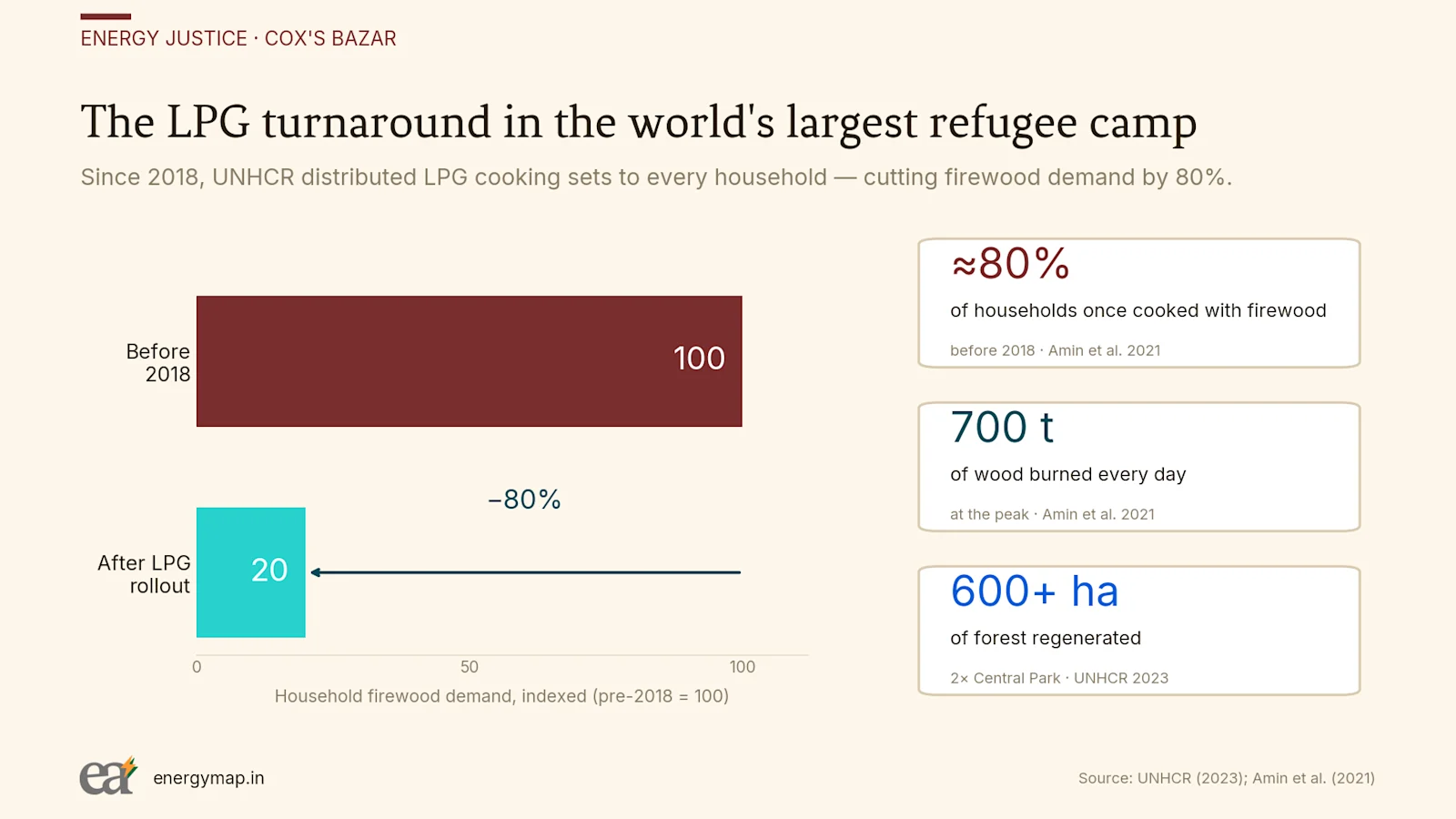
Considerable progress has already been made. Since 2018, UNHCR and partners have supplied liquefied petroleum gas (LPG) cooking sets to every refugee household, cutting firewood demand by 80% and enabling the regeneration of more than 600 hectares — an area twice the size of New York's Central Park (UNHCR, 2023). This is proof of what becomes possible when energy is prioritised rather than sidelined.
But the gains are fragile. Funding shortfalls in 2025 have jeopardised LPG provision, risking the reversal of hard-won environmental and health progress (UNHCR, 2025). Five recommendations follow:
Fund energy as core, not optional. Donor nations must commit sustained, multi-year financing for energy programming. One-off disbursements cannot serve a protracted crisis.
Light the commons. Solar lighting for pathways, latrines, and health posts must be expanded to address nighttime insecurity.
Scale clean cooking and micro-grids. Solar micro-grids and electric cooking pilots offer routes toward self-sufficiency and lower long-term fuel costs.
Build in host-community benefit. Bangladeshi residents of Cox's Bazar are among the country's poorest; energy interventions should explicitly serve them too.
Give refugees a real seat. The procedural injustices documented here cannot be corrected without participatory mechanisms that treat the Rohingya as agents, not subjects.
Conclusion #
Energy deprivation in the Rohingya settlements is far more than a marginal concern. It is a crosscutting human rights emergency that amplifies every other vulnerability these stateless people face. The failure to address it reflects a deficit of vision as much as of resources — a failure to recognise that the rights to health, security, and an adequate standard of living cannot be realised without clean cooking fuel and adequate light.
The international community has made promises — to leave no one behind, to deliver universal energy access, to uphold the dignity of every human being. The Rohingya of Cox's Bazar are still waiting to learn whether those promises are real.
Sources #
Amin, N., Munim, M. S., & Rahman, M. J. (2021). The pursuit of energy in refugee contexts: humanitarian energy access for the Rohingya refugees displaced to Bangladesh. Energy Research & Social Science, 81, 102266.
Committee on Economic, Social and Cultural Rights (CESCR). (2000). General Comment No. 14: The right to the highest attainable standard of health (E/C.12/2000/4). United Nations.
Dhaka Tribune. (2018, August 27). Indoor air pollution a huge problem in Rohingya camps.
Global Voices. (2025, April 6). The Rohingya crisis is pushing biodiversity to the brink in Bangladesh.
Heffron, R. J., & McCauley, D. (2017). The concept of energy justice across the disciplines. Energy Policy, 105, 658–667.
International Rescue Committee (IRC). (2023). Gender-based violence data from Cox's Bazar camps.
Islam, M. S., Hasan, M. K., & Rahman, S. (2024). Achieving energy justice in the Rohingya refugee camps of Cox's Bazar, Bangladesh. Energy Research & Social Science, 113, 103553.
Lahn, G., & Grafham, O. (2015). Heat, light and power for refugees: Saving lives, reducing costs. Chatham House.
Médecins Sans Frontières (MSF). (2024). Echoes of violence in the Rohingya camps of Cox's Bazar.
UNHCR. (2018). Report of the Independent International Fact-Finding Mission on Myanmar (A/HRC/39/CRP.2).
UNHCR. (2023, February 5). Rohingya refugees restore depleted forest in Bangladesh.
UNHCR. (2024). Bangladesh operational data portal.
UNHCR. (2025, July 11). Briefing note on Rohingya arrivals and operations in Bangladesh.
World Health Organization (WHO). (2022). Household air pollution (fact sheet).
Originally written as a graduate essay for the MA in International Relations & Security Studies; lightly edited for publication.
Sources & method
Sources include UNHCR, WHO, IRC, MSF, Chatham House and peer-reviewed energy-justice research (Amin et al. 2021; Islam et al. 2024). Full list at the end of the essay.