
Getting to Yes on Russian Oil: The 2025 US-India Tariff Crisis
In August 2025 Washington hit India with a 50% tariff over Russian crude. Two months later they were nearing a deal. Fisher and Ury's principled-negotiation framework — interests over positions, and a well-built BATNA — explains why.
By Sayonsom Chanda
In August 2025, Washington imposed a 50 percent tariff on Indian exports — half of it explicit punishment for New Delhi's appetite for discounted Russian crude. Barely two months later, the two governments were cautiously talking their way toward a deal. That reversal is a case study in what negotiation scholars call principled bargaining: focus on interests rather than positions, build a credible alternative, and even an energy dispute that looks destined for escalation can be pulled back from the brink.
Energy Has Always Been Political #
Energy has always been political. But rarely has it been this contentious. In August 2025, the Trump administration imposed a staggering 50 percent tariff on Indian exports — half of it explicitly linked to New Delhi's continued purchases of Russian crude oil (Covington & Burling LLP, 2025). The move triggered what analysts called the sharpest trade rupture between the two nations in two decades. And yet, oddly enough, by late October both sides appeared cautiously optimistic about reaching a deal (CNBC, 2025a). How did a dispute that seemed destined for escalation begin moving toward resolution?
Understanding that transformation, I want to argue, requires examining the conflict through the lens of principled negotiation — a framework developed at the Harvard Negotiation Project that emphasises interests over positions, creative options, and objective criteria (Fisher et al., 1991). The 2025 crisis is a compelling case precisely because it sits at the intersection of energy security, geopolitical alignment, and economic interdependence — the kind of multi-dimensional dispute where traditional positional bargaining tends to fail.
There is something here that transcends the immediate crisis. The way nations negotiate over energy resources will increasingly determine not only bilateral relationships but the architecture of the international order itself. As someone who has spent considerable time analysing power systems and energy infrastructure, I find myself drawn to this case because it reveals how technical realities — barrel counts, refinery capacities, shipping routes — become entangled with diplomatic imperatives in ways that most international relations scholarship underestimates.
The Framework: Getting to Yes #
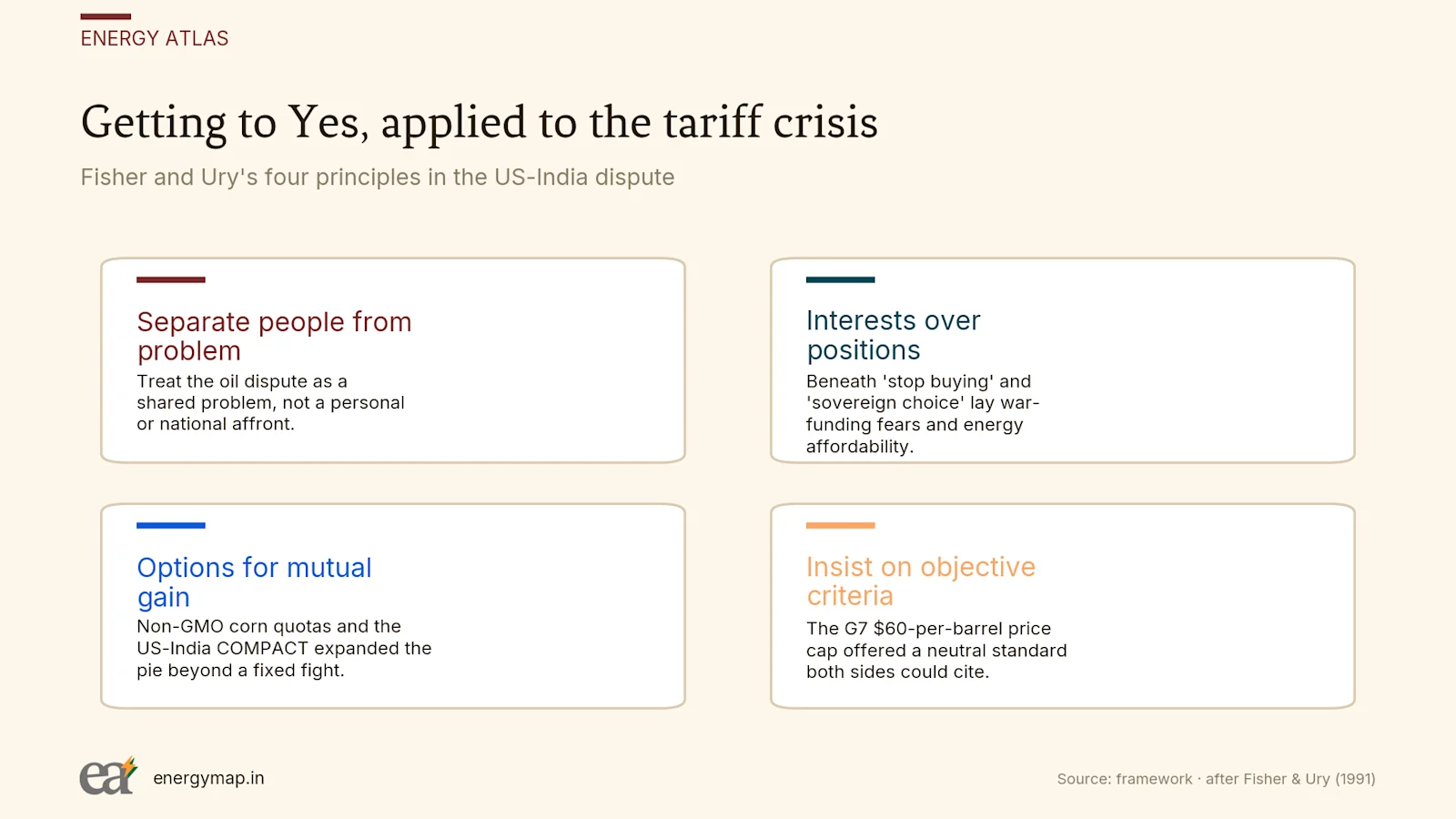
Fisher and Ury's (1981) Getting to Yes established four foundational principles for effective negotiation: separate the people from the problem, focus on interests rather than positions, invent options for mutual gain, and insist on objective criteria. The framework grew out of the Harvard Negotiation Project's study of diplomatic negotiations, including the Camp David Accords (Beyond Intractability, 2023). It stands in deliberate contrast to positional bargaining, which Fisher and Ury characterise as inefficient, relationship-damaging, and prone to producing agreements that neglect the parties' underlying interests.
Central to the framework is BATNA — the Best Alternative to a Negotiated Agreement. A party's BATNA is the most advantageous course of action available if talks collapse entirely (PON, 2025). It provides both a benchmark for judging any proposed deal and, critically, a source of negotiating power. A well-developed BATNA lets a negotiator walk away with dignity when offers fall below their threshold, preventing the desperate concessions that positional pressure is designed to extract.
Energy Diplomacy's Special Problem #
Energy occupies a distinctive space in international relations. Bovan et al. (2020) argue that energy issues exist in a dynamic relationship with foreign policy and national security — what they call the "energy security paradox." Resource-rich nations can leverage supply relationships for political ends, while import-dependent nations must constantly balance economic pragmatism against strategic alignment.
Recent scholarship on energy transitions adds another layer. Huda (2024) proposes a "renewable energy diplomacy" grounded in environmental peacebuilding, arguing that the traditional emphasis on fossil-fuel access must give way to collaborative resource governance and capacity building. That perspective is directly relevant here, because the underlying US-India tensions involve not just oil imports but competing visions of energy-transition pathways and development priorities. Applying this lens to the 2025 dispute means focusing on three things: the positions each party adopted versus the interests beneath them, the role BATNA played in shaping the talks, and the space for creative options that address everyone's real concerns.
Positions Versus Interests #
The opening positions looked irreconcilable. The United States demanded that India stop buying Russian oil, framing this as necessary to curb Moscow's war funding. India's position was equally firm: energy imports were a sovereign decision made on behalf of 1.4 billion citizens (Indian Ministry of External Affairs, 2025). This is textbook positional bargaining — and, predictably, it produced deadlock.
Beneath the positions lay more nuanced interests. America's real concern was not Indian oil purchases as such, but the perception that discounted Russian crude was helping Moscow sustain military operations (Herbert Smith Freehills, 2025). India's interests were multi-layered: affordable energy for domestic consumers, protection of refinery investments, preservation of strategic autonomy, and maintenance of the Russia relationship that had supplied reliable defence hardware for decades. Tellingly, former Reserve Bank of India Governor Raghuram Rajan suggested the tariffs were not really about oil at all, but stemmed from diplomatic friction over who deserved credit for de-escalating India-Pakistan tensions (Business Today, 2025). If he is right, an apparently technical energy dispute was masking a deeper political grievance — exactly the sort of thing principled negotiation is built to surface.
The Power of BATNA #
India's response shows why alternatives matter. Rather than capitulating to tariff pressure, New Delhi systematically strengthened its BATNA. Foreign Minister S. Jaishankar travelled to Moscow in August 2025, where the two countries pledged to expand bilateral trade toward a $100 billion target by 2030 (CNBC, 2025b). At the same time, India accelerated energy purchases from the United States itself — oil imports from America surged more than 270 percent year-on-year in early 2025 (Royal Society for Asian Affairs, 2025). This was elegant BATNA development: India signalled it could sustain Russian imports if it had to, while demonstrating a genuine willingness to diversify toward American supply.
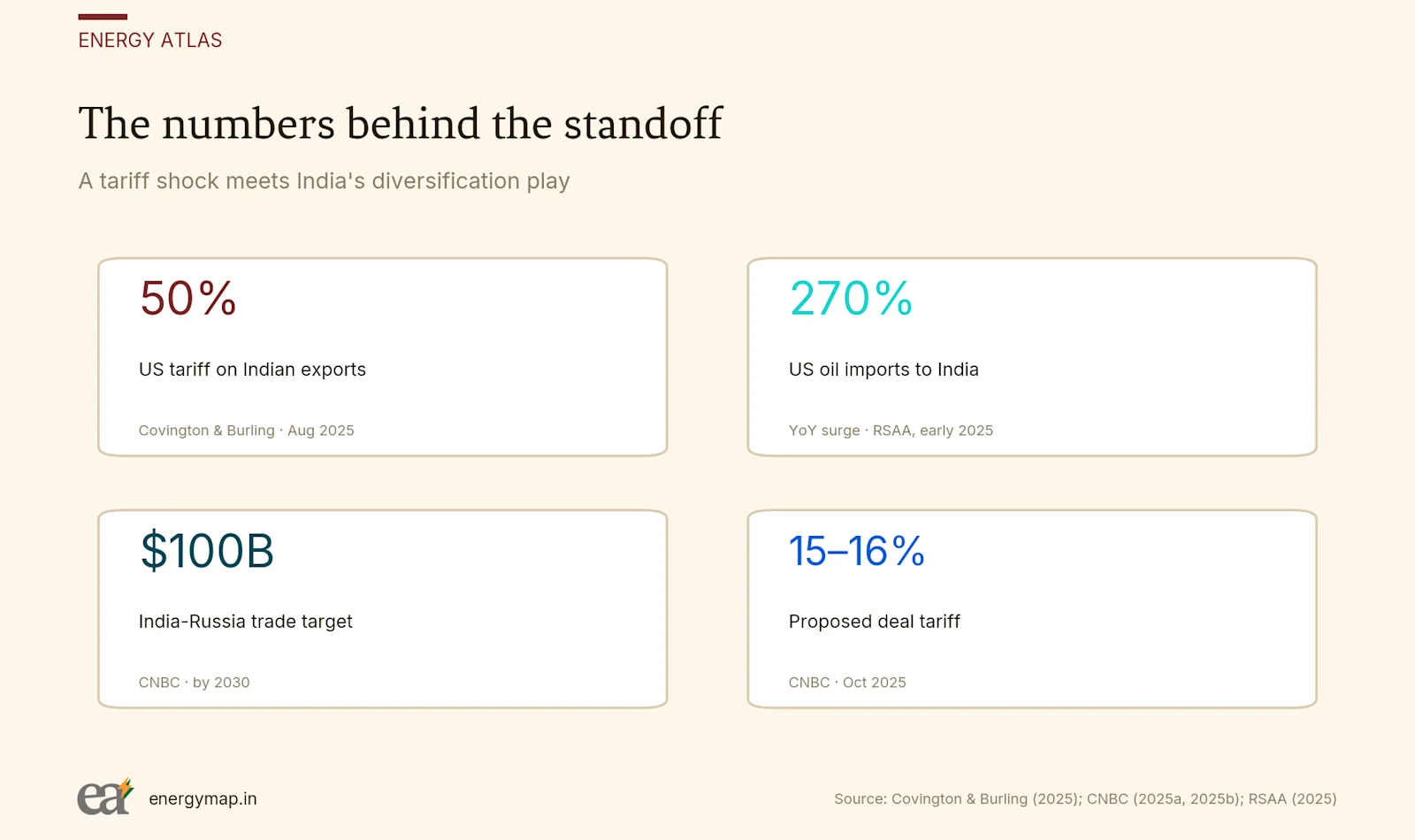
The result? By October 2025, reports indicated the talks had moved toward a potential deal cutting tariffs to 15–16 percent (CNBC, 2025a). India's consistent posture — maintaining strategic autonomy while protecting its core economic interests — appeared to have shaped the trajectory. From a principled-negotiation standpoint, this was predictable. A party with strong alternatives never has to accept unfavourable terms, and the other side eventually recognises that coercion will not work.
Options for Mutual Gain #
The emerging shape of a settlement reveals creative options that serve both parties. India reportedly weighed raising import quotas for American agricultural products, particularly non-GMO corn (CNBC, 2025a) — addressing US export interests without forcing India to abandon energy diversification. A proposed mechanism letting both sides revisit tariffs and market access over time added another integrative element, building in flexibility rather than demanding permanent commitments.
From an energy-systems perspective, the most durable solutions expand the overall resource pie rather than fight over fixed shares. The US-India COMPACT for the 21st Century, announced during Prime Minister Modi's February 2025 Washington visit, framed cooperation around energy security, critical minerals, and emerging technologies (ORF America, 2025). Arrangements like this create value that pure zero-sum bargaining never can. The Quad's focus on clean-energy supply chains offers a further multilateral avenue for the same shared concerns (Foreign Policy, 2025).
Objective Criteria and Legitimacy #
A clear weakness in the American approach was the perception that its stated principle was applied inconsistently. India noted that the United States kept importing Russian uranium, palladium, and fertilisers without comparable strategic-necessity claims (Indian Ministry of External Affairs, 2025). The European Union, even as it implemented its own sanctions, increased Russian LNG imports by 22 percent in the first half of 2025 (CSEP, 2025). China — a larger buyer of Russian oil than India — faced no comparable secondary tariffs. Each of these undercut the legitimacy of the American position and stiffened Indian resistance.
Fisher and Ury (1991) stress that agreements should rest on objective criteria independent of either party's will. The G7 Russia oil price cap of $60 per barrel was exactly such a standard — and India had operated within it while buying discounted Russian crude. Washington's unilateral departure from that framework, penalising India for doing precisely what the cap permitted, exposed the absence of any consistent objective criterion (Covington & Burling LLP, 2025).
What Energy Diplomats Should Take Away #
The 2025 crisis demonstrates both the perils of positional bargaining and the possibilities of principled negotiation in high-stakes energy disputes. Initial positions looked mutually exclusive — America demanding an end to Russian oil imports, India insisting on sovereign energy choices. Yet by examining underlying interests, building robust alternatives, and exploring creative options, both parties edged toward a settlement neither could have imagined during the August confrontation.
Three lessons stand out for practitioners of energy diplomacy:
Coercion invites resistance. Pressure tactics — especially those seen as inconsistently applied — tend to provoke defiance rather than compliance.
Diversification is leverage. Nations with varied energy relationships hold inherently stronger negotiating positions. BATNA is not a theoretical nicety; it is operationally decisive.
Grow the pie. The most durable agreements expand value through complementary cooperation rather than simply dividing contested resources.
Most importantly, the case is a reminder that energy disputes are never purely technical. They involve national identity, strategic autonomy, and competing visions of international order. Negotiators who reduce these conflicts to barrel counts and tariff schedules miss the deeper currents shaping how states behave. By directing attention to interests rather than positions, the principled-negotiation framework offers essential guidance for navigating that complexity — and as new resource competitions emerge over critical minerals, hydrogen supply chains, and grid interconnections, these lessons will only grow more relevant.
Sources #
Beyond Intractability. (2023). Summary of "Getting to Yes: Negotiating Agreement Without Giving In."
Bovan, A., Vučenović, T., & Peric, N. (2020). Negotiating energy diplomacy and its relationship with foreign policy and national security. International Journal of Energy Economics and Policy, 10(2), 1-6.
Business Today. (2025, December 8). 'Russian oil was not the central issue': Raghuram Rajan on Trump's 50% tariff on India.
Centre for Social and Economic Progress. (2025, October 21). India and sanctions on Russian energy: Policy response and future options.
CNBC. (2025a, October 22). India to cut Russian oil purchases, U.S. to slash tariffs as they near trade deal.
CNBC. (2025b, August 22). India, Russia vow to deepen trade ties, defying Trump's tariff threats over oil.
Covington & Burling LLP. (2025, August). Trump administration imposes secondary tariffs on India.
Fisher, R., & Ury, W. (1981). Getting to Yes: Negotiating Agreement Without Giving In. Penguin Books.
Fisher, R., Ury, W., & Patton, B. (1991). Getting to Yes: Negotiating Agreement Without Giving In (2nd ed.). Penguin Books.
Foreign Policy. (2025, July 28). Indo-Pacific energy security concerns could be addressed by the Quad alliance.
Herbert Smith Freehills Kramer. (2025, August 6). U.S. imposes secondary tariffs on Russian oil purchases, raising combined India tariffs to 50%.
Huda, M. S. (2024). Renewable energy diplomacy and transitions: An environmental peacebuilding approach. Energy Research & Social Science.
Observer Research Foundation America. (2025, June 10). A blueprint to advance the U.S.-India energy security partnership.
Program on Negotiation at Harvard Law School. (2025). What is BATNA? How to find your best alternative to a negotiated agreement.
Royal Society for Asian Affairs. (2025, July 4). Navigating the transition: India's role in global energy security.