
Chips, Rare Earths, and Terawatts: Inside the US-China AI Cold War
DeepSeek's $585B shock revealed the truth about the US-China tech race: while Washington plays defense with export controls, Beijing is winning on energy, rare earths, and refined chips - and India may cast the deciding vote.
By Sayonsom Chanda
In January 2025, a little-known Chinese lab called DeepSeek matched America's best AI models at a fraction of the cost — and erased $585 billion from NVIDIA's value in a single week. The shock exposed the real shape of the US-China technology race: Washington has been playing defense with export controls, while Beijing quietly builds the things that actually decide it — abundant energy, refined rare earths, and the chips in between. Whether America or China pulls ahead may ultimately turn on how middle powers like India choose to lean.
When the moat sprang a leak #
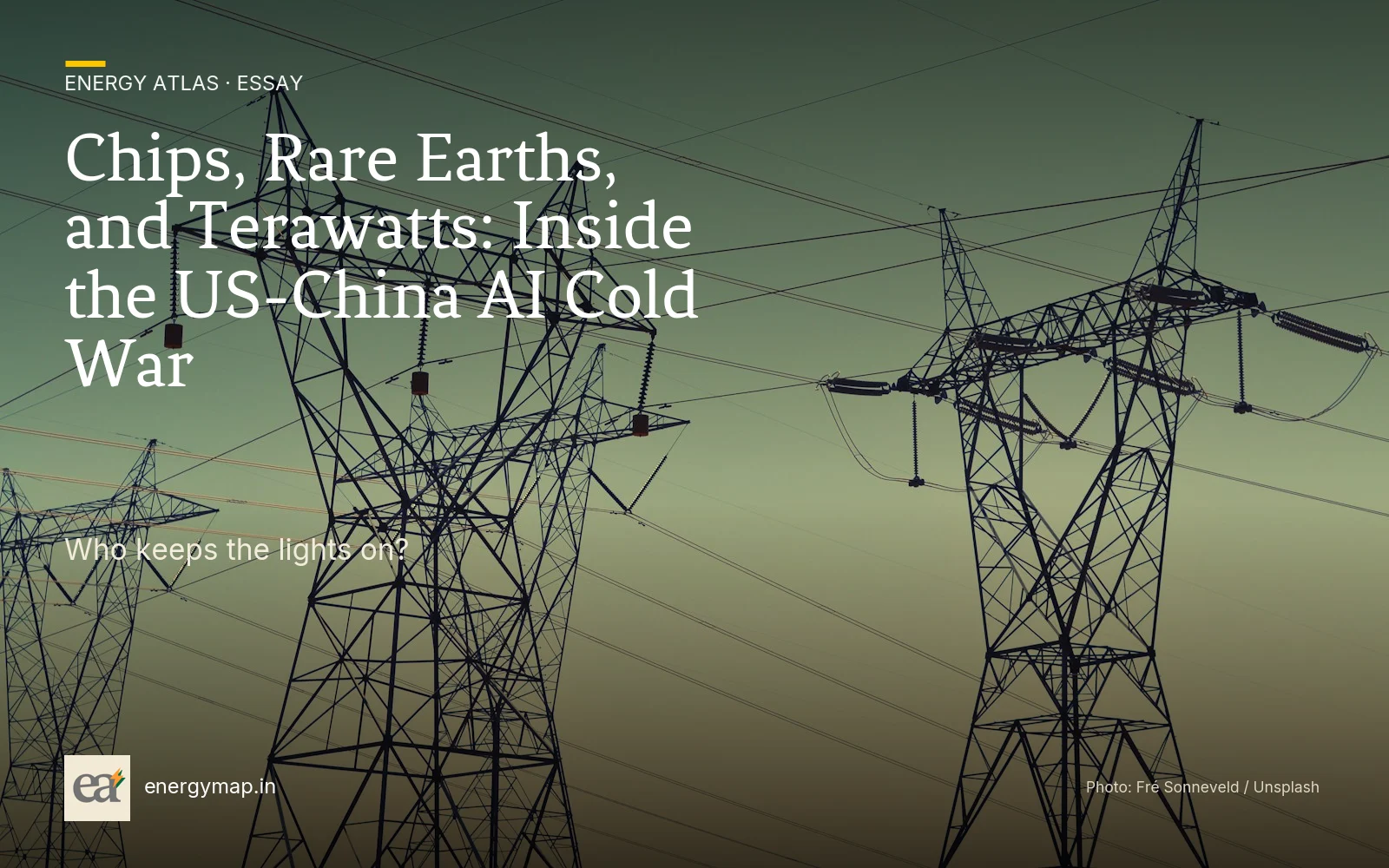
The race for technological dominance — above all in Artificial Intelligence (AI) — between the United States and China is being shaped by economic, strategic, and infrastructural forces, and how each power and its allies respond is rapidly redrawing the global balance of power. In January 2025, DeepSeek Labs published a reasoning model that matched, and sometimes outperformed, ChatGPT. It sparked panic among AI investors who had poured billions into the American formula: bigger datasets, more energy-hungry data centres, and endless capital. DeepSeek reached breakthrough performance at a fraction of the cost (TechCrunch, 2025). It showed that China was forging its own practical path to sovereign, frontier AI without American permission. NVIDIA lost $585 billion in market capitalisation in a single week (Fortune, 2025), and the world saw that US technological leadership had been matched economically — export controls and all.
America plays defense — and fumbles #
Washington's strategy has been fundamentally defensive. The Biden administration introduced the Diffusion Framework, which sorts countries into tiers (RAND, 2025), and banned NVIDIA's H10 — a relatively less powerful chip — for Chinese buyers (CSET, 2023). But when Trump took office, his moves were driven less by strategy than by the urge to undo his predecessor's work, and the US ended up licensing the more powerful H200 to those very same buyers (Mayer Brown, 2026).
Underneath the policy lies a single dependency. TSMC fabricates over ninety percent of the world's most advanced chips (Liu et al., 2025). OpenAI needs them; DeepSeek needs them. That dual dependency turns Taiwan into a geopolitical fulcrum — and, I would argue, a more credible military deterrent than most conventional assets. Analysts call it the "silicon shield" (Raimedhi, 2025). Beijing, whatever its rhetoric on Taiwan, has not attempted a military seizure, and the restraint is calculated. As Lee and Sacks (2022) note, TSMC runs on Dutch lithography machines, Japanese chemicals, and American design software. Capture the island and those inputs vanish overnight, leaving only very expensive wreckage.
China's real chokepoints #
China's weak spots are real, and it would be lazy analysis to gloss over them. SMIC cannot make chips below seven nanometres without ASML's machines, and the Dutch aren't selling. Samsung won't ship high-bandwidth memory to Chinese buyers because Seoul stands with Washington. NVIDIA's CUDA platform — the software layer beneath most of the world's AI workloads — has no meaningful Chinese equivalent, and copying a hardware-software stack is exponentially harder than copying a product. Demographics compound the problem: China's population is ageing fast, and its students often cannot access the hardware needed to become the next generation of chip designers (Raimedhi, 2025). These are genuine pressure points. Washington would be foolish to ignore them — and just as foolish to think they are permanent. Chokepoints erode quickly when enough money and desperation hit the same problem at once.
Confucius taught that adversity is the best teacher, and that mountains are moved by carrying small stones. Stanford's AI Index put the model-quality gap between China and the United States at about 17% in 2024 (Stanford HAI, 2025). By early 2025, as DeepSeek showed, that gap had fallen well below 1%. To many industry observers, Chinese models weren't merely catching up — they were setting standards and pushing the frontier, despite every export control, blacklist, and barrier the US could erect.
What the last Cold War taught us #
History repeats and rhymes. During the Cold War, Western nations embargoed Soviet computer mainframes to cripple Soviet technological progress; the restrictions did not halt Soviet advances (Spykman, 1942; Tucker, 1998). If anything, they pushed Soviet leadership inward, toward stealthy domestic capabilities — including sophisticated cyber tools whose descendants trouble us still. Export controls are like locking the front door while leaving every window open. They have never quite worked, and their re-emergence in the US-China race is easy to see.
China's long game: electrons and elements #
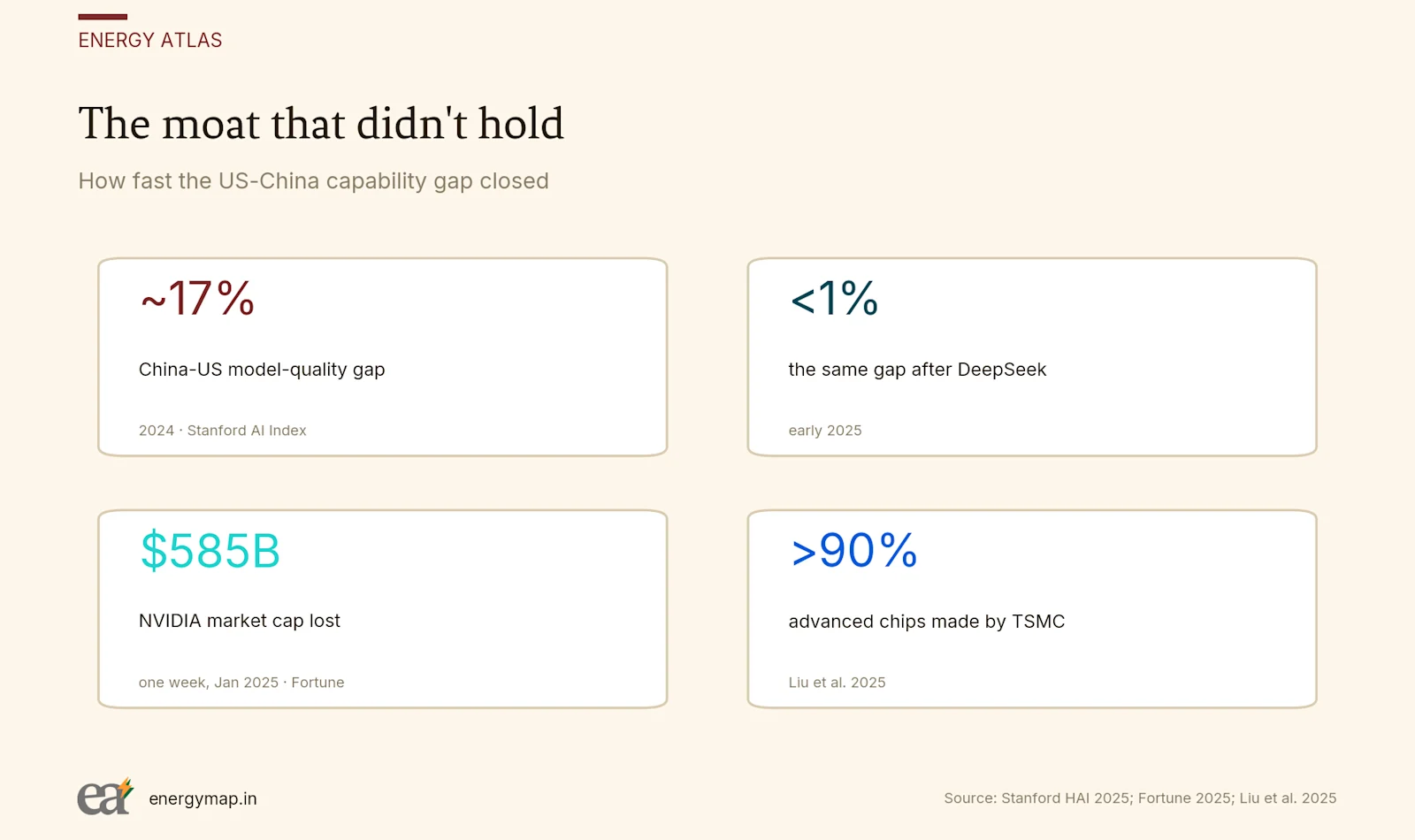
One of the most underappreciated factors in the AI competition is electricity. Beneath the chatter about models and chips, power is the real constraint — frontier AI consumes electricity the way a furnace consumes wood. In the PJM territory (Pennsylvania, New Jersey, and Maryland), the queue to connect new data centres now stretches back more than five years, with over $64 billion in projects stalled since 2023 (RMI, 2025). Over the same period, China's installed capacity reached 4 terawatts — triple America's. In 2025 alone it added 540 gigawatts, eight times what the US managed (Carbon Credits, 2025). Beijing has built forty-two ultra-high-voltage lines carrying renewable power from the western hinterlands to data centres near Shanghai. America has nothing like it. The AI race may not come down to who builds the smartest model; it may come down to who keeps the lights on — and on that score, Beijing is pulling away like a train that has already left the station.
Dig deeper into the supply chain and you reach rare earths. Beijing refines over ninety per cent of the world's supply and controls ninety-nine per cent of refined gallium — the element behind 5G hardware, 6G network chips, defence electronics, and advanced sensors (USITC, 2024). It has been tightening exports of gallium, germanium, antimony, and the rest. Here history doesn't just rhyme — it photocopies. In the nineteenth century, Britain used opium to pry open Chinese markets; the Treaties of Tientsin and Nanjing forced China to accept British goods on terms that amounted to robbery. Two centuries later, China has taken that colonial playbook and flipped it on its head, turning rare earths into the leverage that makes the former colony the gatekeeper. Western defence firms scrambling for gallium might appreciate the irony if they weren't so busy panicking.
The third player: India #
There is a third player in this two-player game: late-boomer India (Raimedhi, 2025). India sits between the American and Chinese ecosystems. We consume AI from both. Our factories assemble iPhones and Samsung handsets. The Indian semiconductor mission is moving with renewed momentum (Nandi, 2025), and the country's technical talent pool is vast and deep. In a bipolar tech race, the nation in the middle is the swing voter in a close election. Whichever way India leans — on data privacy, processing, communications, AI standards, data governance, or supply-chain alignment — India, and nations like it, will move the balance.
Building to last #
Spykman argued in 1942 that America's core task was to prevent any single power from dominating the Eurasian rimland (Spykman, 1942) — which today runs through Taiwan's fabs, Mongolia's rare-earth refineries, and the high-voltage lines feeding China's eastern data centres. As of 2026, a Chinese AI model is essentially indistinguishable from an American one in performance and quality, despite every barrier (RAND, 2026). On top of that, China is building energy infrastructure and controlling the essential minerals. It looks, as Confucius suggested, like carrying small stones day after day to move the mountains Washington has set up. While US policy vacillates between sanctions and licensing, China is playing the longer game — building to last. The question that defines this century is whether the technological order is shaped by the powers fighting over it, or by the middle powers like India that quietly decide which side of the wire they're on.
Sources #
Carbon Credits (2025). 'China Adds Power 8x More Than the US in 2025, with $500B Energy Build-Out in a Single Year.'
CSET (2023). 'A Bigger Yard, A Higher Fence: Understanding BIS's Expanded Controls on Advanced Computing Exports.' Georgetown University Center for Security and Emerging Technology.
Fortune (2025). 'Nvidia sheds $600 billion in market cap amid DeepSeek rout.' Fortune, 27 January.
Lee, K-F. and Sacks, D. (2022). 'The Taiwan Chip Industry as a Geopolitical Flashpoint.' Council on Foreign Relations.
Liu, R.C. et al. (2025). 'From vulnerabilities to resilience: Taiwan's semiconductor industry and geopolitical challenges.' Telecommunications Policy, 49(5), Article 102905.
Mayer Brown (2026). 'Administration Policies on Advanced AI Chips Codified, with Reverberations Across AI Ecosystem.' January.
Nandi, A. (2025). 'India's Semiconductor Ambitions and Global Competitiveness: Confronting the China Challenge.' ORF Occasional Paper No. 502, Observer Research Foundation, October.
Raimedhi, S. (2025). US-China New Cold War in the Indo-Pacific. Course Notes, O.P. Jindal Global University.
RAND (2025). 'Understanding the Artificial Intelligence Diffusion Framework.' RAND Corporation, Perspectives Series.
RAND (2026). 'U.S.-China Competition for Artificial Intelligence Markets: Analyzing Global Use Patterns of Large Language Models.' RAND Research Report RRA4355-1.
RMI (2025). 'PJM's Speed to Power Problem and How to Fix It.' Rocky Mountain Institute.
Spykman, N.J. (1942). America's Strategy in World Politics: The United States and the Balance of Power. New York: Harcourt, Brace and Company.
Stanford HAI (2025). AI Index 2025 Annual Report. Stanford University Human-Centered AI Institute.
TechCrunch (2025). 'DeepSeek claims its reasoning model beats OpenAI's o1 on certain benchmarks.' 27 January.
Tucker, N.B. (1998). 'A precarious balance: Clinton and China.' Current History, 97(620), pp. 243-249.
USITC (2024). 'Germanium and Gallium: U.S. Trade and Chinese Export Controls.' United States International Trade Commission.