
Climate Crisis as a Planned Disaster
Fossil emissions hit record highs in 2024 even after thirty years of climate negotiations. That paradox isn't failure — it's design. A structural look at carbon lock-in, energy security and why the Paris framework cannot deliver.
By Sayonsom Chanda
In 2024, fossil fuel emissions reached an all-time record even as coal, oil and gas production each climbed to the highest levels in history — and while more than 1,700 fossil fuel lobbyists worked the halls of COP29. This is not the story of a climate regime that failed. It is the story of a regime doing exactly what it was built to do: absorbing demands for action and converting them into non-binding declarations that permit business as usual.
The paradox that isn't #
In November 2024, nearly 200 nations convened in Baku, Azerbaijan for the 29th Conference of the Parties to the UN Framework Convention on Climate Change. The summit ended with India and Nigeria accusing the presidency of railroading through a climate finance deal over their explicit objections, while more than 1,700 fossil fuel lobbyists outnumbered the delegations of most vulnerable nations (Stockholm Environment Institute, 2024). At the very conference where delegates debated language on "transitioning away from fossil fuels," the Global Carbon Project announced that coal, oil and gas production had all reached record highs, with fossil CO₂ emissions climbing to 37.4 billion tonnes — 0.8 percent above the previous year's record (Friedlingstein et al., 2024).
This is not a puzzle. It is the predictable output of a regime designed to process demands for climate action and convert them into declarations that describe ambition while carefully avoiding any mechanism to enforce it. The central question is not why the regime fails, but how it sustains the illusion of progress while reproducing the conditions of its own inefficacy.
Three interlocking constraints explain the pattern. First, modern economies remain structurally dependent on fossil-based energy systems that no major power will dismantle at speed without risking domestic instability. Second, in a world reverting to great-power competition, energy security, industrial policy and military readiness consistently override emissions targets. Third, the Paris framework demands symmetrical sacrifice from fundamentally asymmetrical economies. Together they form a nested explanation: the regime fails because great powers will not prioritize it, because their domestic systems cannot absorb the transition costs.
Why nation-states cannot move faster #
Carbon lock-in #
Gregory Unruh's concept of "carbon lock-in," first articulated in 2000, is the foundation for understanding why decarbonization proceeds so slowly despite apparent economic and technological readiness. Industrial economies, Unruh argued, "have been locked into fossil fuel-based energy systems through a process of technological and institutional co-evolution driven by path-dependent increasing returns to scale" (Unruh, 2000, p. 817). The result is a Techno-Institutional Complex — infrastructure, organizational routines, regulation and social practice that collectively resist displacement even when superior alternatives exist.
Seto et al. (2016) identified three forms: infrastructural lock-in from long-lived physical capital, institutional lock-in from regulatory and organizational inertia, and behavioral lock-in from consumer norms. The global energy system, they noted, is "the largest network of infrastructure ever built, reflecting tens of trillions of dollars of assets and two centuries of technological evolution" (Seto et al., 2016, p. 426). Once established, such systems generate powerful constituencies — labor, capital, regional economies, fiscal authorities — whose interests align with perpetuation.
The Indian case #
India illustrates the dynamic with unusual clarity. By conventional metrics the country has succeeded: it hit its Paris target of 50 percent non-fossil electricity capacity five years early and ranks fourth globally in cumulative renewable capacity (Climate Action Tracker, 2024). Solar tariffs have fallen 65 percent since 2014, and non-fossil sources supplied the majority of new generation in fiscal year 2024-25 for the first time (Government of India, 2025). Yet these gains are additive, not substitutive. Coal still generates 75 percent of India's electricity, and that share has stayed essentially constant even as renewable capacity expanded (Climate Action Tracker, 2024).
The political economy of coal explains the paradox. Coal India Limited and its subsidiaries employ roughly 370,000 workers directly, including 128,000 contractual employees, and support 310,000 pensioners (Ministry of Coal, 2024). Beyond direct jobs, more than 15 million people in coal-mining districts derive earnings from coal or allied activity, with 70 percent of coal workers from tribal communities working as informal daily-wage laborers (Renewable Watch, 2024). The sector delivers over 70,000 crore rupees a year to central and state governments, while Coal India's dividends have averaged 6,487 crore rupees annually over five years (Ministry of Coal, 2024).
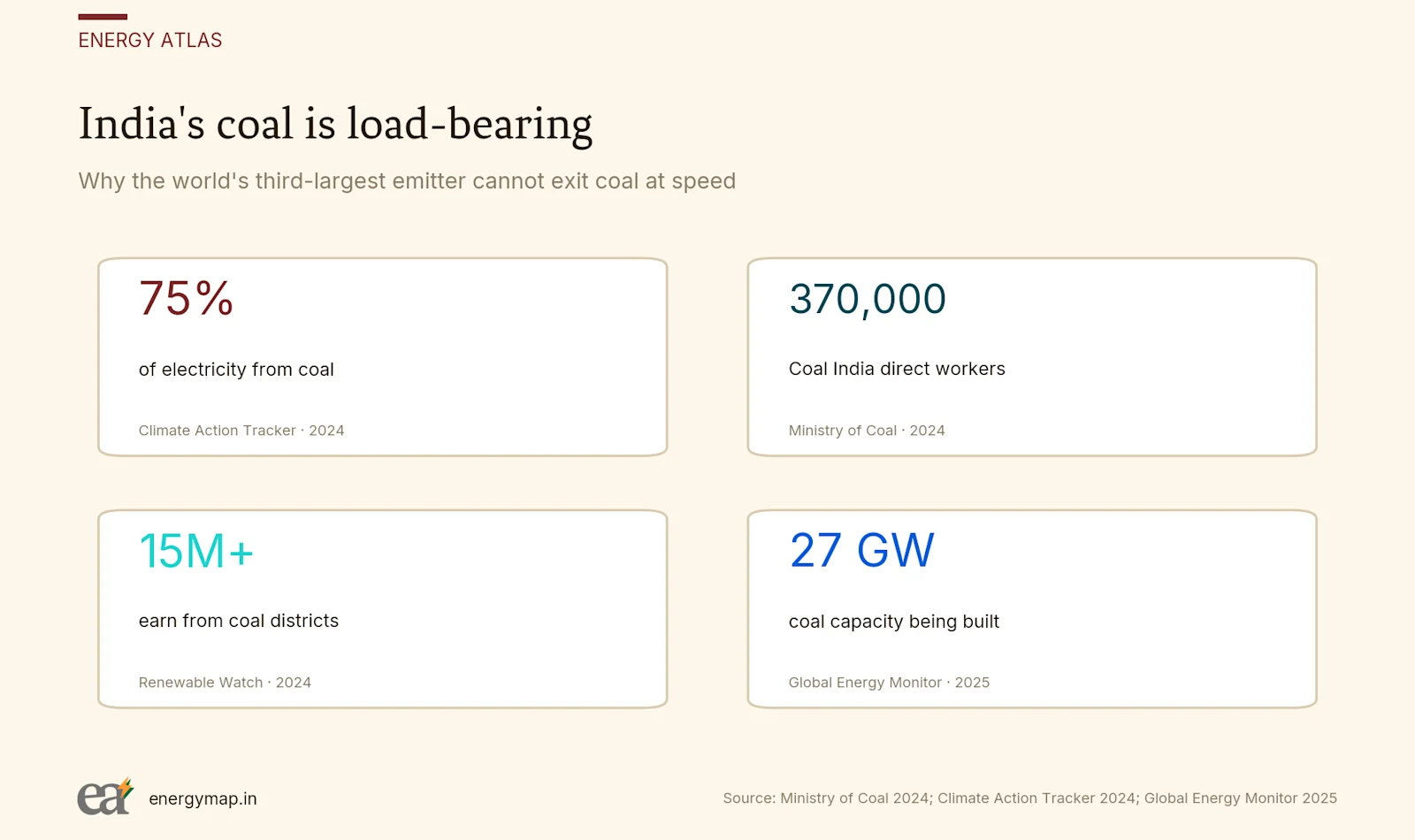
This embeddedness constrains policy regardless of stated ambition. As of July 2025, about 27 gigawatts of coal capacity is under construction in India and 92 gigawatts sit in pre-construction — far beyond the 24 gigawatts contemplated for the entire 2027-2032 period under the National Electricity Plan 2023 (Global Energy Monitor, 2025). India has no coal exit timeline and continues to auction new blocks. Its energy-security doctrine, articulated after the 2022 crisis, prioritizes domestic coal to reduce import vulnerability (Climate Action Tracker, 2024). This is not climate denial; it is a rational response to the political cost of transition, where premature closure would mean mass unemployment, fiscal stress and regional devastation.
When security beats climate #
The second constraint is the subordination of environmental concern to energy security and industrial competition. Climate change presents as a chronic, diffuse threat on decadal timescales; energy security presents as an existential, immediate one. States discount the future, and when forced to choose, they choose security.
Europe after Ukraine #
Russia's invasion of Ukraine in February 2022 triggered the most dramatic reorientation of European energy policy since the 1970s oil shocks. Before the war Russia supplied over 40 percent of EU natural gas demand; within three years the EU cut the value of its energy imports from Russia by 80 percent (European Commission, 2025). REPowerEU committed Europe to phase out Russian fossil fuels while accelerating the transition, mobilizing nearly €300 billion for clean energy.
Yet the framing is instructive. REPowerEU was articulated as an energy-security response, not a climate initiative. The IEA observed that the crisis's "biggest legacy... may be that it accelerates the end of the fossil fuel era," but immediately cast this as security-driven rather than climate-motivated (IEA, 2024). Europe's scramble for LNG from the US, Qatar and elsewhere was not constrained by emissions — and its willingness to pay premium prices, competing directly with Global South nations for scarce cargoes, revealed the true hierarchy of priorities.
The Inflation Reduction Act as permission structure #
The United States is more revealing still. The Inflation Reduction Act of 2022 is the most significant climate legislation in American history, allocating $369 billion for clean energy and climate programs and projected to cut US emissions more than 40 percent below 2005 levels by 2030 (CSIS, 2022). But its architecture shows climate serving as the permission structure for industrial policy, not the motive.
The IRA's domestic-content and "foreign entity of concern" provisions are designed to exclude Chinese products and rebuild American manufacturing. As CSIS put it, "much of the bill is also aimed squarely at enhancing competition with China" (CSIS, 2022). Beijing filed a WTO complaint in March 2024 calling the provisions "discriminatory, protectionist, and contrary to WTO rules" that "threaten to undermine international cooperation" on climate (S&P Global, 2024). US Trade Representative Katherine Tai countered that the IRA was "a groundbreaking tool... to seriously address the global climate crisis and invest in U.S. economic competitiveness" — conjoining climate and competitiveness as co-equal aims (USTR, 2024). The law passed because it could be sold as jobs, reshoring and China competition. The corollary: when climate conflicts with security or industry, security wins.
China's dual game #
China is simultaneously the world's largest emitter, largest clean-energy investor and largest exporter of coal infrastructure. In 2024 it accounted for 32 percent of global fossil CO₂ emissions — roughly 12 gigatonnes — while dominating production of solar cells (85 percent) and lithium-ion batteries (75 percent) (Friedlingstein et al., 2024; IEA, 2024). The positioning is not contradictory: it decarbonizes at home while exporting carbon-intensive development abroad through the Belt and Road Initiative. Even so, its emissions were projected to rise 0.2 percent in 2024, with a decline inside the uncertainty range but not assured (Friedlingstein et al., 2024). Party legitimacy rests on growth; constraining energy in the name of climate is a risk no leadership will take voluntarily.
Why the Paris framework cannot work #
The Paris Agreement embodies a contradiction: it asks symmetrical commitments from asymmetrical economies. The "nationally determined contribution" structure lets each nation set its own targets — producing a regime of voluntary pledges no one enforces, because no one can afford the political cost of enforcement.
The historical emissions burden #
The asymmetry begins with history. As of 2023 the United States had emitted about 430 billion tonnes of cumulative CO₂ since industrialization — roughly a quarter of all historical emissions and more than twice China's total (Statista, 2024). The EU accounts for a further 22 percent. India, home to one-sixth of humanity, has contributed about 4 percent despite being the third-largest annual emitter today (Carbon Brief, 2023). Attributing colonial-era emissions to the colonizing powers rather than the territories where extraction occurred raises the Global North's share further (Carbon Brief, 2023).
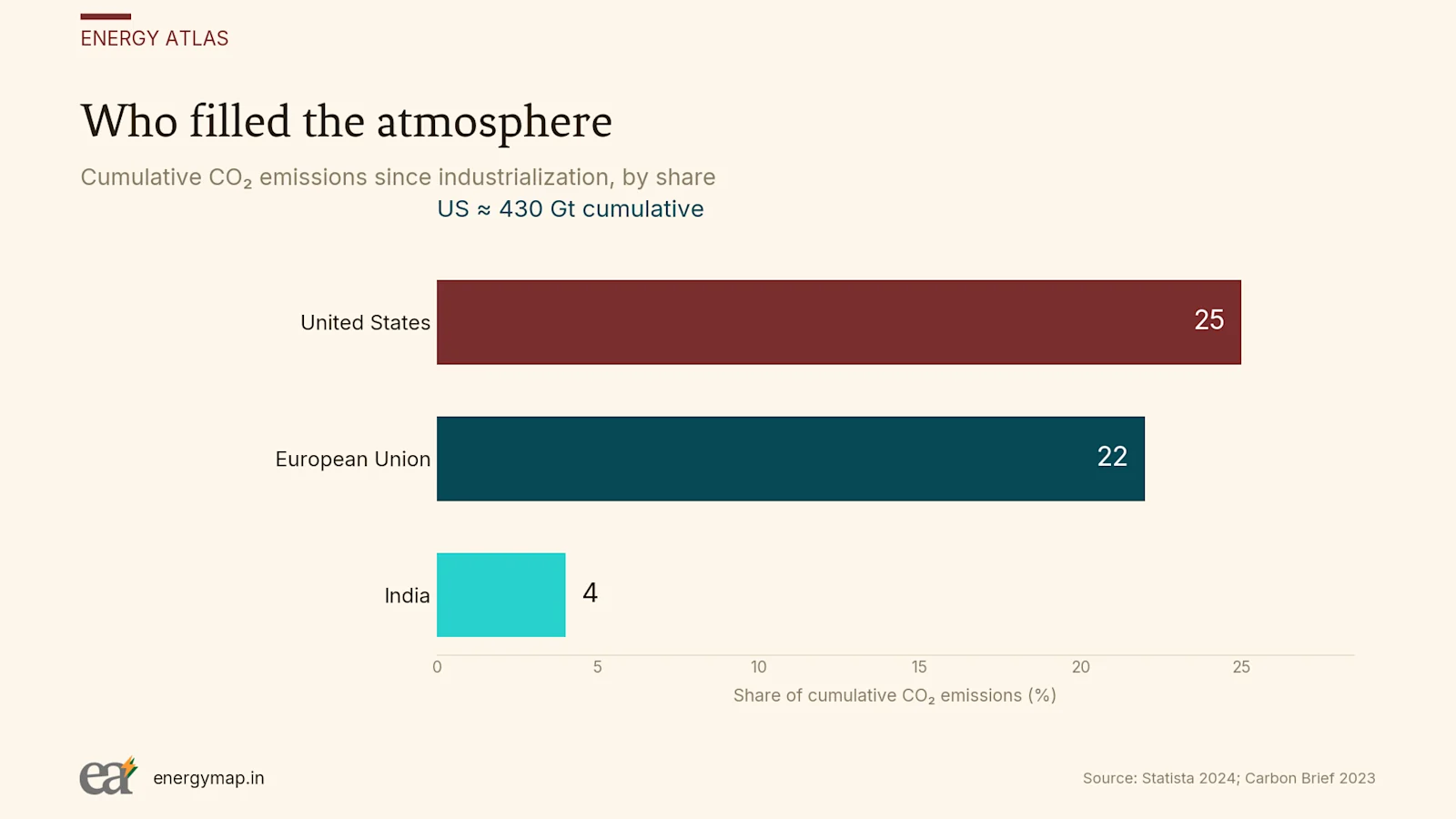
The grievance is concrete, not rhetorical. India's COP29 intervention noted that cumulative emissions between 2020 and 2030 are projected to consume 86 percent of the remaining carbon budget, and that public climate finance "must fully cover the costs of deviations from least-cost development pathways for developing countries" (Ministry of Environment, India, 2024). If the remaining budget before breaching 1.5°C were shared per capita, the North has already spent more than its share and is now asking the South to constrain development to compensate (Hickel, 2020).
The finance gap #
The finance gap crystallizes the asymmetry. COP29 closed with a pledge of $300 billion a year by 2035 — triple the earlier $100 billion, but far short of the $1.3 trillion a year developing nations say they need (UNFCCC, 2024). India alone estimates $2.5 trillion to meet its existing NDC targets through 2030 and $673 billion for adaptation (NRDC, 2024). Adjusted for inflation and the share delivered as loans rather than grants, $300 billion is barely advancement on the status quo. TERI called the outcome "too little, and too long a duration," warning that "the planet needs solutions and not semantics" (TERI, 2024); India's environment ministry said it "fails to address the urgency of the climate crisis and disregards the principles of fairness and inclusivity" (TERI, 2024).
The legitimacy crisis #
Together, historical burden and finance failure create a legitimacy crisis. Developing nations are asked to accept higher energy costs, forgo the industrialization strategies that built today's advanced economies, and bear adaptation costs for damage they did not cause — in exchange for transfers that never arrive at the promised scale. India frames its position through "climate justice," stressing per-capita emissions (India 2.9 tonnes; the US roughly 14) rather than absolute totals. It promised an updated 2035 NDC by December 2025 but missed the February and September deadlines — leverage in finance talks, or genuine uncertainty about what is feasible (The Diplomat, 2025). Either way, the signal is dysfunction: the third-largest emitter cannot or will not commit to a binding trajectory.
Alternative architectures #
If the diagnosis is right, the question is not how to strengthen the existing regime but whether a different architecture could work better. Four options merit consideration:
Plurilateral climate clubs. Abandon universalism for coalitions of the willing organized around shared economic interest. Nordhaus (2015) proposed that small groups could implement carbon pricing with border-adjustment mechanisms that make non-participation costly. The EU's Carbon Border Adjustment Mechanism, in its transitional phase since 2023, is an early step — but it risks becoming a vehicle for Northern protectionism that excludes developing nations without offering transition support.
Sectoral compacts. Target high-emitting sectors — steel, cement, shipping, aviation — rather than whole economies. Concentrated producers are easier to monitor: it is simpler to watch a thousand cement plants than an entire economy. The danger is leakage, shifting production to uncovered sectors or jurisdictions without touching the underlying political-economy constraints.
Technology transfer. Prioritize diffusion over targets. India has demanded transfer "without Intellectual Property Rights restrictions on green technologies" (Ministry of Environment, India, 2024); the International Solar Alliance, launched with France in 2015, models South-South cooperation that bypasses Northern IP gatekeeping. But cheap technology does not resolve infrastructure lock-in: substituting for centralized coal requires grid transformation, storage and stranded-asset management that hardware alone cannot deliver.
Energy-security integration. Accept that security will always trump climate, and design climate policy through the security logic rather than against it. Distributed renewables cut import dependence and harden grids against disruption; the Wilson Center notes that "the geopolitical premium in energy security lies both in resilience and obtaining an economic edge in global competition" (Wilson Center, 2023). Framing decarbonization as security enhancement, as the IRA did, may prove more durable than moral appeal — though whether it generalizes beyond the American context is unclear.
Conclusion #
The global climate regime is not failing; it is succeeding at what it was designed to do — managing expectations while preserving the fossil-based growth model. It processes demands for action, converts them into non-binding declarations and inadequate pledges, and offers a venue for repeated expressions of ambition that substitute for change. This is not cynicism but structural analysis: the regime reflects the constraints states face and the interests they prioritize.
Real progress would require one of two things: structural transformation of the domestic political economies that lock in fossil dependence, or reconstitution of the regime around more realistic assumptions about how states behave. The first means confronting powerful constituencies and absorbing transition costs no major government has been willing to bear. The second means trading the universalist pretensions of the UNFCCC for narrower, enforceable arrangements among willing parties. Neither is easy. But pretending the current regime can deliver transformation — that the gap between rhetoric and reality will close through incremental improvements in ambition language — serves no one except those who benefit from delay. The climate crisis will not be solved by the conferences that invoke it. Acknowledging that is the first step toward governance that might actually work.
Sources #
Carbon Brief (2023). Analysis: Which countries are historically responsible for climate change?
Center for Strategic and International Studies (2022). Why the new climate bill is also about competition with China.
Climate Action Tracker (2024). India country profile: Policies and action.
European Commission (2025). REPowerEU: A plan to rapidly reduce dependence on Russian fossil fuels.
Friedlingstein, P., et al. (2024). Global Carbon Budget 2024. Earth System Science Data, 16.
Global Energy Monitor (2025). Global Coal Plant Tracker.
Government of India, Press Information Bureau (2025). India's environmental transformation. Ministry of Environment, Forest and Climate Change.
Hickel, J. (2020). Quantifying national responsibility for climate breakdown. The Lancet Planetary Health, 4(9), e399-e404.
International Energy Agency (2024). Russia's war on Ukraine.
Ministry of Coal, Government of India (2024). Coal sector created substantial employment opportunities in last 10 years.
Ministry of Environment, Forest and Climate Change, Government of India (2024). India highlights four important aspects of global climate action at COP29.
Natural Resources Defense Council (2024). India's road to and from the Baku climate talks.
Nordhaus, W. (2015). Climate clubs: Overcoming free-riding in international climate policy. American Economic Review, 105(4), 1339-1370.
Renewable Watch (2024). Just transition: Need for green transition in the coal mining districts of India.
S&P Global Commodity Insights (2024). US-China trade talks break down over Inflation Reduction Act energy tax credits.
Seto, K. C., Davis, S. J., Mitchell, R. B., Stokes, E. C., Unruh, G., & Ürge-Vorsatz, D. (2016). Carbon lock-in: Types, causes, and policy implications. Annual Review of Environment and Resources, 41, 425-452.
Statista (2024). Cumulative CO₂ emissions from fossil fuel combustion worldwide, 1750–2023, by major country.
Stockholm Environment Institute (2024). COP29 closes with a climate finance deal, but at what cost?
The Diplomat (2025). India at COP30: A mismatch between grandstanding and climate action.
The Energy and Resources Institute (2024). TERI @ COP29.
United Nations Framework Convention on Climate Change (2024). COP29 agrees to triple finance to developing countries.
United States Trade Representative (2024). Statement from Ambassador Katherine Tai on the People's Republic of China's request for WTO consultations regarding the Inflation Reduction Act.
Unruh, G. C. (2000). Understanding carbon lock-in. Energy Policy, 28(12), 817-830.
Wilson Center (2023). Russia's war in Ukraine: Green policies in a new energy geopolitics.