
Selective Multilateralism: How Energy Splits and Binds the G20 and BRICS
At the G20 and BRICS summits, fierce rivalry over the technology and minerals of the energy transition coexists with cooperation on climate. The result is 'selective multilateralism' — and it explains why the old IR theories no longer fit.
By Sayonsom Chanda
In the winter of 2022, even as Brussels and Berlin condemned Russia's invasion of Ukraine, they quietly burned more coal than they had in years — climate pledges colliding with the raw imperative of survival. That collision is now the defining feature of great-power politics, and the G20 and BRICS summits stage it in full view: fierce competition over the means of the energy transition alongside stubborn cooperation on its ends. This is what I call "selective multilateralism" — and it explains why neither neorealism nor neoliberalism, on its own, can account for how states now behave.
When Energy Became the Battleground #
When President Trump mediated a ceasefire between Russia and Ukraine on March 18, 2025, the agreement's core provision — a halt to attacks on each country's energy infrastructure — revealed how thoroughly energy now dominates geopolitical calculation. Energy security has evolved from a technical detail into the defining battleground of twenty-first-century statecraft. Unsurprisingly, "energy" was a central talking point at the G20 summits in Bali (2022) and New Delhi (2023) and the BRICS summits in Johannesburg (2023) and Kazan (2024).
These gatherings reveal a profound paradox. A neorealist competition for dominance over the means of the energy transition — technology, resources, and supply chains — coexists with a neoliberal imperative to cooperate on its ends: climate stability, market predictability, and shared prosperity. While G20 declarations acknowledge that "security issues can have significant consequences for the global economy," the BRICS+ bloc signals its intent to build a "more balanced world order" and to challenge the "harmful effects of unilateral and illegal coercive measures" — language that directly implicates energy sanctions. As neorealism predicts, systemic shocks open windows for revisionist powers to challenge the status quo, which helps explain why BRICS has been adding West Asian members.
Just as control of shipping routes underwrote the British Empire and access to oil shaped American power in the twentieth century, the pathways of the energy transition are now decisive for who holds power in the twenty-first. But this time the politics face unique constraints: hard limits set by environmental science, technology that changes faster than institutions can adapt, and interdependence so deep that going it alone often backfires.
To dissect the paradox, I read it through two frameworks. Neorealism, or structural realism, as defined by Kenneth Waltz, holds that the anarchic structure of the international system compels states to prioritise survival and seek power (Waltz, 1990) — a powerful lens on the competitive, zero-sum dynamics of energy geopolitics. Neoliberalism, and particularly the complex-interdependence framework of Robert Keohane and Joseph Nye, argues that even under anarchy the multiple channels of interaction and shared vulnerabilities push states toward absolute gains through cooperation. The current era is defined not just by the weaponisation of energy — a classic realist move seen in Russia's actions in Europe — but by the weaponisation of interdependence itself. The very networks of trade and technology that neoliberals believed would foster peace have become conduits for coercion.
The Neorealist Calculus: Energy as Power #
Waltz's structural realism offers essential insight into contemporary energy competition, but it needs adaptation. Traditional realist analysis focuses on military capabilities and territorial control — tangible assets with clear offensive and defensive distinctions. Energy blurs those categories. A pipeline can serve both economic integration and strategic coercion; a solar-panel factory produces both consumer goods and geopolitical leverage.
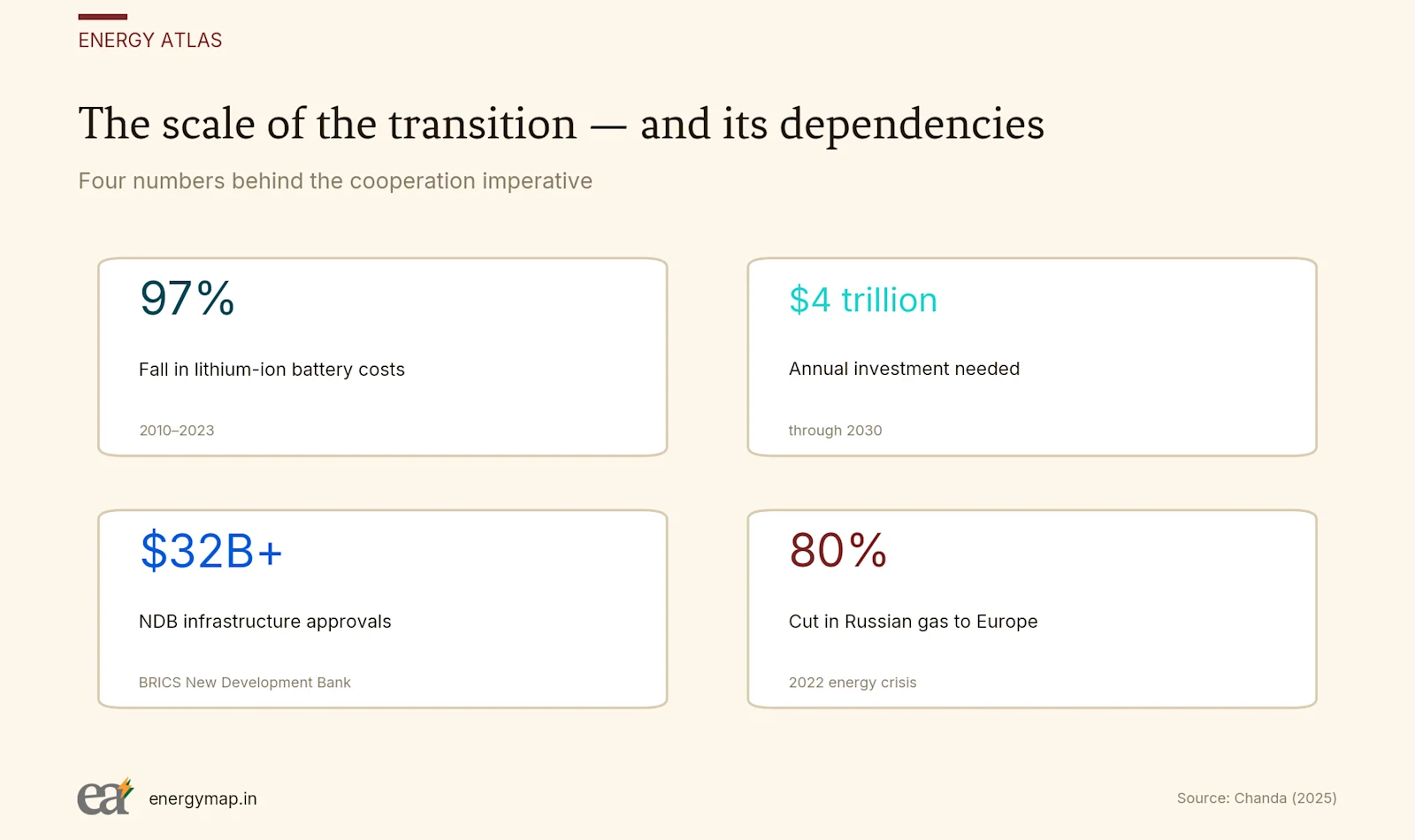
Energy security also complicates the Waltzian assumption that capabilities are fungible. Military power cannot substitute for energy access — as the Soviet Union discovered when its vast arsenal could not compensate for economic inefficiencies rooted in energy misallocation. Russia's weaponisation of natural gas — cutting European flows by 80% and driving prices above $250 per barrel equivalent — shows how material capabilities translate into coercive leverage, but also reveals the limits. The very act of weaponisation destroyed Russia's decades-built reputation as a reliable supplier, permanently altering European energy strategy and accelerating the transition Moscow sought to prevent.
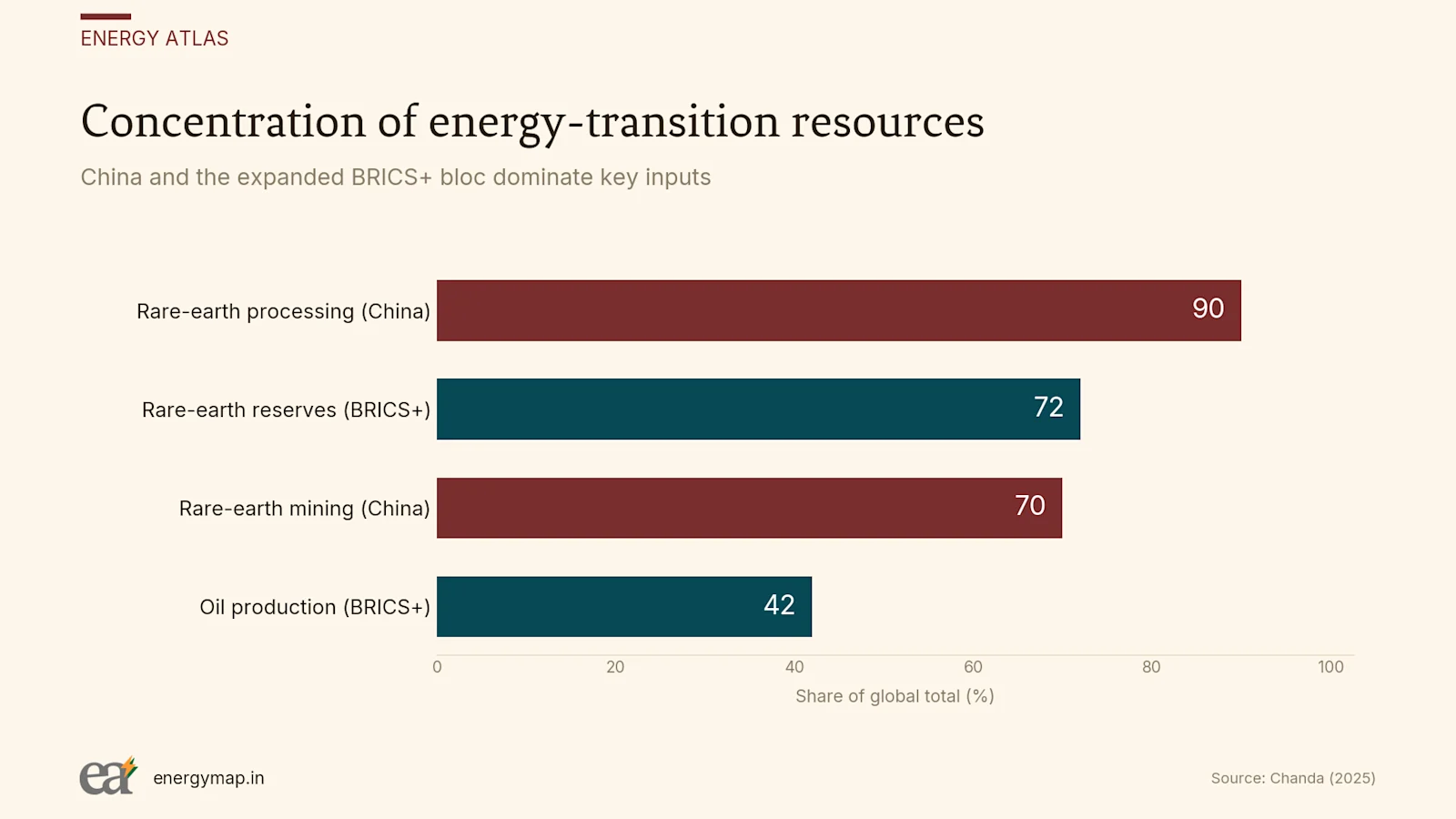
The emerging clean-energy economy reproduces these dynamics with new resources. China's dominance in critical-mineral processing exemplifies the concentration of material power: it controls 70% of rare-earth mining and nearly 90% of global processing capacity. That concentration triggers classic balancing behaviour. The expanded BRICS+ bloc now controls roughly 42% of global oil production and 72% of rare-earth reserves.
This is a textbook security dilemma, in which one state's defensive actions look threatening to another — and it is playing out vividly in the U.S.–China contest over clean energy. Viewing Chinese dominance in solar, wind, and battery manufacturing as a threat to its economic and national security, the United States passed the Inflation Reduction Act and imposed export controls to rebuild a domestic industrial base. From Washington these are defensive measures. Beijing read the IRA, the export controls, and student-visa caps as an offensive containment strategy meant to stifle its technological rise. The result was an escalatory spiral, culminating in a tariff war that fragmented the global economy into competing blocs. The neorealist logic becomes self-fulfilling: because states cannot trust others' intentions under anarchy, they prepare for the worst case and thereby create the very competition they fear (Shahi & Ascione, 2016).
The institutional scaffolding is being built to match. The BRICS New Development Bank has approved more than $32 billion for infrastructure projects, and the planned BRICS Bridge payment platform challenges the dollar's hegemony in energy trade — not merely an economic initiative but a systematic effort to alter the distribution of capabilities in the system. The timing reveals strategy: BRICS expansion during an acute energy crisis exploited Western vulnerability to supply disruptions, consolidating material power precisely when adversaries were weakest (Anderl & Witt, 2020) — across the entire transition value chain, from lithium and cobalt through battery manufacturing to renewable technologies.
Neoliberalism: The Case for Cooperation #
Pure neorealism cannot explain persistent cooperation amid intensifying competition. Keohane and Nye's complex-interdependence framework illuminates why even strategic rivals maintain collaborative mechanisms — though it, too, needs refinement for the energy context (Axelrod & Keohane, 1985).
The original formulation assumed relatively stable patterns of mutual vulnerability. The energy transition instead creates dynamic interdependencies that shift rapidly with technology. When China achieved a 97% reduction in lithium-ion battery costs between 2010 and 2023, it did not merely gain market share — it restructured global interdependence. States that had bet on alternative battery chemistries found themselves dependent on Chinese supply chains not through political coercion but through economic rationality.
That technological determinism challenges both theories' assumptions about state agency. Germany's Energiewende, launched with strong political will and substantial resources, foundered partly on physical realities: intermittent renewable generation requires either massive storage or continued fossil-fuel backup. Contemporary energy systems create unprecedented mutual vulnerabilities. Chinese battery production depends on Australian lithium and Western technology; American energy-independence aspirations cannot erase decades of Chinese processing expertise; European renewable ambitions require both Chinese manufacturing and Middle Eastern capital. These interdependencies generate powerful domestic constituencies favouring engagement over autarky.
Technical imperatives — international standards, grid codes, carbon-accounting methodologies — reinforce the pull. The shared vulnerability of climate change compels cooperation even between adversaries; the BRICS Energy Research Cooperation Platform facilitates technical exchange that benefits all members regardless of strategic rivalry. Even revisionist powers cannot escape atmospheric chemistry or sea-level rise. Financial interdependence compounds the effect: the transition is expected to require roughly $4 trillion in annual investment through 2030, and no single state or bloc holds enough capital. The New Development Bank, despite its origins as a challenge to Western financial hegemony, increasingly finances projects aligned with global climate goals as economic logic supersedes geopolitical positioning.
Selective Multilateralism: Reconciling Competition and Cooperation #
The contradiction between fierce competition and persistent cooperation is neither theoretical failure nor empirical anomaly. It reveals selective multilateralism — a mode of engagement in which states simultaneously pursue relative gains in strategic domains while accepting absolute gains in areas of mutual vulnerability.
History offers a precedent. The nineteenth-century Concert of Europe managed ideological competition between conservative and liberal powers while cooperating to prevent systemic war; contemporary energy multilateralism manages technological competition while cooperating on climate stability (Kay, 2011). The key difference is the existential nature of the climate threat, which constrains competitive behaviour more tightly than balance-of-power logic ever did. Unlike France's Maginot Line or a border wall, climate change — driven largely by the energy industry — cannot be walled off by any single nation. That is why, despite ideological rivalries and trade wars, forums persist where politicians, policymakers, scientists, and analysts from all states converge on shared problems.
Managing this duality requires institutional innovation beyond traditional multilateral frameworks (Keohane, 1998). Three mechanisms are already visible:
Minilateral clean-energy clubs. Small groups of like-minded states — such as the QUAD's clean-energy work — bypass broader geopolitical tension to cooperate more deeply.
Targeted bilateral partnerships. Arrangements like the India–EU climate partnership allow cooperation that carefully navigates the realities of economic competition.
Professional standards bodies. The renewable-energy standards work of the IEEE and IEC proceeds with participation from China, the United States, and Europe, as technical expertise supersedes political rivalry.
Conclusion: Governance in an Energy-Based World Order #
If energy security is the backbone of the emerging world order, then neither neorealism nor neoliberalism alone captures the dynamics of simultaneous — or selective — competition and cooperation. Even Alexander Wendt's constructivist insight that "anarchy is what states make of it" requires modification (Wendt, 1992): in the energy transition, anarchy is increasingly what technology makes of it.
The trade-war truce between the U.S. and China confirms that the material constraints imposed by physics, chemistry, and engineering are as binding as any political agreement. As the system evolves toward multipolarity, energy security will remain central to both competitive and cooperative imperatives. Structural realism and complex interdependence both remain relevant, but they demand synthesis rather than selection — a "pragmatic synthesis" that embraces rather than resolves contradiction, acknowledging that international relations increasingly operate through paradox management rather than problem resolution.
How well states and institutions adapt will determine whether humanity navigates the narrow passage between climate catastrophe and geopolitical conflict — or succumbs to the dual perils of environmental destruction and strategic miscalculation. The stakes could not be higher, nor the challenges, theoretical and practical, more profound.
Sources #
Axelrod, R., & Keohane, R. O. (1985). Achieving Cooperation under Anarchy: Strategies and Institutions. World Politics, 38(1).
Kay, C. (2011). Andre Gunder Frank: "Unity in Diversity" — from the Development of Underdevelopment to the World System. New Political Economy, 16(4), 523–538.
Keohane, R. O. (1998). Beyond Dichotomy: Conversations between International Relations and Feminist Theory. International Studies Quarterly, 42(1).
Waltz, K. N. (1990). Realist Thought and Neorealist Theory. Journal of International Affairs, 44(1).
Wendt, A. (1992). Anarchy Is What States Make of It: The Social Construction of Power Politics. International Organization, 46(2).