
The Missing Pillar: Energy Security and the Future of Multilateralism
The postwar order built institutions for health, finance, and nuclear weapons - but left energy ungoverned. The 2026 Iran-Israel-US crisis and the closure of the Strait of Hormuz show why energy security must become multilateralism's next pillar.
By Sayonsom Chanda
As of March 2026, the Iran-Israel-US war has given us an almost clinical view of where the multilateral system is weakest. The postwar order built governance for public health, for trade and finance, and for nuclear weapons — but it left energy unregulated, on the implicit assumption that markets and mutual dependence would keep the oil flowing. This essay argues that energy security must become the new central pillar of multilateralism's future.
Multilateralism is not collapsing — it is failing where governance was never built #
Operation Epic Fury was launched on February 28, 2026 — the same day as the third round of Oman-mediated nuclear talks with Iran. As those talks reportedly came close to a breakthrough, with Iran signalling its willingness to accept zero enriched-uranium stockpiles under full IAEA verification (Al Jazeera, 2026a), the bombings and drone attacks began. The timing tells us something: the speed at which multilateral organisations like the IAEA operate was simply not sufficient for one of the most powerful members of the UN Security Council — the United States — a state that had already decided on a faster option. This is not a classic failure of multilateralism. But it establishes a key premise for its future: the system must operate faster and align far more closely with the security interests of its most powerful members, or those members will keep acting outside it whenever they calculate that unilateralism is cheaper.
Before going further into what has failed, it is worth asking the prior question: what is working? The WTO, the IMF, and the WHO still coordinate. These are domains where serious, structured multilateral governance exists — and it works. But look at energy, or cybersecurity, or artificial intelligence, and there is no comparable global institution. The rules are not clear. The mandates do not exist. It is precisely in these ungoverned spaces that multilateral arrangements break down — as we see now, with energy infrastructure held hostage to a geopolitical contest in the Gulf, oil prices moving in absurd directions, and India facing an LNG crisis that was completely unanticipated because energy was never governed at the level it deserved.
The point, then, is this: multilateralism is not in crisis in its entirety. It is in crisis in specific domains where governance was never built. This is consistent with what Acharya (2017) describes as a "multiplex world" — multiple overlapping orders rather than a single layer of multilateral governance. The post-WW2 architects were guided by what was then existential: nuclear proliferation, financial stability, and the prevention of great-power wars. Energy, artificial intelligence, and cybersecurity were not on their radar. Having spent fifteen years as an energy and AI professional in national laboratories and global technology companies, I have had a close-up view of why these are the domains where governance is now most urgently needed. Whatever we assume will never fail tends to be exactly what fails — and the wise response is to build redundancy around it. The Strait of Hormuz, one of the most critical energy chokepoints on earth, is now virtually empty. We never built redundancy around it, and we are living with the consequences.
The primary chokepoint: the P5 veto #
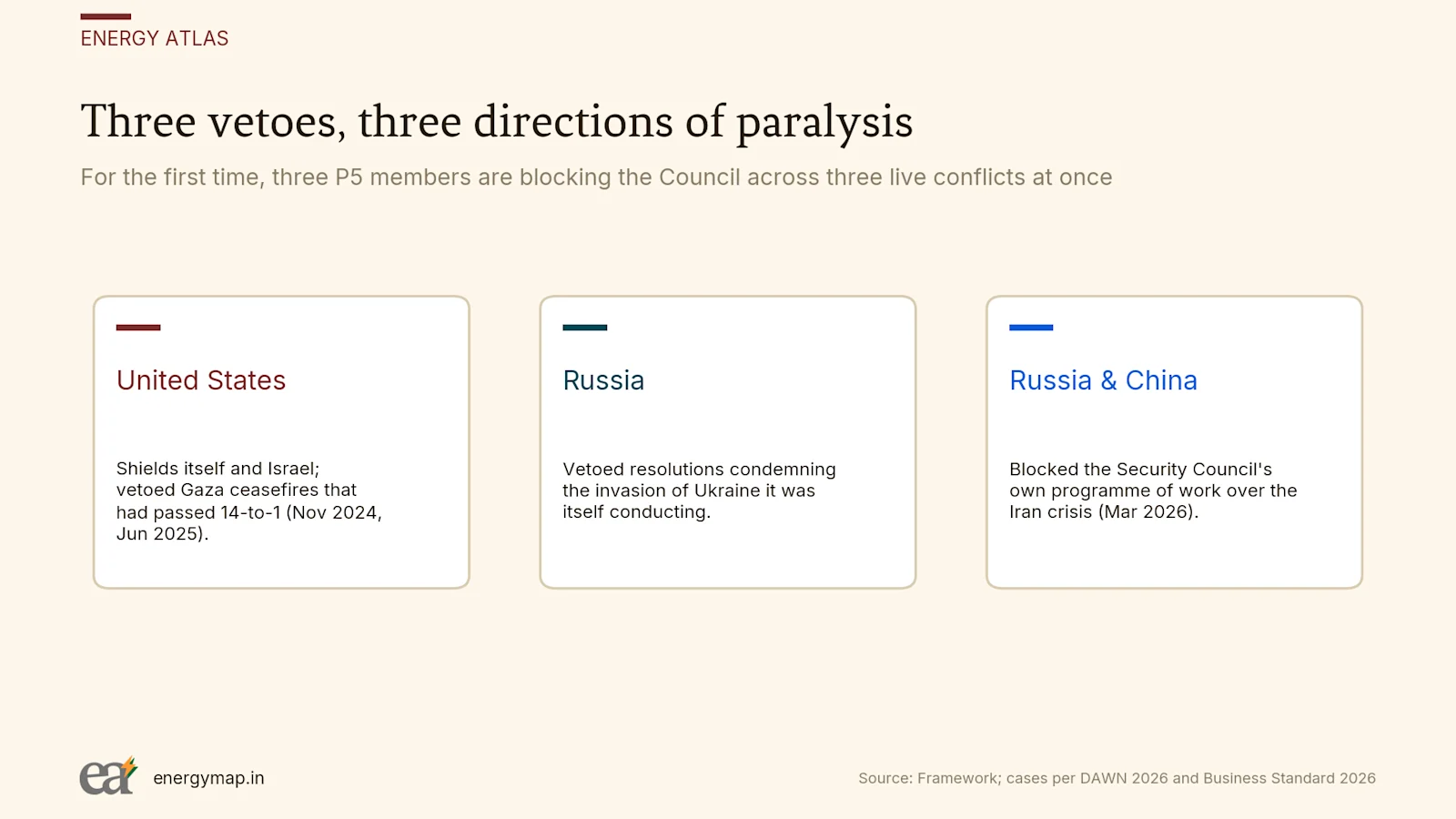
The veto powers of the P5 were designed to keep the great powers inside the multilateral system. They have become, instead, the instrument for acting outside of it. Every time the United States is involved in a conflict — as it is now with Iran — it holds the power to veto any UN resolution that might constrain it. That is hard to call fair when the United States is the party striking Iranian soil. We saw the same dynamic in Gaza, where the US vetoed ceasefire resolutions that passed fourteen to one in both November 2024 and June 2025 (DAWN, 2026). We saw it again with Russia and Ukraine, where Russia vetoed resolutions condemning an invasion it was conducting. And now, in March 2026, Russia and China have blocked the Security Council's own programme of work over the Iran crisis (Business Standard, 2026). Three conflicts. Three P5 members. Three directions of paralysis, all at once. That is new.
Hurd's (2002) observation is appropriate here: the legitimacy of any institutional action depends on the perception of authority. What we have in the US-Iran-Israel conflict is beyond a question of legitimacy — it is a situation of complete disregard for international norms, in which the institution meant to enforce them is paralysed by the veto powers of the very states violating them. This is not a temporary dysfunction. It is structural. The Council retains its formal status while losing any practical capacity to act, and the gap between the ceremony and the substance is what makes this moment so troubling.
Keohane (1984) argued that multilateral institutions reduce transaction costs and enable cooperation. But there is a hidden assumption in that argument: that whoever is the hegemon wants the system to work in that mode. The Iran war has exposed the assumption. The United States evidently calculated that a unilateral strike would cost far less than continued multilateral dialogue — a calculation that directly conflicts with the entire purpose of multilateral institutions, which is to make cooperation cheaper than conflict. If the hegemon decides unilateralism is cheaper, it will act unilaterally and use its veto anyway. We should be honest about what UN General Assembly resolutions amount to in that world: moral posturing without operational authority.
Empty moral posturing degrades trust #
The Security Council created the governance machinery for nuclear non-proliferation, and for decades it largely worked. But the JCPOA terminated in October 2025, and Iran subsequently prepared to invoke Article X of the NPT — the withdrawal clause that requires only three months' notice (United Nations, 1970). What this sequence reveals is a structured pattern of decline: never a single dramatic collapse, but a systematic erosion of trust and the destruction of compliance incentives over a long period.
The IAEA — itself a multilateral body — assessed that Iran held over nine tonnes of enriched uranium, including more than 400 kilograms at 60% enrichment (Institute for Science and International Security, 2025). The problem is that multilateralism failed to build a restraint or trust mechanism around these conclusions. The great powers could not trust one another, and that was the governance failure that produced the crisis. The verification data was supposed to be the basis for diplomacy. Instead it became the basis for targeting. Once a country learns that opening its facilities to inspectors is functionally the same as opening them to bombers, why would it ever again cooperate with a monitoring regime?
The compliance incentives were destroyed through successive rounds of talks that produced agreements without follow-through. The JCPOA was not perfect — nobody would claim it was — but it was at least a framework, and that framework collapsed. Preemption does not prevent the next war. The United States made this miscalculation when it invaded Iraq, and it did not prevent the war in Afghanistan that followed. The preemptive strikes on Iran are probably history repeating itself, though these things are never entirely clear until someone lives through the consequences ten or twenty years on. The Bulletin of the Atomic Scientists (2025) warned that the strikes would produce exactly the opposite of their stated non-proliferation objective. I find that warning credible.
The cascade problem #
The multilateral order — the Security Council's fifteen members, the General Assembly, the ICJ — prevented a third world war for over eighty years. But it did not reckon with what happens when one nation goes rogue on nuclear capability and others follow. It is unsurprising that Carnegie's Jamie Kwong noted that Saudi Arabia has publicly stated it will pursue nuclear weapons if Iran does (Carnegie Endowment, 2025).
Why the future of multilateralism depends on energy-security governance #
Now to the core of the argument, because this is where I believe the future of multilateralism will be decided. Multilateralism will be a significant force in the world again if — and only if — we can bake energy security into the multilateral fold. I have worked on energy security at US Department of Energy national laboratories for a considerable part of my career, and I have seen firsthand that no multilateral institution has a mandate for energy-chokepoint crises. This is the most glaring design flaw in the post-World War II order. OPEC is the apex body for monitoring oil production, and the IEA manages petroleum-reserve strategy, but neither has authority over P&I insurance for ships or over energy-chokepoint security. The G20 is useful for communication. UNCLOS establishes navigational rights. But cumulatively, there is no multilateral governance to ensure global energy security — and that absence is what makes other multilateral functions appear dysfunctional.
In Thakur's (2017) words, the UN security architecture was designed for interstate threats. But interstate threats are only half the problem. The other half is the interdependence of states — the reality that, without energy, economic collapse follows across all of them. That is why energy governance must be institutionalised in the future of multilateralism.
People are not just waking up to this today. The gap was always there, but we never had such a strong dependence of the global economy on energy as we do now. Without electricity, there are no data centres, no artificial intelligence, no functional internet. The IMF works with the accuracy it does because the Great Depression taught the world what happens when monetary governance is absent; the financial crises were, in a perverse way, good for institutional design, because they demonstrated the need. The energy insecurity we are experiencing now should be the equivalent wake-up call. Weiss and Thakur (2010) identified what they called the "anomaly" of global governance: the gap between transnational problems and national jurisdictions. That anomaly is widest in energy, and the Iran conflict is the moment that has cracked it open.
Beyond price: the chokepoint problem #
I should acknowledge honestly that producers and consumers have opposing incentives. Producers seek to maximise price; consumers seek stability. That tension explains why past efforts — from the 1974 International Energy Programme to the G20 energy working groups — produced coordination but never governance. But what the Strait of Hormuz crisis reveals goes beyond price. It is about chokepoint security. The producing countries — Saudi Arabia, Kuwait, Qatar — are losing revenue, losing citizens to Iranian missile strikes, watching their infrastructure burn. On the importing side it is even more severe: in India, the LNG crisis means restaurants cannot operate and people are cooking without gas; in Pakistan, people are beginning to starve. These countries disagree on price. They do not disagree on whether the Strait should be open. That narrower but harder zone of mutual vulnerability — where every actor on both sides of the market loses at once — is where an energy-governance architecture can and should be built.
India's energy-dependence trap #
How India responds to its energy-security predicament will provide a blueprint for how developing nations shape the future of multilateral organisations and agreements.
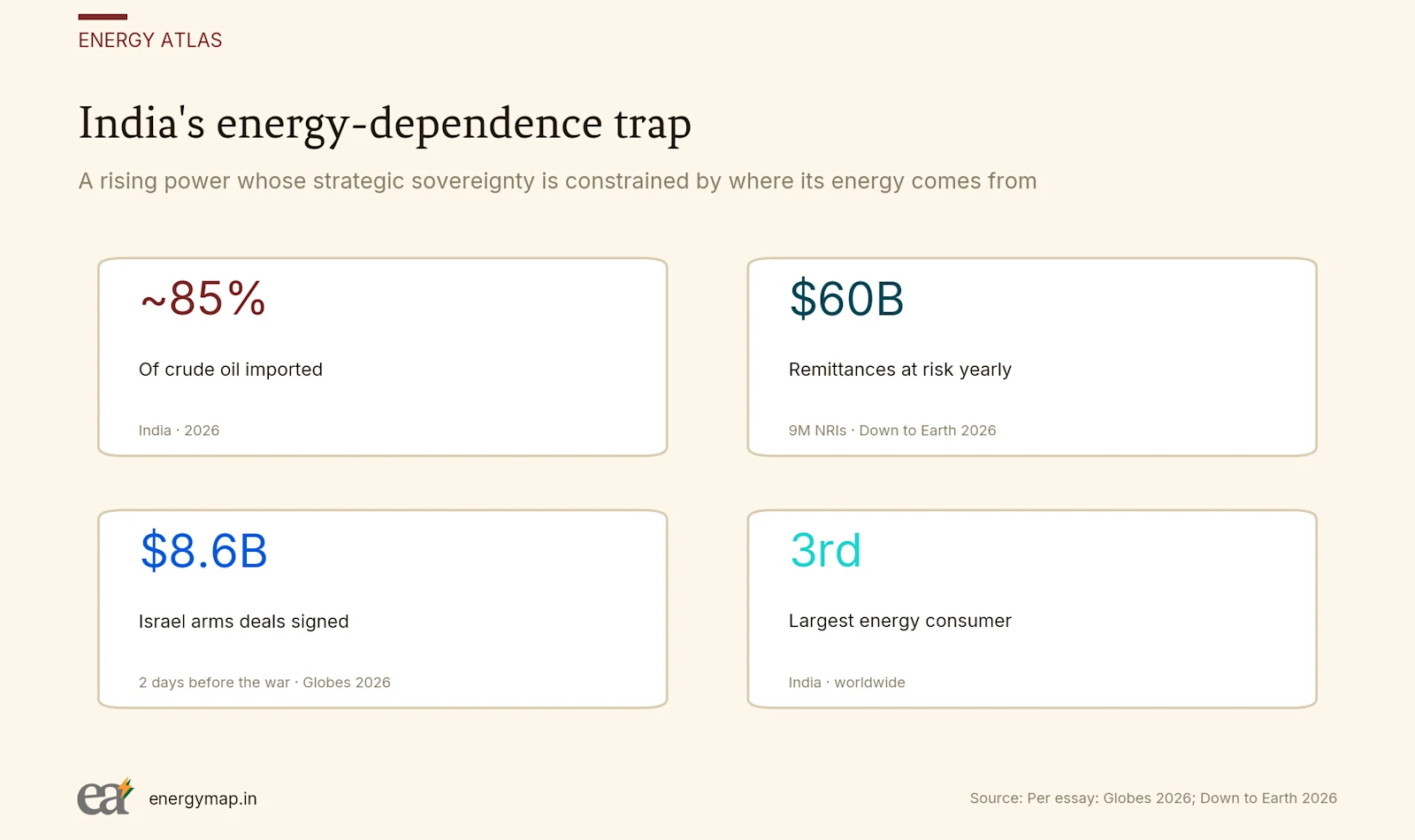
India occupies a genuinely unique position in the current order. It is a member of both the Quad and the SCO — one aligned with Washington, the other with Beijing and Moscow. It is Israel's largest defence customer, with deals reportedly worth $8.6 billion signed just two days before Operation Epic Fury (Globes, 2026). It chairs BRICS in 2026, and under its chairmanship the bloc has issued no statement on the war — a marked contrast with Brazil's 2025 presidency, which condemned the June strikes as violations of international law (Al Jazeera, 2026c). India has been one of the largest contributors to UN peacekeeping since the 1950s, yet it abstained on key General Assembly votes condemning Russia's invasion of Ukraine.
As of 2026, India imports roughly 85% of its crude oil. The government's own review has acknowledged heightened risks to energy security, inflation, and fiscal stability, including the potential loss of an estimated $60 billion in annual remittances from nine million non-resident Indians in the Middle East (Down to Earth, 2026).
India's External Affairs Minister Jaishankar told Parliament that India stands for diplomacy and the protection of its citizens abroad (Zee News, 2026). That is the official position. The structural reality is that India's strategic sovereignty is constrained by the sources of its oil and the waterways it must traverse.
India is, in a real sense, paralysed: it can support neither party without losing a relationship it cannot afford to lose. That paralysis should not be read as a failure of Indian diplomacy. It is a structural consequence of energy dependence within a multilateral system that has no energy governance.
Jones's (2010) "Beyond Blocs" report asked whether the West and rising powers share enough common interest to sustain cooperation. The Iran crisis suggests that they do, and that the most tangible shared interest is energy security. India is uniquely positioned to lead the construction of an energy-governance framework — because it is the world's third-largest energy consumer, the founding force behind the International Solar Alliance, and one of the few major states able to engage credibly across both Western and non-Western institutional architectures.
Multilateralism will gain new layers — not collapse #
Ruggie (1992) defined multilateralism as an institutional form based on generalised principles of conduct that apply to all members. Article 2(4) of the UN Charter (United Nations, 1945) still prohibits the use of force against any state's territorial integrity. The NPT's three pillars still formally bind their signatories. UNCLOS still governs maritime navigation. The principles are there. What has changed is that compliance has become conditional and selective — applied when convenient, suspended when a powerful state decides the cost of obedience exceeds the cost of resistance.
What we are observing is better described as institutional layering than institutional death. New organisations — the SCO, the AIIB, BRICS+, and coalitions like the Quad, AUKUS, and I2U2 — are emerging alongside the older ones, not replacing them. The AIIB is a financial partner to the World Bank. The SCO is ideologically aligned with the UN on counter-terrorism. BRICS+ does not intend to dismantle the G20, but is keen to challenge its normative assumptions. The future of multilateralism is being built in real time: it is becoming denser, more fragmented, and more uneven. And the core danger is that one critical layer was never built — energy-security governance.
Hampson and Heinbecker (2011) argued that shifts in economic gravity would generate new forms of multilateral cooperation. Carnegie's analysis that the Middle East is the only major region without standing multilateral bodies for diplomacy and security coordination (Hamzawy, 2025) explains that region's particular vulnerability. But the point goes beyond any single region. Whatever form the bifurcation of the order takes — a Western-led layer, a China-Russia axis, a set of key states navigating between them — every configuration requires energy. The future of multilateralism will be determined, in large part, by whether energy security is baked into each of these constructs or left, once again, as an afterthought.
Conclusion: turning the crisis into a catalyst #
A few recommendations follow from this analysis.
Build an Energy Chokepoint Governance Mechanism, housed within the G20. To be effective, it should hold operational authority over maritime-insurance backstops for critical straits, pre-negotiated emergency tanker routing, strategic-petroleum-reserve coordination that reaches beyond OECD membership to include China, India, and the Gulf producers, and a real-time chokepoint-monitoring platform. The precedent is the Financial Stability Board, created after the 2008 crisis to govern a domain existing institutions had left dangerously unattended. Energy security warrants an equivalent innovation.
Reform the Security Council veto. If a permanent member believes unilateral action is better, it will act and then use its veto afterward. At a minimum, there must be a mandatory justification requirement and a prohibition on veto use when the P5 member is itself a party to the conflict.
Give the Middle East standing regional security institutions, analogous to the OSCE or the ASEAN Regional Forum — built in peacetime, not patched together under drone-fire.
Turn middle-power sovereignty into an institutional programme, with India foremost. India's scale, its credibility across both institutional camps, and its founding role in the International Solar Alliance give it the standing to convene an energy-governance initiative that neither Washington nor Beijing could credibly lead alone.
The international order will not fall dramatically. The primary risk is that it degrades slowly — quietly enough that people stop taking it seriously. That is the more probable outcome, unless multilateral institutions can demonstrate, in the middle of a live conflict, that they can deliver better energy security and get the relevant parties to talk through the instruments already in place. If they can — if the Iran crisis becomes the catalyst for baking energy governance into the multilateral architecture, the way the Great Depression catalysed financial governance and the Cuban Missile Crisis catalysed non-proliferation — then this will be the first stable move toward a multilateral future worth having. If they cannot, the next chokepoint closure will find the same institutional vacuum, and the same belated recognition that the architecture everyone assumed would hold was never actually built.
Sources #
Acharya, A. (2017). After liberal hegemony: The advent of a multiplex world order. Ethics & International Affairs, 31(3).
Al Jazeera. (2026a, February 28). Peace 'within reach' as Iran agrees no nuclear material stockpile: Oman FM.
Al Jazeera. (2026c, March 6). Is BRICS bloc divided over US-Israel attacks on Iran?
Bulletin of the Atomic Scientists. (2025, June). What if Iran withdraws from the NPT?
Business Standard. (2026, March 4). Russia, China block US UNSC Presidency's Programme of Work over Iran crisis.
Carnegie Endowment for International Peace. (2025, April). Bargaining short of the bomb: A strategy for preventing Iranian NPT withdrawal.
DAWN. (2026). UN General Assembly: Demand end to illegal US-Israel war on Iran.
Down to Earth. (2026). Iran-Israel conflict heightens risks to India's energy security, inflation and fiscal stability: Government review.
Globes. (2026). India agrees arms deals with Israel worth $8.6b — report.
Hampson, F. O., & Heinbecker, P. (2011). The "new" multilateralism of the twenty-first century. Global Governance, 17(3).
Hamzawy, A. (2025, June). Does collective security in the Middle East still have a chance? Carnegie Endowment for International Peace.
Hurd, I. (2002). Legitimacy, power, and the symbolic life of the UN Security Council. Global Governance, 8(1).
Institute for Science and International Security. (2025, May). Analysis of IAEA Iran verification and monitoring report.
Jones, B. (2010). Beyond blocs: The West, rising powers, and interest-based international cooperation. Stanley Center for Peace and Security.
Keohane, R. O. (1984). After hegemony: Cooperation and discord in the world political economy. Princeton University Press.
Ruggie, J. G. (1992). Multilateralism: The anatomy of an institution. International Organization, 46(3).
Thakur, R. (2017). The United Nations, peace and security: From collective security to the responsibility to protect (2nd ed.). Cambridge University Press.
United Nations. (1945). Charter of the United Nations.
United Nations. (1970). Treaty on the Non-Proliferation of Nuclear Weapons (NPT).
Weiss, T. G., & Thakur, R. (2010). Global governance and the UN: An unfinished journey. Indiana University Press.
Zee News. (2026). 'Dialogue and diplomacy should be pursued,' says EAM S Jaishankar on West Asia tensions.