
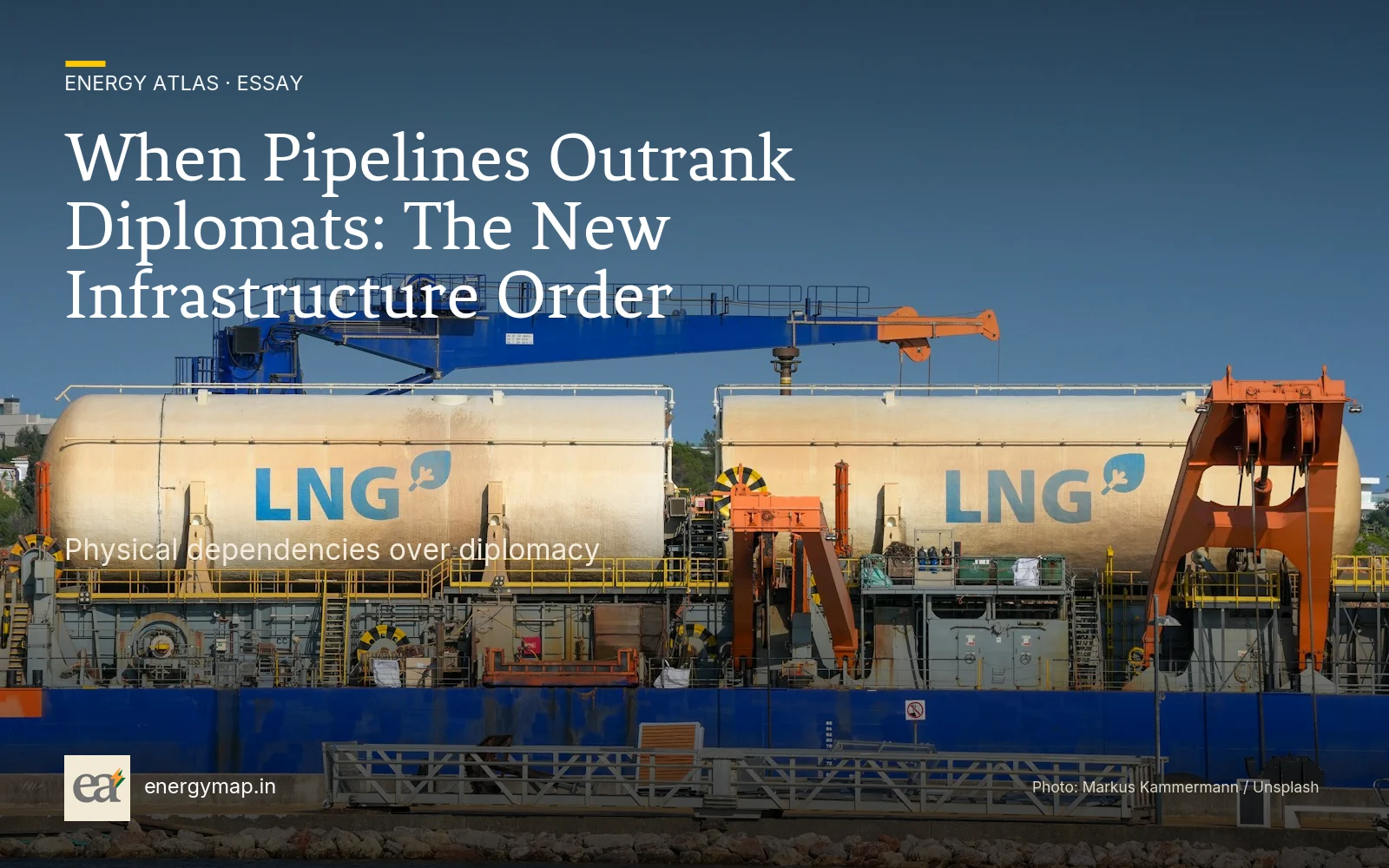
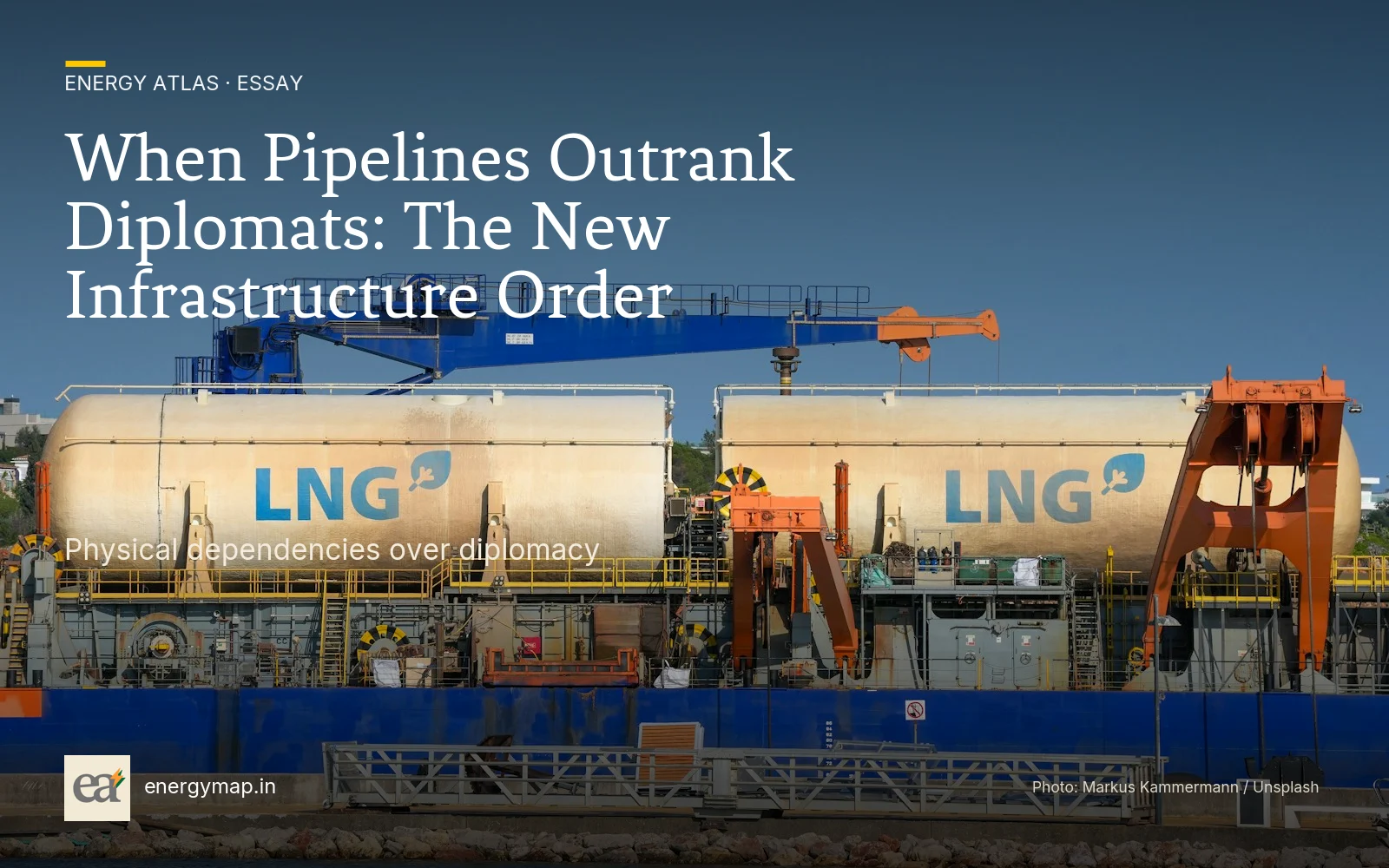
When Pipelines Outrank Diplomats: The New Infrastructure Order
Israel strikes Iran and Washington is powerless; Russia and Ukraine agree only to spare each other's pipelines. A new world order is emerging in which shared infrastructure—not diplomacy—sets the limits of war.
By Sayonsom Chanda
Russia and Ukraine could not agree to spare each other's cities—only to stop bombing each other's pipelines and power plants. Months later, Israel struck Iran and Washington was powerless to stop it. The pattern is unmistakable: a new world order is emerging in which shared infrastructure, not diplomatic agreements, decides who can fight whom.
> "He who has the gold makes the rules."
> — Donald J. Trump, Truth Social, April 25, 2025
The "deal is done" world #
On June 13, 2025, Israeli jets struck Iran's nuclear facilities. Washington's warnings meant nothing. The attack reveals the contours of an emerging world order defined by a "deal is done" mentality. Deals require leverage, and leverage requires shared infrastructure. Israel and Iran share nothing—no pipelines, no refineries, no mutual investments—so American influence vanishes and only force remains.
Three months earlier, a different story played out between Russia and Ukraine. After ninety minutes on the phone, Trump and Putin agreed to something unprecedented: Russia would stop attacking Ukrainian energy infrastructure for thirty days, and Ukraine would stop targeting Russian oil refineries. Not a ceasefire for cities. Not a troop withdrawal. Just mutual protection for pipelines and power plants.
When pipelines matter more than people—when power grids get the protection that civilians don't—we glimpse the basis of the new order: shared material stakes, not diplomatic agreements, define the limits of war.
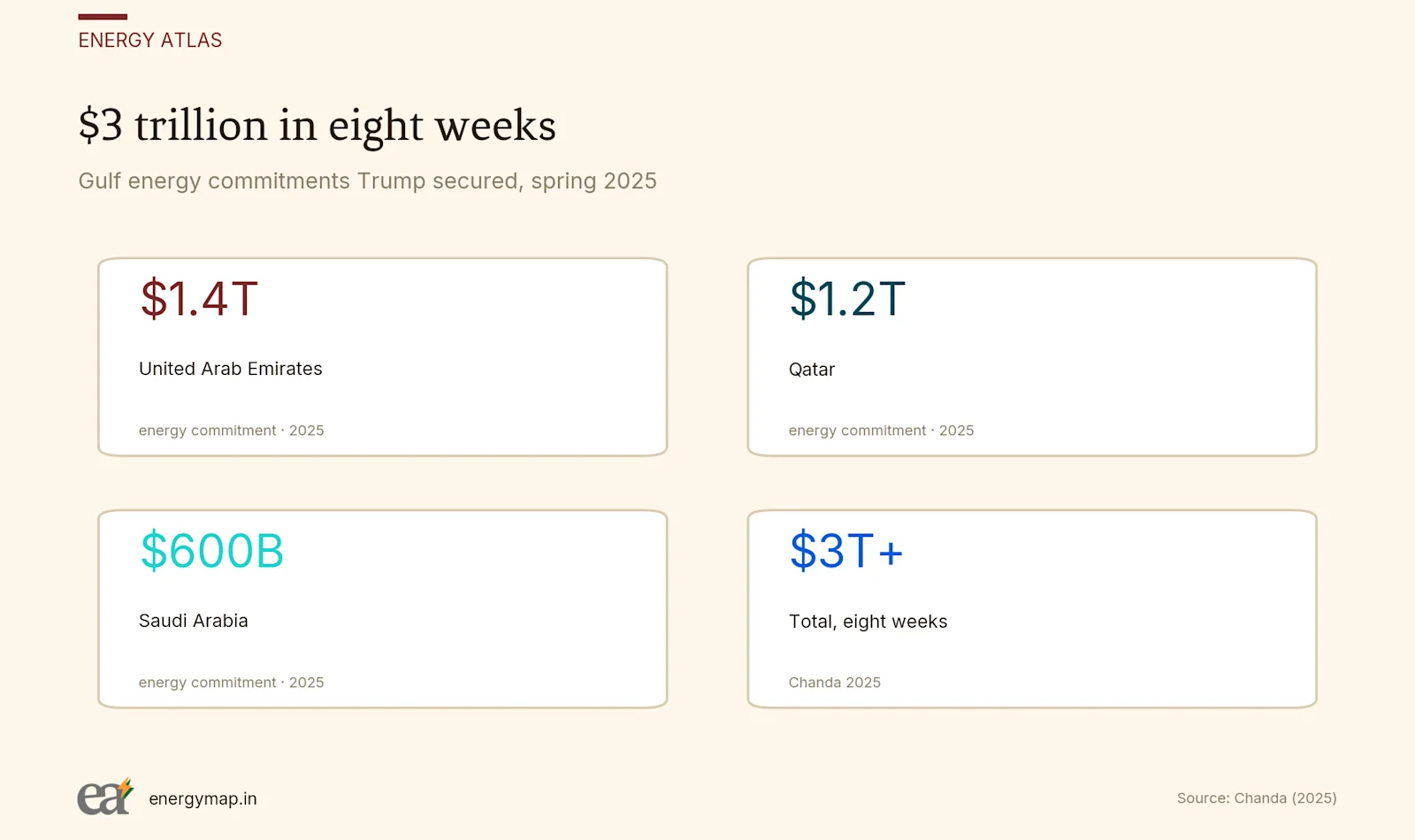
This infrastructure-first logic amounts to a systematic replacement of the post-1945 diplomatic order with something more permanent. In eight weeks, Trump secured over $3 trillion in energy commitments—$600 billion from Saudi Arabia, $1.2 trillion from Qatar, $1.4 trillion from the UAE. These are not trade agreements a future administration can cancel. They are infrastructure investments with generational lifespans: LNG terminals such as Golden Pass ($10.5 billion) and Plaquemines ($21 billion) require thirty-year contracts to justify construction; pipeline networks cost billions and take decades to amortise; rare-earth processing facilities take almost twenty years to replicate. Each project creates a physical reality that makes reversal economically catastrophic.
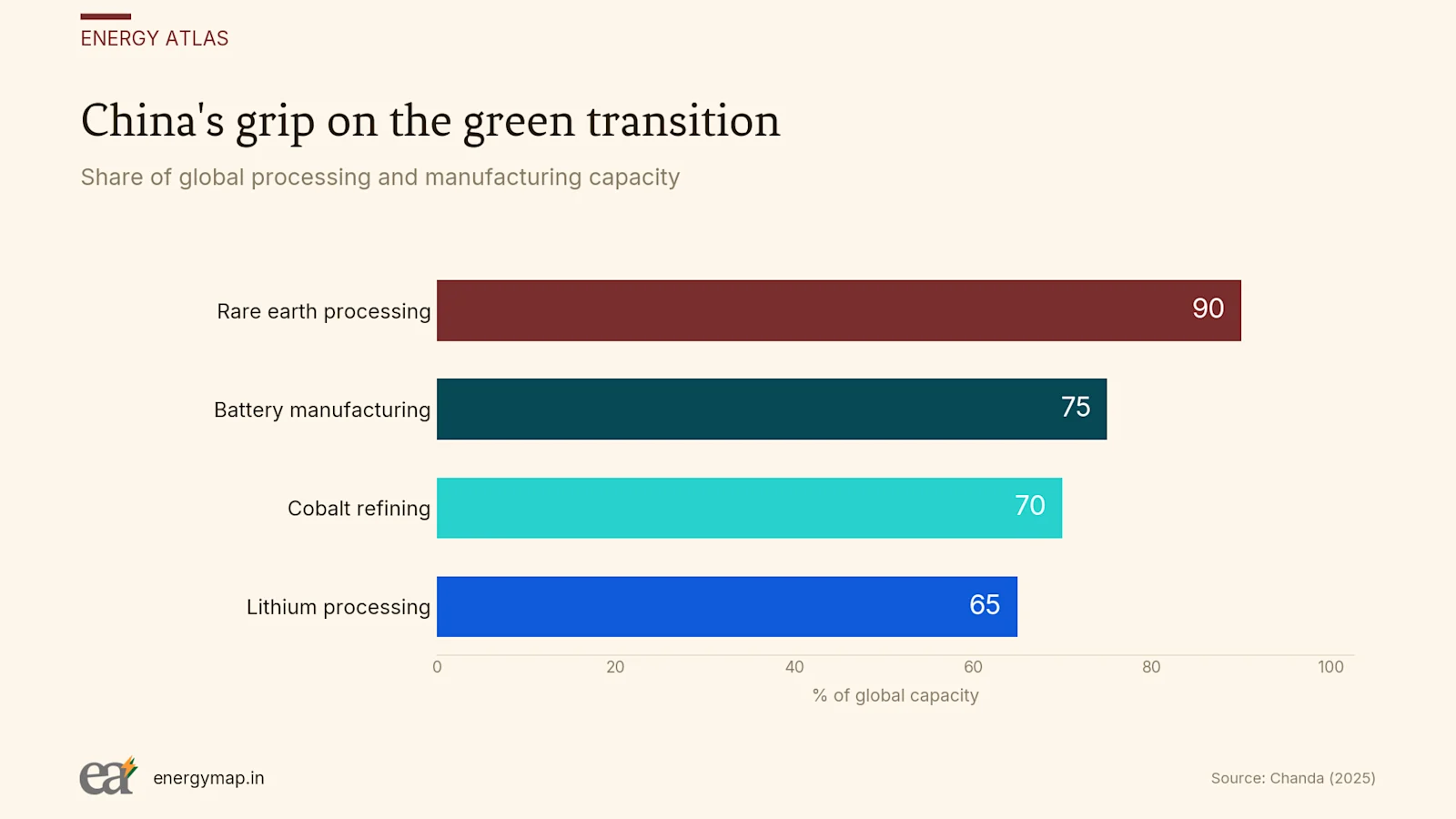
The Vienna Convention's protocols, NATO's Article 5 guarantees, the UN Security Council's collective-security framework—all these carefully constructed institutions assume that politics shapes reality (Roberts, 2018). But when Europe relies on American LNG after severing its Russian pipelines, and when every nation's green transition depends on Chinese rare-earth processing that controls 90% of global capacity, physical infrastructure becomes destiny.
Trump hasn't simply disrupted the liberal international order; he is engineering its replacement—a system where business rationality enforces stability through mutual dependence on assets too expensive to abandon, too critical to attack, and too embedded to escape. This energy infrastructure is the new "gold," and he is rewriting the world order on the thesis that whoever has the gold makes the rules—even if it means sharing the gold with adversaries.
Historical parallels, revolutionary departures #
History offers no shortage of order-disrupting leaders—Napoleon spreading nationalism across Europe, Wilson replacing realpolitik with idealism, FDR constructing Bretton Woods from the ruins of colonialism. Yet Trump's infrastructure-based transformation finds its most instructive parallel in Rome's final centuries, with a twist that separates modern design from ancient decay.
When tax revenues dwindled in the fourth and fifth centuries, Roman emperors discovered that subsidising barbarian foederati cost less than maintaining professional legions. Tribes—Franks, Vandals, Visigoths—provided military service in exchange for Roman gold, creating dependencies that seemed mutually beneficial. But the arrangements were flexible: tribal leaders could negotiate better terms, switch allegiances, or abandon agreements when better opportunities arose.
Trump's energy foederati appear to follow this pattern. Not diplomats but Steve Witkoff, a New York real-estate magnate, leads the teams meeting world leaders to broker profitable transnational partnerships. "Good deal" logic supersedes long-standing security commitments, and each commitment locks in decades of physical dependency. Rome purchased barbarian loyalty with gold that could be spent elsewhere; America purchases partnerships with infrastructure that cannot move.
The Power of Siberia pipeline's $55 billion investment locks Russia and China into a multi-decade partnership through 2,800 kilometres of steel. Europe's scramble to build $40 billion in LNG import facilities creates a dependence on American supply that would take a generation to reverse. North American LNG export capacity is set to double by 2028—from 11.4 to 24.4 billion cubic feet daily—representing not merely trade flows but permanent industrial architecture.
Washington, however, seems wary of the folly of the Roman emperors. Alaric's Visigoths served Rome faithfully until better options emerged—then sacked the Eternal City in 410 CE. Unlike Rome's portable loyalties, these physical systems create mutual captivity. The infrastructure doesn't symbolise the relationship; it is the relationship. Where Rome's system collapsed because human loyalties shifted, Trump's energy order may endure precisely because pipelines don't move, refineries can't march to better opportunities, LNG terminals stay anchored to their coastlines, and AI models and datacentres demand enormous, fixed resources to run.
The birth of the energy triumvirate #
The seed of this change predates Trump. It began with the shale revolution under the Obama administration (Ross & Voeten, 2025). Quietly, the United States pivoted from being one of the world's largest oil importers to one of the largest exporters of gas and oil—well before Trump's "drill, baby, drill."
But the U.S. does not limit its energy dominance to mimicking a Gulf oil exporter. It seeks a higher, more comprehensive energy security. Trump is leading that charge, using the theatre of trade war and tariffs to appease his nationalist base while setting up mutual partnerships with China—rather than the earlier approach of containing it. The Indo-Pacific strategy, the QUAD, AUKUS submarines—decades of containment architecture—collapse before a simpler fact: China controls the periodic table's critical elements, essential to every renewable and semiconductor technology. When Beijing restricted rare-earth exports to the U.S. in April 2025, affecting everything from EV batteries to wind turbines, Trump responded not with sanctions but with partnership proposals. Why spend twenty years and hundreds of billions building alternative processing when collaboration yields immediate returns?
This pragmatism, pursued to its conclusion, produces an energy triumvirate that governs through complementary monopolies. America commands LNG exports through massive coastal terminals and dominates global finance through dollar hegemony and SWIFT. China dominates green-transition materials—not just rare earths but lithium processing (a 65% global share), cobalt refining (70%), and battery manufacturing (75%). Russia provides the hydrocarbons that fuel traditional industry, plus the uranium, nickel, and palladium behind nuclear power and catalytic converters. Together, these three control points govern over 70% of global energy flows—not through military occupation or ideological alignment, but through infrastructure that would take decades and trillions to replicate.
The arrangement's elegance lies in its self-enforcing stability. America doesn't challenge Chinese rare-earth dominance because LNG profits more than compensate—Cheniere Energy alone expects $100 billion in long-term contracts. China tolerates Russian energy sales to India because access to Siberian minerals matters more than a stance on Ukraine. Russia accepts junior status because Chinese markets offer sanctions-proof survival, with bilateral trade reaching $240 billion in 2024.
Regional responses and strategic adaptations #
Because the triumvirate has secured its own energy, the new order will be marked by a striking indifference among China, Russia, and the U.S. to maintaining maritime routes or rules-based market stability. The Pacific shows how quickly American dependability has evaporated under transactional diplomacy. Despite AUKUS—the grand submarine alliance meant to contain China—Canberra and Beijing quietly rebuilt their economic relationship. Trump's June 12, 2025, demand for an "America-first review" of submarine commitments sent the intended message: even nuclear deterrence is now transactional. Twenty-four hours after a cordial call with Xi produced another "deal," Australia discovered it had wagered its security on promises written in disappearing ink.
South Korea's response is even more dramatic. Newly elected President Lee Jae-Myung plans to accelerate rapprochement with Japan despite historical grievances and territorial disputes. Joint military exercises, unprecedented intelligence sharing, and coordinated semiconductor policy signal a recognition that regional self-reliance matters more than American guarantees. When your protector treats alliances as real-estate transactions, geographic proximity trumps ideological affinity.
For nations outside the triumvirate, India is both cautionary tale and emerging playbook (Rana & Chatterjee, 2011). Like Byzantium navigating between Rome and rising powers, India attempts something audacious: simultaneous dependence on all three poles. Russian crude satisfies 40% of consumption at discounted prices—$140 billion in 2023–24 alone, paid increasingly in rupees and yuan rather than dollars. American LNG arrives at premium rates through new import terminals in Gujarat and Tamil Nadu. Chinese technology powers the renewable transition, from solar panels flooding Indian markets to batteries for a growing EV sector.
External Affairs Minister Dr. Jaishankar articulates this calculated realpolitik: "The age of unalloyed ideology has passed. Development imperatives drive our choices." Buy Russian oil despite Western pressure; import American LNG despite the premium; engage Chinese technology despite border tensions in Ladakh and an explicit China–Pakistan alliance. The price of this hedging runs steep—paying more for diversity than efficiency would suggest—but the alternative is vassalage to a single pipeline.
Seen this way, neither neorealism nor neoliberalism alone captures the dynamics of simultaneous—or selective, or situational—competition and cooperation. Even Alexander Wendt's constructivist insight that "anarchy is what states make of it" requires modification: in the energy transition, anarchy is increasingly what technology makes of it (Wendt, 1992). The recent U.S.–China trade-war truce confirms that the material constraints imposed by physics, chemistry, and engineering are as binding as any political agreement. How well states and institutions adapt will determine whether humanity navigates the narrow passage between climate catastrophe and geopolitical conflict—or succumbs to both (Nye, 1990).
AI-infrastructure geopolitics #
Where energy infrastructure meets artificial intelligence, a new layer emerges: "AI-infrastructure geopolitics." AI's voracious appetite for power creates fresh chokepoints atop the existing ones. Training GPT-4 required an estimated 50 gigawatt-hours of electricity; future models will demand exponentially more. Only nations with abundant, inexpensive energy can sustain such computational ambitions at scale.
This explains Putin's directive for Sberbank to develop AI systems using "10–40 times less energy than American models"—not technological inferiority but strategic adaptation to energy constraints. It explains why Saudi Arabia commits $20 billion to AI facilities powered by solar farms, tying computational capacity to desert geography. When nations train critical infrastructure on Chinese AI systems powered by Russian energy, they acquire dependencies no diplomatic accord can unravel.
More insidiously, AI increasingly optimises the very networks that constrain geopolitical possibility. Machine-learning algorithms determine pipeline flows, anticipate maintenance, balance grid loads, and route LNG shipments. This creates recursive dependencies: algorithmic efficiency determines energy costs, which determine computational capacity, which determines economic competitiveness. The old Cold War at least allowed ideological defection; try defecting from a smart grid that runs your hospitals, traffic systems, and power plants.
The new sovereignty and its discontents #
In this order, sovereignty itself demands redefinition. The Westphalian notion of supreme authority within territorial boundaries turns quaint when economic survival depends on pipelines crossing dozens of jurisdictions, submarine cables linking continents, and satellites owned by foreign corporations. The new sovereignty is not about self-sufficiency—an impossibility in the age of infrastructure—but about managing multiple dependencies to preserve operational autonomy (Ikenberry, 2018).
Türkiye exemplifies the dance: buying Russian S-400 systems while hosting American nuclear weapons, building pipelines with Moscow while remaining in NATO, courting Chinese investment while keeping its EU customs-union membership. Each relationship creates leverage against the others; the art lies in preventing any single dependency from becoming absolute.
Yet this stability extracts a terrible price: the evacuation of politics and the elimination of diplomatic courtesy. When infrastructure outlives ideologies, when efficiency is prized over ethics, when material flows outrank human aspirations, we trade democratic possibility for thermodynamic certainty. Call it the permanence paradox: the very stability created by infrastructure lock-in forecloses the flexibility democratic renewal requires. How do you vote out a pipeline? How do you sanction a country whose rare-earth processing your entire renewable transition depends upon? How does a social movement challenge an AI system that runs the city?
Conclusion: a two-tier world #
The emerging order delivers a perverse form of stability: peace among the powerful, chaos for the rest.
Between the energy triumvirate—America's LNG infrastructure, China's rare-earth processing, Russia's pipeline networks—mutual captivity prevents conflict. War becomes economically irrational when your enemy controls your battery supply chain or your gas heating. The three powers discovered what eight decades of UN mediation could not: genuine stability rooted in shared material stakes rather than shared ideals.
Beyond this triangular embrace, though, transactional diplomacy accelerates fragmentation. Without infrastructure creating mutual hostages, American deal-making becomes impotent—the Iran–Israel conflict is proof. Saudi Arabia and Turkey pursue regional ambitions unconstrained; the two Koreas eye each other warily as security guarantees dissolve into real-estate negotiations. Regional powers, unbound by pipeline politics, revert to older logics of force and fear.
Future historians may mark 2025 as the birth of a two-tier world: an infrastructure core where physics enforces peace, and a turbulent periphery where politics still reigns. The infrastructure-based world order promises the triumvirate something unprecedented—competition without catastrophe, rivalry without ruin. For everyone else, it offers only the cold comfort of irrelevance. In this new order, you matter only if you control something too expensive to destroy. Human aspiration, democratic renewal, political transformation—these become luxuries reserved for nations still free enough, or foolish enough, to believe that ideas can triumph over infrastructure.
Sources #
Ikenberry, G. J. (2018). Why the liberal world order will survive. Ethics and International Affairs, 32(1), 17–29.
Nye, J. S. (1990). Soft power. Foreign Policy, 80, 153–171.
Rana, K. S., & Chatterjee, B. (Eds.). (2011). Economic Diplomacy: India's Experience.
Roberts, I. (Ed.). (2018). Satow's Diplomatic Practice (7th ed.). Oxford University Press.
Ross, M., & Voeten, E. (2025, June 13). Shale boom seen as helping shape Trump foreign and trade policy. Axios.
Wendt, A. (1992). Anarchy is what states make of it: The social construction of power politics. International Organization, 46(2), 391–425.
Fairclough, N. (1993). Discourse and Social Change. Polity Press.
Société des Nations. Recueil des traités et des engagements internationaux enregistrés par le Secrétariat de la Société des Nations [League of Nations Treaty Series]. Harrison & Sons.