
Cables, Fuel, and Pipelines: How the Quad Can Actually Secure the Indo-Pacific
The 2024 Baltic cable sabotage showed how easily undersea infrastructure can be weaponized. If the Quad stays a talk-shop instead of an operational alliance, the Indo-Pacific's maritime and energy arteries face the same slow degradation.
By Sayonsom Chanda
The 2024 Baltic cable sabotage showed how easily undersea infrastructure can be weaponized — and how sea power now means protecting cables, pipelines, and energy routes as much as deploying warships. China has mastered this grey-zone space by fusing fishing fleets, port investments, and economic coercion into a single maritime strategy. Unless the Quad answers with shared fuel reserves, coordinated LNG routing, resilient ports, rapid cable-repair units, and unified legal frameworks, it risks repeating SEATO's fate: more show than substance.
In November 2024, a Chinese cargo vessel dragged its anchor for nearly 100 miles across the Baltic seabed, severing two crucial undersea cables as if they were fragile threads. The official explanation — "weather difficulties" — strains credulity. Any seasoned mariner can attest to the unmistakable jolt of steel grinding against rock. A hundred tons of anchor scraping the seabed would rattle the hull and alert the entire crew.
This was no accident. It was grey-zone warfare: slow violence carried out with surgical intent. And here lies the uncomfortable parallel. Unless the Quadrilateral Security Dialogue stops playing at being a talk-shop and begins acting as a genuine operational alliance, the Indo-Pacific will face the same creeping degradation of its maritime arteries now evident in European waters.
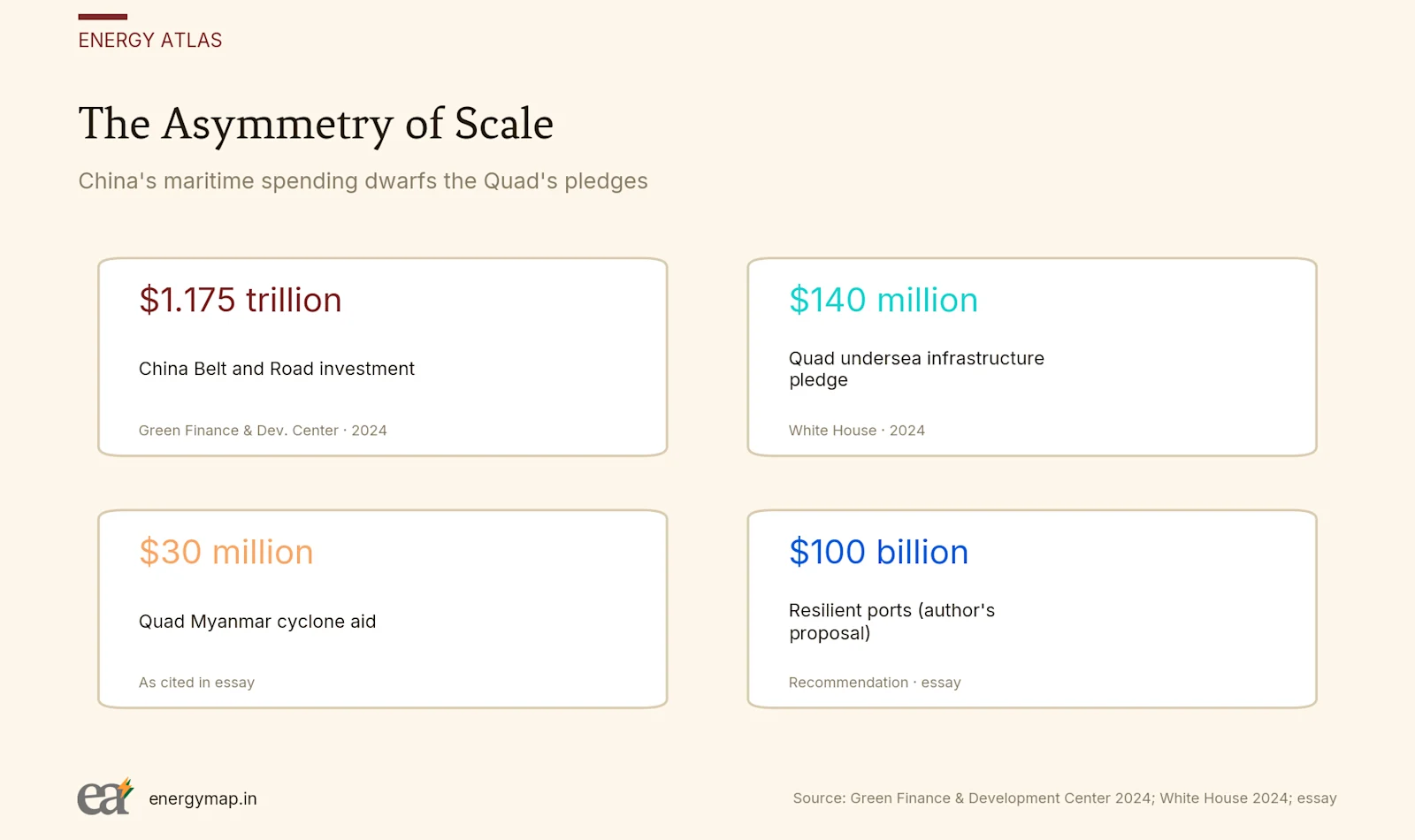
The Baltic incident points to a strategic truth too often ignored: maritime competition is no longer solely about fleets and submarines. The real contest runs through the unseen channels of global commerce — cables, pipelines, and nodes buried beneath the sea. The Quad's Wilmington Summit last September, with its $140 million pledge for undersea infrastructure and some promising AI research, sounded impressive in press releases (White House, 2024). But the gap between that ambition and China's hybrid tactics remains vast. Beijing is already years ahead — turning fishing fleets into militias and merchant ships into weapons — while the Quad hesitates over its own organizational chart.
Sea Control or Sea Denial? The Quad's Strategic Paralysis #
Viewed from inside the energy industry, the Quad's central weakness is clear: it cannot decide whether its mission is sea control or sea denial. In trying to hedge, it achieves neither.
Mahan's dictum still holds. Sea control — the ability to deny space to an adversary while keeping it open for oneself — remains the true prize (Mahan, 1890). Yet Quad planners seem captivated by the illusion that submarine-based denial can substitute for control. John Hemmings offers a stark comparison: the Quad today resembles the Triple Entente before 1914 — divided and strategically confused (Hemmings, 2022). History shows how that ended.
In Washington, at least, the problem is acknowledged. Congress passed the Strengthening the Quad Act with overwhelming bipartisan support — 379 votes — calling for a measurable strategy instead of mere promises (U.S. House of Representatives, 2024). One wishes Delhi shared such clarity.
India has a 3,488-kilometer disputed border with China, marked by deadly hand-to-hand clashes at Galwan Valley (Clary, 2025). Its naval doctrine rightly recognizes that military strength determines wartime outcomes. Yet India hesitates to implement even basic security measures for its sea lanes — striking, given how decisively the Indian Navy shaped the 1971 Bangladesh war.
UNCLOS Article 44 guarantees transit passage rights without suspension, a principle China exploits skillfully. Its militia trawlers sail "innocently" while mapping submarine routes, probing reactions, and rehearsing blockades. They operate in a twilight zone — neither clearly civilian nor clearly military — where international law offers no remedy.
Australia's contradictions are its own. It sends over a third of its goods to China while holding only two weeks of refined fuel reserves domestically (Australian Bureau of Statistics, 2024). The Quad Critical Minerals Initiative, launched in July 2025, aims to build resilience. But without binding commitments, it remains hope dressed as strategy.
The Undersea Infrastructure Crisis #
Few threats are more underappreciated than the systematic assault on undersea infrastructure. Since 2022, the Baltic alone has seen ten damaged cables — seven incidents in just three months. Recall the Nord Stream explosions: those pipelines were not merely gas conduits; they underpinned Europe's entire energy system.
The Indo-Pacific is primed to relive the Baltic's nightmare. Consider the Balticconnector "accident": Finnish investigators found sensor equipment and Russian-language laptops aboard the Chinese vessel. That was not coincidence — it was reconnaissance disguised as misfortune.
The irony is striking. Malabar 2024 featured eight warships, twelve aircraft, and advanced anti-submarine warfare drills — formidable assets, no doubt (Indo-Pacific Defense Forum, 2024). But while the Quad displays its strength above the surface, Beijing targets its vulnerabilities below.
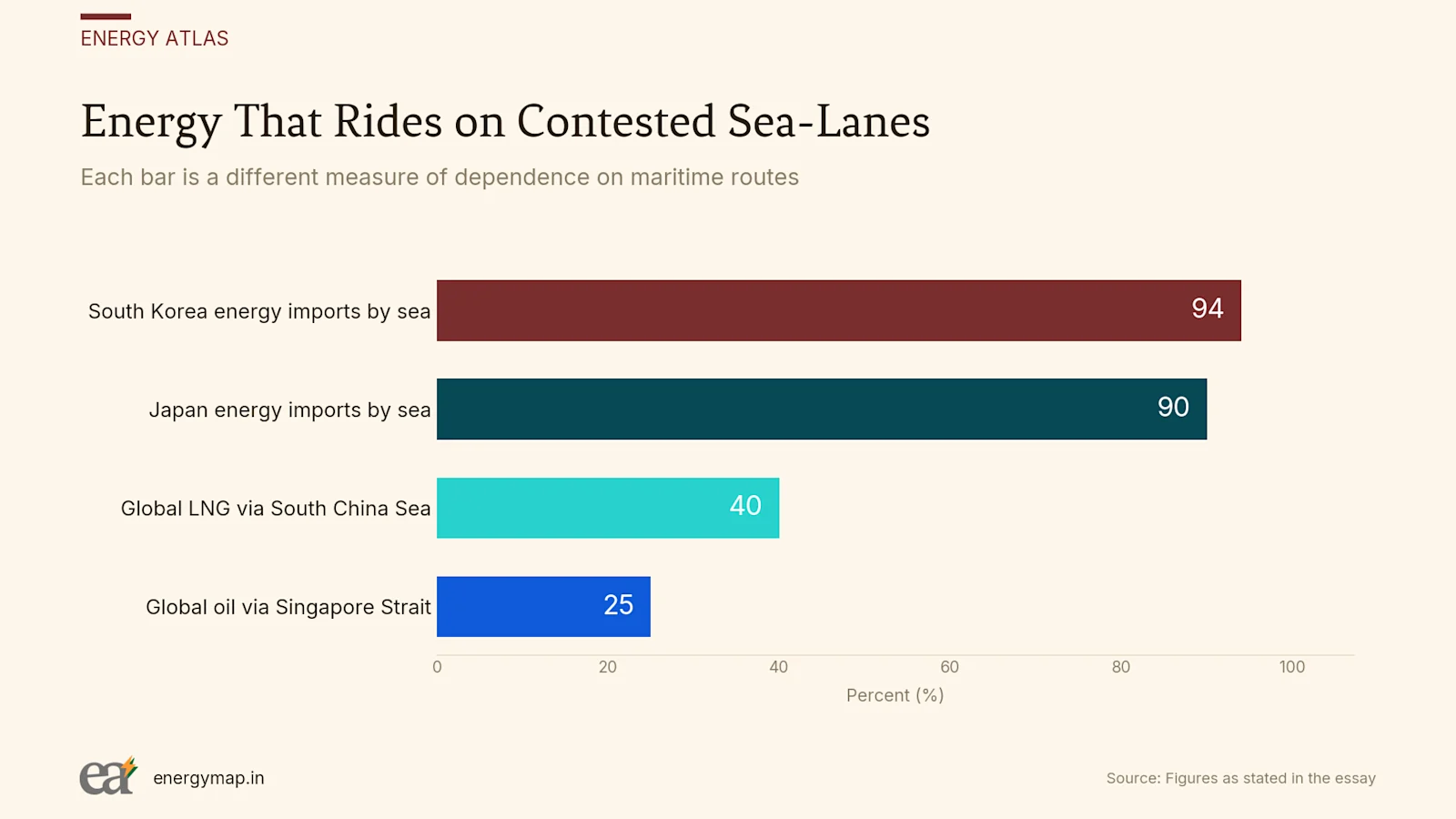
Geography amplifies the risk. Forty percent of global LNG passes through the South China Sea. Japan imports 90 percent of its energy by sea; South Korea, 94 percent. Every cable and pipeline is a vulnerability waiting to be tested. Australia knows this well — seven years of freedom-of-navigation operations did not slow Chinese island-building in contested waters (Klein & Rapp-Hooper, 2023).
Unlike NATO, which has already stood up a Baltic command with drones and satellite surveillance to guard against cable sabotage, the Quad lacks even a draft protocol. Four members, four systems of classification, four rules of engagement — no unity, and therefore no deterrence.
The Maritime Militia: Civilian Combat Power #
Here China demonstrates ingenuity bordering on brilliance. Its so-called fishing fleet — 70,000 vessels equipped with BeiDou navigation — is focused less on catching fish than on gathering intelligence. They practice "rafting," clustering into floating barricades. They drag anchors in "accidents" that sever cables. They escort commercial convoys while harassing rivals. They deploy aging "shadow fleet" tankers with opaque ownership to evade sanctions while collecting intelligence. Each move is calibrated just below the threshold that might trigger a military response (Erickson & Kennedy, 2016).
International law lags behind. The UN Convention on the Law of the Sea (UNCLOS) was never meant to accommodate civilian vessels acting as quasi-naval auxiliaries. The 1988 Convention for the Suppression of Unlawful Acts Against the Safety of Maritime Navigation (SUA) explicitly limits its scope to interstate voyages. And the Proliferation Security Initiative requires the consent of flag states — consent Beijing consistently declines.
Economic Asymmetry: Coercion Without Ships #
China has poured $1.175 trillion into the Belt and Road, turning ports into surveillance hubs (Green Finance & Development Center, 2024). The Quad, by contrast, promotes cable projects worth a few hundred million and Australia's symbolic clean-energy grants. The scale is not comparable.
But Beijing's most effective weapon is not money — it's dependency. When Canberra demanded a COVID-19 investigation, China did not send warships. It cut off wine and barley imports, costing billions overnight. That is modern sea power: coercion without ships.
Semiconductors offer false reassurance. Yes, democratic nations dominate chip production — but chips cannot fuel a tanker or light a city. Rare earths can. When Beijing restricted exports in April 2025, European factories shut within weeks. The Quad's promised Minerals Partnership will not deliver until 2035 — by which time China will likely control the EV supply chain.
Energy markets could have handed the Quad a trump card. The United States now leads global LNG exports; Australia follows. Japan has world-class regasification. India's demand surges by the day. Together they could shape an energy order to rival Beijing's. Instead, LNG is increasingly diverted to Chinese ports — a shift that has raised real concern among policymakers and underscores the urgent need for a more proactive strategy.
ASEAN's Strategic Opportunity #
Southeast Asian countries are balancing economic interests against security concerns. They grasp a truth the Quad would do well to absorb: maritime power and prosperity are tightly linked. Cooperation on that front strengthens both economic stability and strategic security.
Surveys suggest rising support — 41 percent favorable views of the Quad, up from 31 percent in 2023 (Stromseth, 2024). Yet Malaysia's prime minister, Anwar, warns against "provocative frameworks" (Deligöz, 2024). His country needs Western technology to exploit offshore gas but Chinese markets to sell it. How is Kuala Lumpur to choose?
AUKUS, meanwhile, confuses more than it clarifies. Nuclear submarines excel at sea denial but do nothing to protect commercial traffic or cables at depth. ASEAN leaders read the signal correctly: great-power rivalry comes first, their maritime security a distant second. Humanitarian gestures — like $30 million in Quad aid for Myanmar's cyclone recovery — help, but they cannot compete with China's billion-dollar port projects. Concrete outweighs goodwill.
The Five Power Defence Arrangements have endured since 1971 because their mission was narrow and achievable: keeping the Singapore Strait open, a chokepoint for 25 percent of global oil. SEATO, by contrast, collapsed because it ignored maritime fundamentals.
NATO offers the most relevant template. While Article 5 attracts the attention, NATO's genuine strength lies in standardized communications, shared surveillance, and interoperable procedures. Without those foundations, the Quad risks resembling SEATO — impressive rhetoric, little substance.
Beijing's Long Game #
China is not reacting. It is executing a deliberate, decades-long maritime strategy (Shah, 2017). Through the Malacca Strait, its convoys already integrate civilian, military, and coast-guard assets into seamless formations. They are not merely protecting commerce; they are normalizing omnipresent control.
The Global Security Initiative offers allies security ties without the headaches of sovereignty. The SCO builds land routes to undercut sea dependence. RCEP embeds port-access clauses with economic teeth. And the maritime militia remains the ace in the hole — too civilian to be military, too military to be civilian.
Three Things the Quad Must Do #
Each month, Chinese influence tightens around key chokepoints. Each quarter, another "accident." Each year, the costs of confrontation rise. To counter this, the Quad should:
Build Maritime Domain Awareness. Permanent Quad operations centers, seabed sensors, spoofing detection, and forensic teams on standby (Grossman, 2022).
Establish Undersea Security. Dedicated protection missions, preemptive interdictions, and rapid repair-and-attribution mechanisms.
Adopt a Graduated Response. Automatic escalation triggers that replace committee paralysis with real deterrence.
These military steps need economic and legal muscle behind them: $100 billion for resilient ports, differential shipping insurance, shared fuel reserves, and alternative chokepoints — plus new vessel categories, universal jurisdiction for infrastructure sabotage, and sanctions on shadow fleets.
I once thought the Quad's forays into climate and health diluted its focus. I now think otherwise. Securing isotope supply chains, building hydrogen corridors, monitoring fishing from space — these are not side projects. They are strategic infrastructure as vital as warships (Wilson Center, 2024). When cyclones hit, Quad relief sustained supply chains where China merely promised. People remember who kept the lights on.
The Quad has the attributes Mahan identified — industrial power, geography, tradition (Rajesh, 2020). But unless the 2025 India Summit produces binding mechanisms, the window may close. By 2030, we could see Chinese trawlers loitering above every cable, "accidents" as common as storms, and Quad communiqués as empty as SEATO's final declarations. Admirals in Yokosuka will track militia fleets, understanding perfectly — but comprehension without action is impotence. Control of the sea no longer lies in grand fleets. It lies in cables, insurance, and pipelines.
Sources #
Australian Bureau of Statistics. (2024). International Trade in Goods and Services, Australia.
Clary, C. (2025). US–India Relations in the Trump–Modi Era: Convergence alongside Strategic Autonomy. Asian Survey, 65(4–5), 579–604.
Curtis, L., Fitt, J., & Adams, A. (2022). Operationalizing the Quad. Center for a New American Security.
Deligöz, H. (2025). Malaysia's South China Sea Policy: The Role of Small States in Peacebuilding? In Geopolitics of the South China Sea: Power Struggle in Asia (pp. 109–140). IGI Global Scientific Publishing.
Erickson, A. S., & Kennedy, C. M. (2016). China's Maritime Militia. CNA Corporation, 7, 1–28.
Green Finance & Development Center. (2024). China Belt and Road Initiative (BRI) Investment Report 2024.
Grossman, D. (2021). Toward an Improved Understanding of the US Indo-Pacific Strategy. In Maritime Issues and Regional Order in the Indo-Pacific (pp. 187–209). Springer International Publishing.
Hemmings, J. (2022). Should the Quad Become a Formal Alliance? Journal of Indo-Pacific Affairs, 5(2), 65–77.
Klein, A., & Rapp-Hooper, M. (2023). Freedom of Navigation Operations in the South China Sea: What to Watch For. Lawfare.
Mahan, A. T. (1890). The Influence of Seapower on History. Project Gutenberg.
Rajesh, G. K. (2020). Contest for the Indo-Pacific: Why China Won't Map the Future. Artha Journal of Social Sciences, 19(4), 85–90.
Shah, D. P. (2017). China's Maritime Security Strategy: An Assessment of the White Paper on Asia-Pacific Security Cooperation. Maritime Affairs: Journal of the National Maritime Foundation of India, 13(1), 1–13.
Singh, T. P., Singh, L. J., & Singh, N. K. (2024). India and QUAD in the Indo-Pacific Region: A Perspective on Maritime Security. Jadavpur Journal of International Relations, 28(2), 148–165.
Stromseth, J. (2021). ASEAN and the Quad: Strategic Impasse or Avenue for Cooperation? Brookings Institution Policy Commons.
U.S. House of Representatives. (2024). H.R. 5375 — Strengthening the Quad Act. 118th Congress, 2nd Session.
White House. (2024). Fact Sheet: 2024 Quad Leaders' Summit.