
Little Sparta's Dilemma: Security, Oil, and the Criminalisation of Dissent in the UAE
The UAE built one of the Arab world's most effective counter-terrorism machines, then aimed it at its own citizens. Federal Law No. 7 of 2014 recast peaceful activists as terrorists, while oil, finance, and Western silence keep the system intact.
By Sayonsom Chanda
The United Arab Emirates has built one of the most effective counter-terrorism machines in the Arab world, and then turned it on its own citizens. Federal Law No. 7 of 2014 and the decrees around it equate peaceful activism with violent extremism, buying short-term stability at the cost of long-term legitimacy. This is the paradox at the heart of Emirati security: the system may stop the lone wolf, but it also imprisons the critic.
The mall attack that shattered an image #
A veiled woman entered Abu Dhabi's Boutik Mall on December 1, 2014, carrying a gun along with her groceries. Minutes later, Ibolya Ryan, a Hungarian-American kindergarten teacher, lay dead in a shopping-centre bathroom. The killer, an Emirati national, had also planned a second attack: a homemade bomb at an Arab-American doctor's home. This lone-wolf assault shattered the Emirates' carefully maintained image of absolute security.
The timing mattered. The attack came just months after Federal Law No. 7 of 2014 on Combating Terrorism Crimes took effect (Gibbs, 2017), a law written amid deeper anxieties. As ISIS proclaimed its caliphate and the Muslim Brotherhood's fortunes shifted across the Arab world, Emirati rulers saw threats everywhere. The statute they wrote would target peaceful critics as often as violent extremists.
The Emirates occupies a singular position: millions of expatriate workers fuel its economy while regional chaos, from Yemen's civil war to Iran's ambitions, keeps tensions alive at its borders. That pressure shapes a counter-terrorism strategy built on a single move: conflate any and all dissent with extremism. The conflation defines not just domestic governance but the UAE's relationship with Western allies, who grant remarkable latitude to a partner in the war on terror even as it imprisons human rights defenders under terrorism statutes (Hall & Debre, 2025).
The threat landscape: real dangers and constructed enemies #
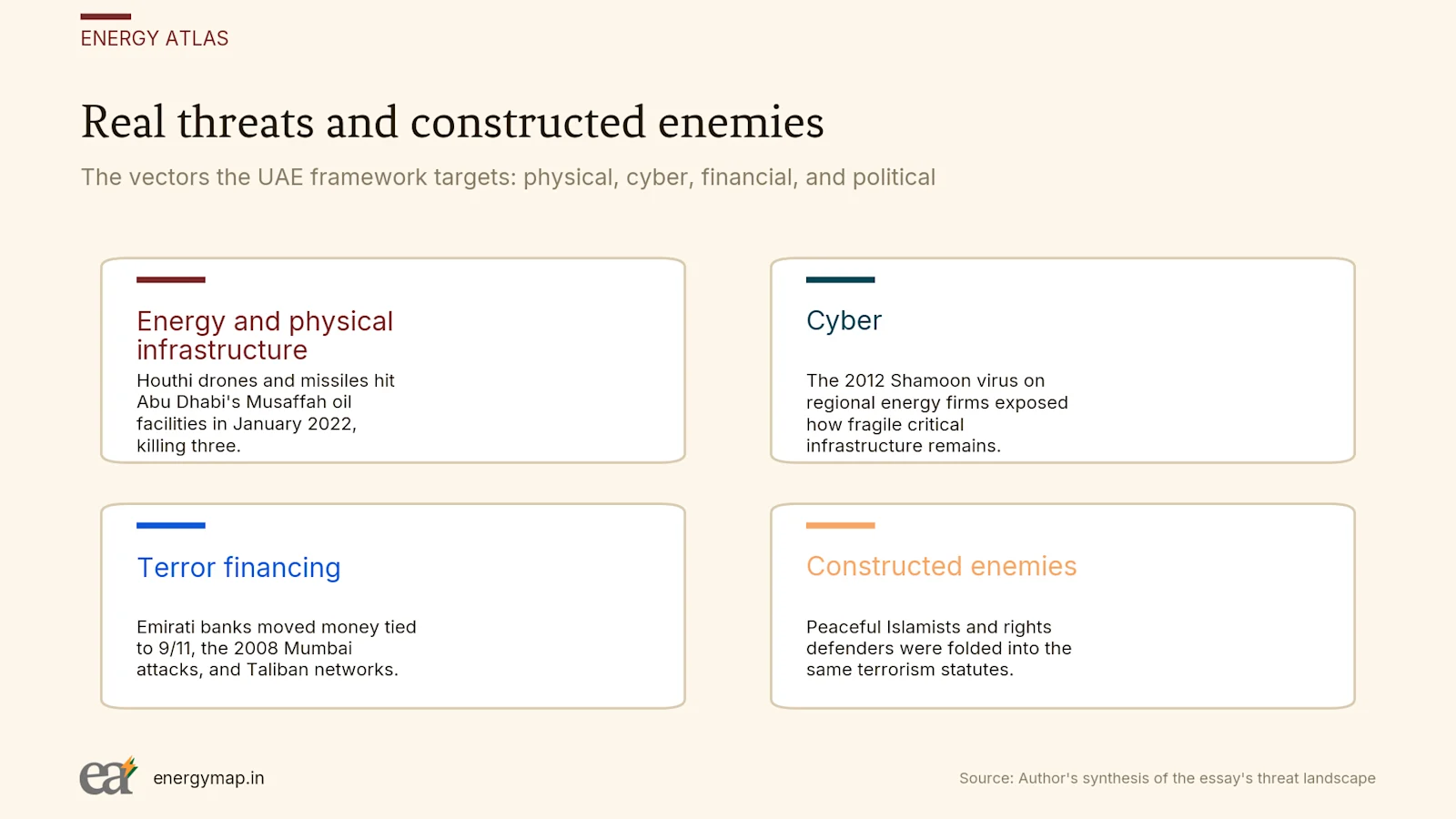
The UAE's terrorism problem runs deeper than many realise. The 9/11 Commission found that over half the September 11 hijackers departed from Dubai International Airport, carrying money from financiers who laundered funds through Emirati banks. Two decades on, those revelations still drive the surveillance apparatus that defines the counter-terrorism framework.
January 2022 exposed newer vulnerabilities. Houthi missiles and drones struck Abu Dhabi's industrial Musaffah area, killing three and wounding six. The target was oil infrastructure, the economy's lifeblood. The strike underscored the real challenge facing a nation projecting military power into Yemen, Libya, and Somalia while promising tranquillity at home.
The list of groups that have targeted or operated within the UAE is long. Al-Qaeda in the Arabian Peninsula treats Gulf monarchies as Western puppets deserving destruction. Abd al-Rahim al-Nashiri, mastermind of the USS Cole bombing, operated from the UAE until his 2002 capture, proof that the country served as both target and transit point for jihadist networks.
ISIS posed a different problem. Where Al-Qaeda focused on the "far enemy," the Islamic State sought immediate territorial control, directly challenging the legitimacy of sitting governments. Its social-media recruitment particularly worried authorities governing a young, connected population exposed to radical content online. Officials conceded that terrorism required more than military force, yet their solution proved just as troubling.
From jihadists to the Muslim Brotherhood #
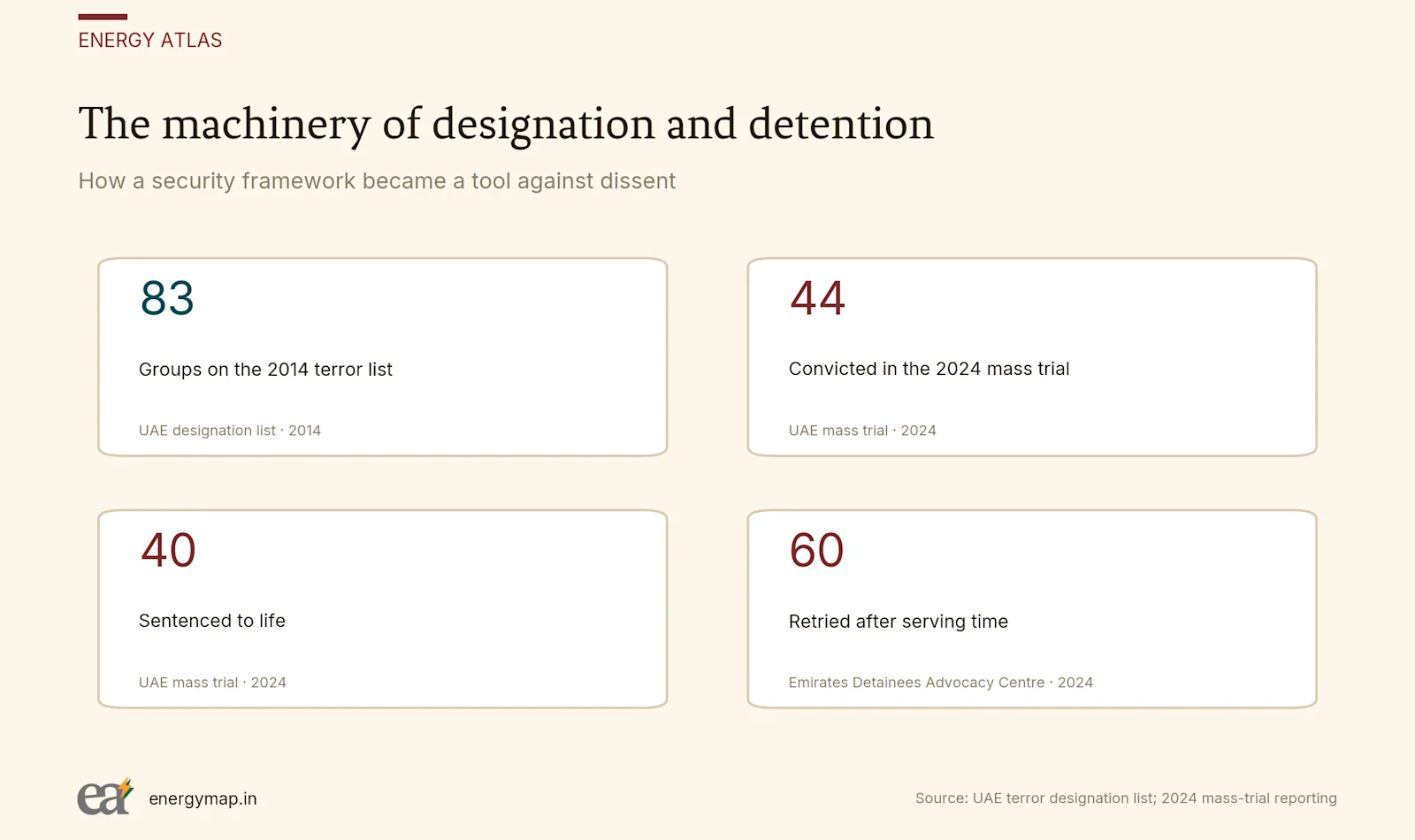
The UAE's designation list tells the story. The November 2014 roster named 83 organisations: predictably Al-Qaeda, the Taliban, and ISIS, but also the Muslim Brotherhood and its local affiliate, al-Islah. Equating political Islam with terrorism exposes a deeper fear: the Brotherhood's vision of Islamic governance questions the legitimacy of hereditary monarchy.
The Brotherhood has pursued power through elections and social services, not violence. Its brief Egyptian ascendancy after 2011 terrified Gulf rulers who saw a template for their own opposition. The billions the UAE poured into Egypt's 2013 military coup showed how counter-terrorism had merged with counter-revolution (Ferguson, 2016).
The reach extended abroad. The UAE labelled the Council on American-Islamic Relations and the Muslim Association of Britain as terrorist organisations, groups that operate legally in the US, UK, and EU. Washington and Oslo rejected the labels outright. As the Emirati human rights activist Ahmed Mansoor put it, "Many of the names on this list are included purely for political reasons. Such a designation only serves to bolster the perception of real terrorists like ISIS."
Financial networks and cyber threats #
Money moves through Dubai like water through sand, sometimes vanishing into dark channels. A 2008 UN investigation found that UAE banks had processed transactions funding Lashkar-e-Taiba's Mumbai attacks. Emirates-based businesses have channelled money to the Taliban and the Haqqani network. The city-state's status as a financial hub creates vulnerabilities that ordinary security measures cannot reach.
Cyber threats multiply the concern. The UAE's futures, smart cities, tech hubs, artificial intelligence, all create new attack surfaces. The 2012 Shamoon virus, which struck regional energy companies without directly hitting the UAE, showed how exposed critical infrastructure is to cyber terrorism. The response was sweeping cybercrime legislation that, critics argue, criminalises legitimate online expression as readily as it protects power grids (Hakmeh, 2018).
The legal architecture: Federal Law No. 7 and its instruments #
Defining terrorism: the power of ambiguity #
Federal Law No. 7's language reveals its purpose. A "terrorist consequence" includes "terrifying people" but also "any breach to the security of the local or international community" or "any attempt to influence the work of public authorities." By that definition, a protest sign becomes a weapon and a critical tweet becomes incitement (Josua, 2021).
Article 1 defines "antagonising the state" as terrorism without saying what antagonism means. Under such vague wording, almost any political expression risks charges carrying life imprisonment or death. The law's 70 articles make threatening state security or the royal family, enticing anyone to join organisations, or financing suspicious elements all acts of terrorism. Martin Scheinin, the UN's first special rapporteur on counter-terrorism, warned against exactly this: "The adoption of overly broad definitions carries the potential for deliberate misuse of the term."
The complementary web #
The framework extends through a web of laws. Federal Decree-Law No. 20 of 2018 built sophisticated financial-tracking machinery, creating a Financial Intelligence Unit and demanding extensive reporting; crucially, it declares that "the penal claim shall not lapse by limitation," granting prosecutors permanent power over terrorism cases. Federal Law No. 34 on Combating Discrimination, Hatred, and Extremism widened the definitions further, routing those who "insult religions" or "spread hatred" into Munasaha deradicalisation centres that work directly with prosecutors, facilities that human rights groups document as tools for indefinite political detention. The Cybercrime Law criminalises online expression "propagating or favouring" terrorism, with a minimum of one year in prison and a 100,000-dirham fine; facilitating online communication with terrorist leaders brings 10 to 25 years. Together, these instruments effectively ban most forms of online political speech.
Enforcement: a closed loop #
The State Security Directorate in Abu Dhabi and Dubai State Security run counter-terrorism operations, with local police as first responders, a dual system that ensures thorough surveillance nationwide. The forces are well trained and well equipped.
The judicial process is another matter. Special security courts lack independence; the UN Special Rapporteur on Judicial Independence described the system as "under the de facto control of the executive branch." The fusion of security services, prosecution, and judiciary creates a closed loop in which acquittals almost never happen.
The 2024 mass trial laid the flaws bare: limited access to case materials, inadequate legal representation, and judges manipulating witnesses. Defendants reported prolonged solitary confinement in inhumane conditions, and evidence extracted through days of torture entered the record as primary evidence (MENA Rights Group, 2025). The Emirates Detainees Advocacy Centre reported that 60 defendants faced retrial for crimes they had already served time for, a plain violation of double jeopardy.
Strategic rationale: between security and control #
The Arab Spring rewired Emirati threat perception overnight (Battaloglu & Farasin, 2017). Ben Ali fled Tunisia. Mubarak fell in Egypt. Gaddafi died in Libya. Each collapse advertised authoritarian fragility (Josua & Edel, 2021). The Brotherhood's Egyptian electoral victory rattled UAE leaders most, an alternative source of legitimacy that could challenge the monarchy itself.
Federal Law No. 7 was enacted in August 2014, thirteen months after Egypt's military removed President Morsi. The timing was not coincidental. Regional instability fused with the rise of the Islamic State to create what authorities called an emergency, though critics argued the real emergency was political Islam's electoral potential.
The pattern repeats abroad. UAE operations in Libya, Yemen, and Somalia supposedly target terrorism, yet in Yemen Emirati forces fight AQAP and the Houthis while also striking Islah party members who belong to the internationally recognised government. "Counter-terrorism" turns out to cover a broader goal: preventing Islamist governance anywhere in the neighbourhood.
The soft-power dimension #
Coercion alone does not explain the strategy. Hedayah, established in 2012 with the Global Counter-Terrorism Forum, positioned Abu Dhabi as a thought leader in countering violent extremism. The Sawab Centre, launched in Washington in 2015, counters ISIS propaganda online; nearly 50 campaigns have generated over a billion impressions, with 60% of followers in the vulnerable 13-34 bracket. Such initiatives present Emirati counter-terrorism as sophisticated and modern rather than crude repression.
The tolerance agenda goes further still. A Minister of Tolerance was appointed in 2016. Pope Francis visited in 2019. The Abrahamic Family House places a mosque, church, and synagogue side by side; the Human Fraternity Document was signed by the Pope and Al-Azhar's Grand Imam. Each gesture projects religious moderation while providing cover for crushing political Islamists, defending "true" Islam against extremist distortion.
Economic security imperatives #
Expatriates make up nearly 90% of the UAE's population. Foreign investment, tourism, and hub status all depend on stability, and a single major attack could trigger capital flight and destroy the safe-haven image. That vulnerability explains the emphasis on financial control. Financial Action Task Force scrutiny produced genuine improvements in anti-money-laundering systems, but the same controls enable comprehensive transaction surveillance, letting authorities monitor and pressure dissidents through their finances (Jones, 2022).
Does it work? Successes and their price #
By narrow metrics, the framework performs. Few attacks have occurred since 2014; the 2022 Houthi strikes are nearly the only ones. Surveillance and international intelligence-sharing have foiled numerous plots. American officers nicknamed the UAE "Little Sparta" for its battlefield effectiveness, not least in Yemen, where Emirati forces freed Mukalla from AQAP control. Financial controls show measurable progress too: the Terrorist Financing Targeting Centre convened nearly a dozen known executive meetings and workshops in 2023, and the UAE added Houthi backers to its sanctions lists.
The human rights crisis #
The security gains carried an extraordinary price. The 2024 trials convicted 44 defendants, 40 of them sentenced to life, for founding the Justice and Dignity Committee, a peaceful advocacy group. Sixty defendants had already served time for identical charges dating to 2013. Women Journalists Without Chains documented how vague provisions enable prosecutorial overreach: journalists, academics, and rights defenders face terrorism charges for ordinary professional work. Independent civil society has essentially vanished, most of it now operating from exile.
International cost, and the West's silence #
During COP28 in Dubai, UN Special Rapporteur Mary Lawlor condemned fresh terrorism trials against defenders due for release as "a shameful act" undermining the UAE's leadership claims. The Universal Periodic Review produced eight recommendations to stop using counter-terrorism law against human rights defenders.
Yet the costs stay minimal. Strategic weight, from military partnership to energy supplies and regional investment, insulates the UAE from pressure. Western governments that condemn abuses elsewhere stay silent here. The double standard corrodes global counter-terrorism credibility and helps abusive practices spread under the cover of security (Ní Aoláin, 2024).
What reform would require #
Legitimate security is possible, but it would demand real change:
Narrow the definition of terrorism to actual violence or credible threats, and delete vague constructs like "antagonising the state." Scheinin's standard, acts causing or intending death or serious injury to compel a government, should guide the revision.
Make the security courts independent. Defendants need unrestricted legal access, full evidence disclosure, and civilian appeals; torture-tainted confessions must be inadmissible, with consequences for the officials who extract them.
Put the rehabilitation centres under law. Indefinite administrative detention reviewed only quarterly should carry clear time limits and judicial oversight, or be abolished.
Protect civil society. Designating human rights organisations as terrorists undermines genuine counter-terrorism while closing the last peaceful channels for dissent (Human Rights Watch, 2025). A vibrant civil society is itself an early-warning system for real radicalisation.
Give international oversight teeth. Ratifying the Optional Protocol to the UN Convention Against Torture would open detention facilities to monitoring; regular rapporteur visits and genuine engagement with their findings would signal real commitment.
Conclusion: the cost of absolute security #
The UAE's framework shows how security measures born of an authoritarian mindset end up manufacturing the very instability they claim to prevent. Conflating dissent with extremism closes the channels for peaceful expression and risks driving grievances underground, where they can turn genuinely radical. The 2024 mass trials, targeting people already imprisoned for more than a decade, reveal a system that perpetuates security problems rather than solving them.
The Shah's Iran, Mubarak's Egypt, and Ben Ali's Tunisia all built sprawling security states that criminalised dissent under one justification or another. It is not hard to predict where the UAE's version leads: short-term stability, long-term fragility. And as long as the West looks away, prioritising commercial and strategic interests over human rights, Abu Dhabi has no incentive to reform.
The UAE faces real threats that demand serious answers. The question is not whether to build strong counter-terrorism measures, but whether security can coexist with human dignity and political diversity. The current framework's answer, that any dissent threatens the state's existence, is neither sustainable nor justified.
One teacher died in the December 2014 mall attack. The laws passed since were meant to prevent the next killing; they have also imprisoned hundreds of activists, professors, and ordinary citizens who dared suggest their country might choose differently. The state calls them terrorists. Their families call them missing.
So which really endangers the UAE: the lone wolf with a knife, or the system that turns every critic into an enemy of the state? Abu Dhabi will eventually have to choose between security built on some measure of trust and the paranoid stability of the perpetual crackdown.
Sources #
Battaloglu, C., & Farasin, F. (2017). From democratization to securitization: Post-Arab Spring political order in the Middle East. Digest of Middle East Studies, 26(2), 299–319.
Ferguson, D. (2016). Silencing the Arab Spring with co-opted counterterrorism. Berkeley Journal of Middle Eastern & Islamic Law, 7(1), 1–33.
Gibbs, T. (2017). An analysis of the effectiveness of anti-money laundering and counter-terrorist funding legislation and its administration in the UAE.
Hakmeh, J. (2018). Cybercrime legislation in the GCC countries: Fit for purpose? [Research paper]. London: Chatham House (Royal Institute of International Affairs).
Hall, S., & Debre, M. (2025). Developing best practices "against terrorists who protest": Regional organisations as learning clubs for autocracies. Contemporary Security Policy (advance online publication).
Human Rights Watch. (2025). UAE: Dissidents, relatives designated 'terrorists': Individuals, companies targeted in sweeping reprisal.
Jones, M. O. (2022). Digital authoritarianism in the Middle East: Deception, disinformation and social media. Oxford University Press.
Josua, M. (2021). What drives diffusion? Anti-terrorism legislation in the Arab Middle East and North Africa. Journal of Global Security Studies, 6(3), 1–38.
Josua, M., & Edel, M. (2021). The Arab uprisings and the return of repression. Mediterranean Politics, 26(5), 586–611.
MENA Rights Group. (2025). Silencing dissent in the name of fighting terrorism: Administrative measures as a tool of repression in the MENA [Briefing paper]. Geneva: MENA Rights Group.
Ní Aoláin, F. (2024). The rise of counter-terrorism and the demise of human rights. Emory International Law Review, 39(1), 1–22.