

Buying power without a modelling desk
One of our clients, an Indian textile group is buying a flat block through open access. A fixed rule requiring no forecasting and no analyst moves its average energy cost by roughly a quarter.
A buyer with no analyst #
I want to work through a case that describes a large number of Indian electricity buyers. The company below is composed rather than real, and every number attached to it comes from measured market data.
Consider a textile processing group in Tamil Nadu running three units on a combined load of about ten megawatts, drawing round the clock across two shifts and a weekend maintenance window. Electricity is among its three largest costs. It has moved to open access to reduce that cost, and it buys a flat block through a trader who quotes against the exchange.
It employs no one whose job is to analyse electricity. The finance head reviews the bill, the plant head manages the load, and neither of them has an hourly price series or the means to interpret one. When the trader proposes a contract structure, the company has no independent basis on which to evaluate it.
This is the ordinary condition of the Indian commercial and industrial buyer. It is not a small segment.
What the flat block costs #
The company buys the same quantity in every hour, because that is the simplest thing to buy and because its load is genuinely flat.
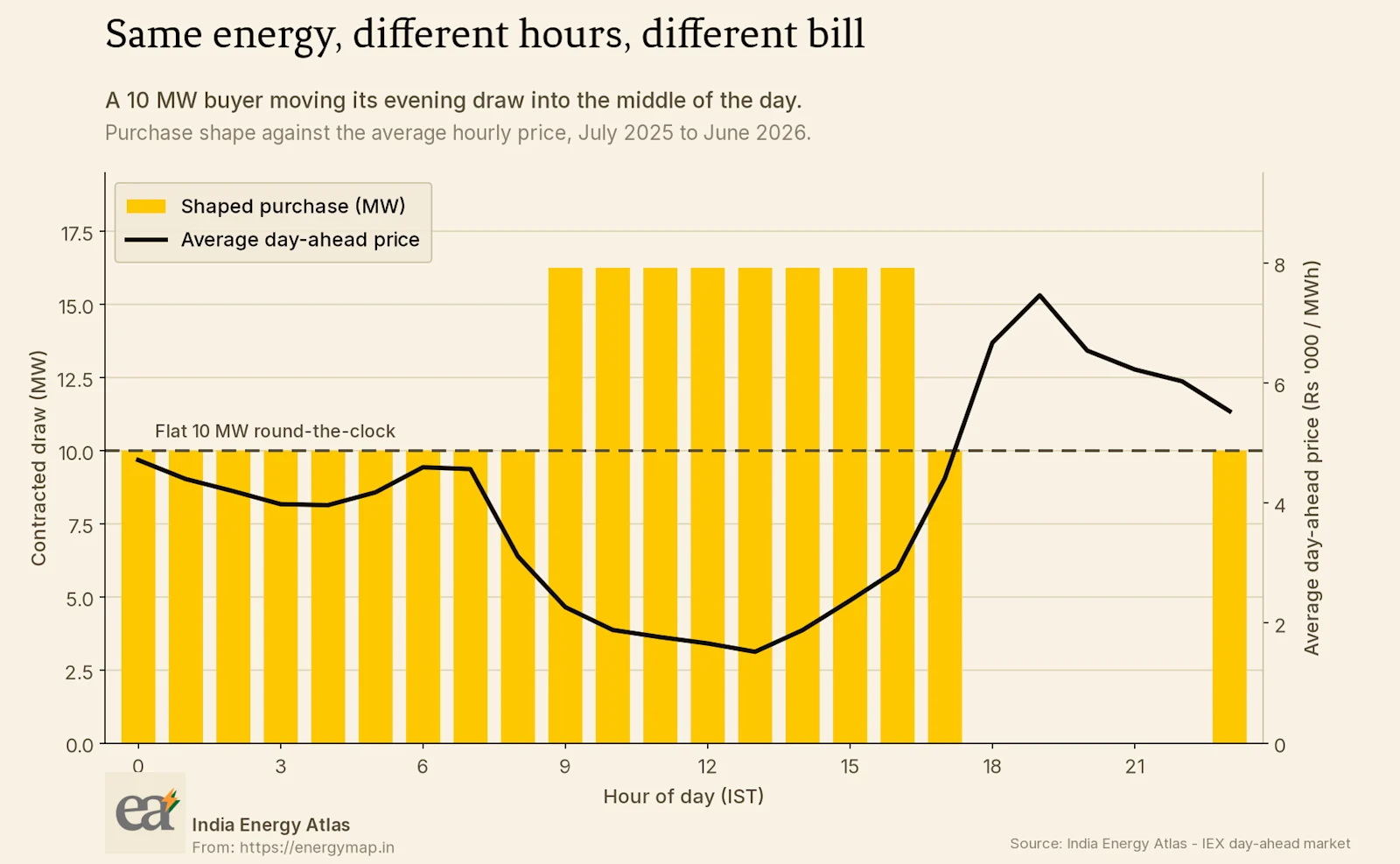
The dashed line is the flat position. The dark line is the average day-ahead price by hour over the past year. The company buys the same amount of electricity in the cheapest hour of the day and in the most expensive one, and the gap between those hours is now very wide.
What a rule the plant head could implement is worth #
I deliberately avoided constructing an optimisation, because a buyer with no analyst cannot run one and would not trust the output. Instead I applied a fixed rule that requires no forecasting and no daily decisions.
The rule is to buy nothing during the evening block and to make up the same quantity of energy during the middle of the day. Total annual consumption is unchanged to the megawatt-hour. Only the hours change.
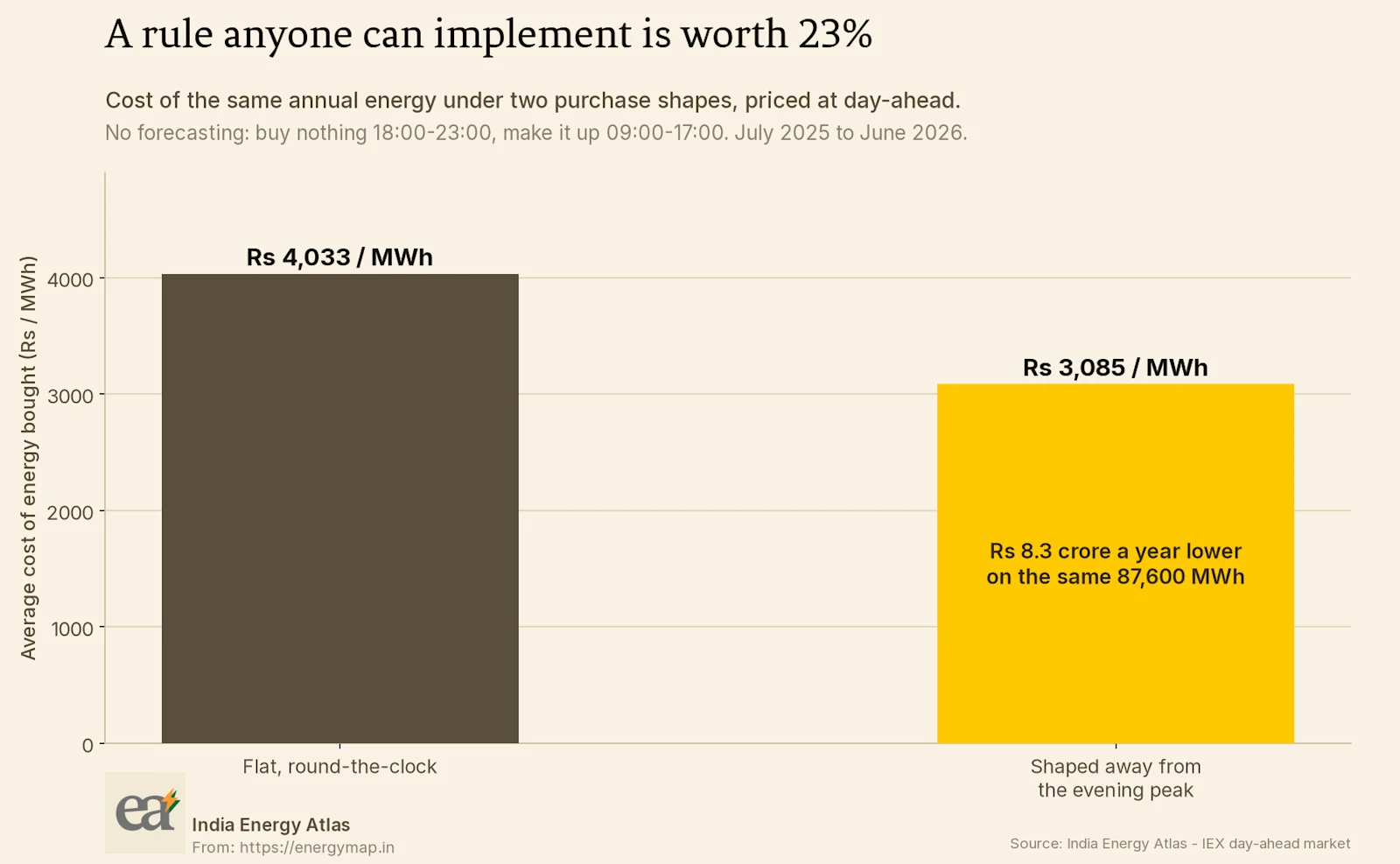
The saving is large enough to change the economics of the plant. It comes with an obvious operational cost, which is that the company has to move production out of the evening, and for a textile processing operation with continuous processes that is a real constraint rather than a trivial one. Some of that shift can be absorbed by rescheduling shifts. Some of it would need thermal buffering or storage, and at that point the saving becomes the revenue line in an investment case.
The question the company could not previously ask is what its evening consumption actually costs. Once that number exists, the investment case writes itself.
What the company still cannot do #
I want to be careful not to overclaim what a single analysis delivers.
The exhibit above prices energy at the day-ahead clearing price. A real open access buyer also pays transmission charges, wheeling charges, cross-subsidy surcharge and losses, and several of these vary by state and by voltage level. The saving on the delivered cost will be smaller than the saving on the energy component. I do not know by how much for this hypothetical company, because it depends on the state's open access order and on the specific connection.
The analysis also assumes the company can buy at the clearing price, which a smaller buyer purchasing through an intermediary generally cannot. The intermediary's margin will absorb part of the gain.
One further finding is worth reporting because it cuts against a common assumption. I checked how often the exchange splits into different area prices, which is what would expose a buyer to locational risk. Over the past year the market cleared at a single price across all areas in the overwhelming majority of hours. Location is rarely a risk for this buyer, and in the small number of hours when the market does split, the spread is large. That is a tail risk rather than a routine cost.
The second question the company should ask #
Shifting load is one of two decisions available here, and the company would reach the other one quickly.
Once the value of avoiding the evening block is established, the obvious follow-up is whether to install storage and buy through the evening from a battery charged at midday. That question needs a different calculation, comparing the annual saving against the installed cost, the round-trip efficiency loss, the degradation schedule and the state's rules on whether a behind-the-meter battery can be charged from an open access drawal.
I have not run that calculation here, and I want to be clear that the exhibits above do not answer it. What they do is establish the revenue line that the calculation needs, which is the part the company could not previously produce. The remaining inputs are procurement questions with reasonably well-known answers.
There is a sequencing point worth making. The load-shifting rule requires no capital and can be tested for a month at no risk. The storage investment requires capital and is difficult to reverse. Running the first establishes how much of the theoretical saving survives contact with the plant's actual operating constraints, and that number is the correct input to the second decision. A company that installs storage before testing the shift has committed capital against an untested assumption about its own flexibility.
What this changes about who needs a modelling team #
The traditional answer to this company's problem is that it needs analytical capability it cannot justify hiring. A single analyst costs more than the company currently believes it can save, and the company has no way to test that belief without first hiring the analyst.
The analysis above took a measured price series and a fixed rule. It required no proprietary model, no scenario engine and no specialist. What it required was access to the hourly data in a form the company could use, and a workspace in which to apply a rule to it. That is the gap the Modeler workspace is built to close, and it is a considerably smaller gap than a modelling team.
So what, and for whom #
For a commercial and industrial buyer. Establish what your load costs by hour before negotiating your next contract. If your consumption profile is flat and your supplier's quote is flat, you are paying the average of a distribution that has become extremely wide.
For an open access consultant or trader. Buyers who understand their hourly exposure make better counterparties and larger commitments. The information asymmetry is a smaller business than the one available on the other side of it.
For a state regulator. Open access buyers respond to hourly price signals when they can see them. Making hourly settlement data available to consumers in a usable form is a low-cost demand response intervention. Tamil Nadu, Karnataka and Gujarat each have large open access segments where this would have a measurable effect.
For a storage developer. The evening block avoidance calculation above is the customer's side of a behind-the-meter storage business case, and it can be computed for any prospective customer from public data before the first meeting.
The day-ahead and area price series used here are published through the Atlas data products, and the live market view is maintained at the IEX market page.
Sources & method
IEX day-ahead clearing prices and area prices, India Energy Atlas production series, July 2025 to June 2026, hourly means. The company described is composed rather than real; every price and saving is computed from measured market data on a 10 MW round-the-clock baseline totalling 87,600 MWh a year. The shaped case holds annual energy constant to the megawatt-hour. Costs are the energy component at day-ahead clearing prices and exclude transmission charges, wheeling charges, cross-subsidy surcharge, losses and any intermediary margin. Cover photograph by Lalit Kumar on Unsplash.