
Some Indian states buy most of their power from somewhere else
Two large states meet close to nine tenths of their demand from other states. Whether the corridors can deliver that in the hours it is needed is a study that sits in nobody's remit.
The study that does not get run #
There is a category of analysis that everyone agrees is worth doing and almost nobody commissions. Interstate import dependence sits squarely in it. Each state plans its own supply, each regional load despatch centre manages its own balance, and the question of what happens to a state that imports most of its electricity when the exporting corridor is constrained tends to fall between the two.
I went looking for how large that exposure actually is.
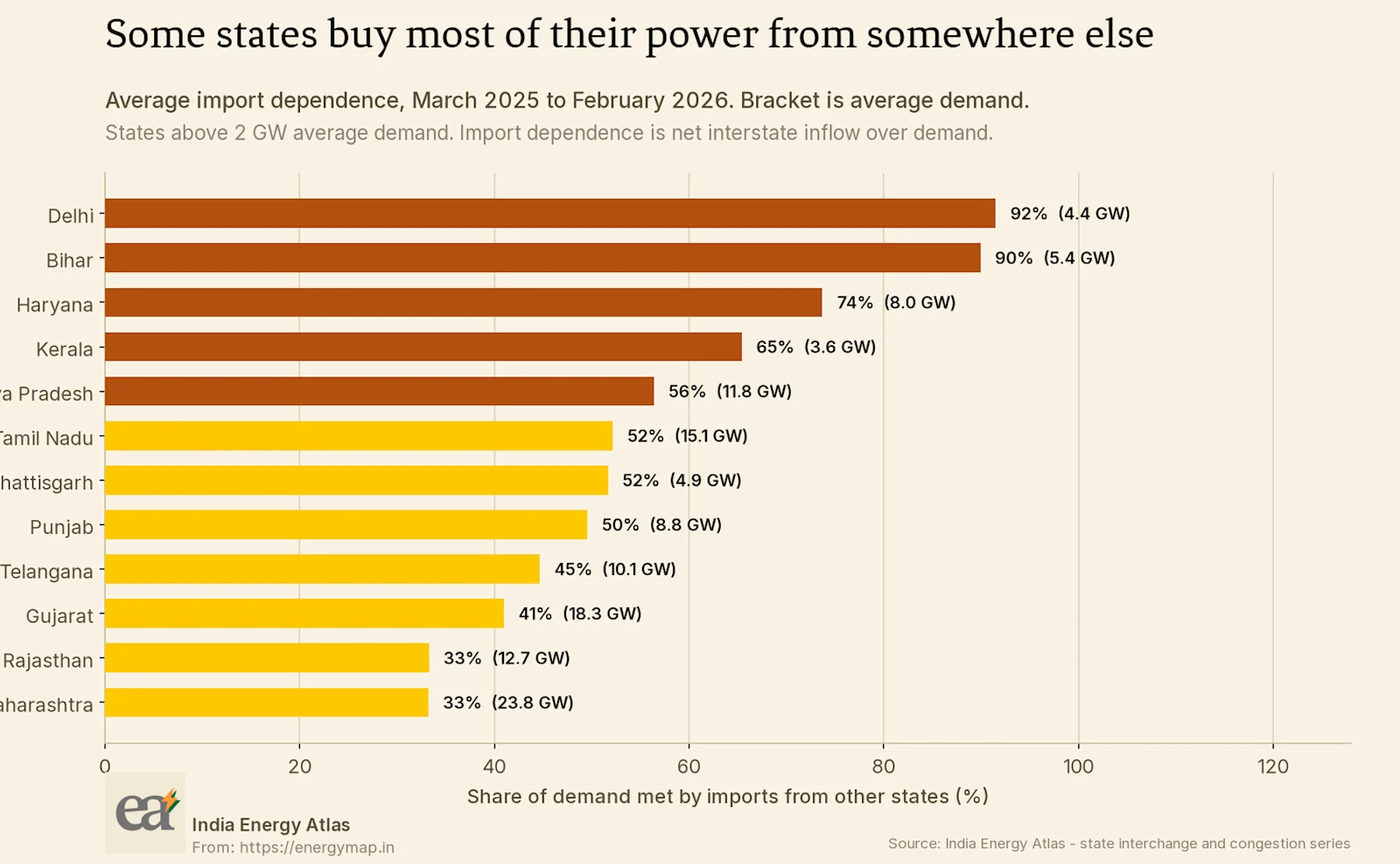
Two states in this sample meet close to nine-tenths of their demand from other states on an average day. Several more sit above half. These are not small systems. The bracketed figures give each state's average demand, and the states at the top of the chart include some of the country's largest load centres.
I should be explicit about the measurement. Import dependence here is net interstate inflow divided by demand, averaged over the year to February 2026. It is a net figure, so a state that imports heavily in some hours and exports in others will show a lower number than its gross exposure. The convention understates rather than overstates the dependence.
What the corridors are doing #
A state's import dependence is only meaningful alongside the corridor that supplies it.
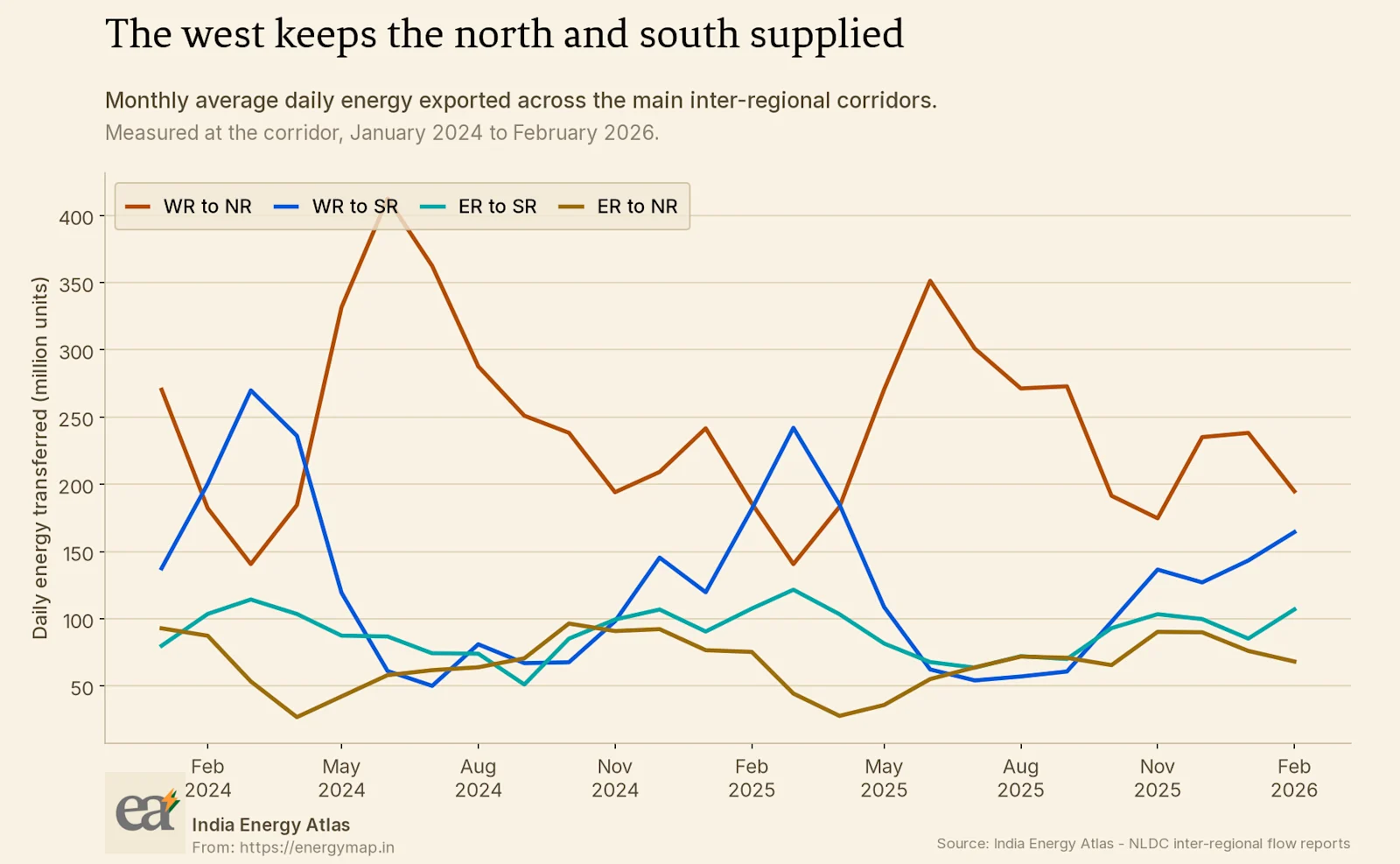
The western region is the source for both the north and the south, and the volume moving from west to south has grown noticeably over the period. That growth is the physical counterpart of the renewable build in Gujarat, Rajasthan and Maharashtra reaching load centres further away.
Corridors of this kind are planned on multi-year horizons and commissioned on schedules that slip. A state whose import dependence is rising faster than the corridor serving it is accumulating a risk that will not appear in its own capacity adequacy calculation, because that calculation typically assumes contracted imports arrive.
Every state plans its own adequacy. The question of whether the wires can deliver what everyone has assumed belongs to no one in particular.
Why the analysis gets skipped #
I do not think this is a failure of competence. It is a consequence of how the work is scoped.
A state utility that runs a resource adequacy study is answering a question about its own contracted capacity. The imports appear in that study as a firm quantity, because they are contractually firm. Whether they are physically deliverable in the specific hours when the state most needs them is a transmission question, and the transmission planner is running a separate study with a different objective function.
Neither study is wrong. The gap between them is where the risk lives, and closing it requires a model that co-optimises generation and transmission across states rather than two models that hand each other assumptions.
That kind of study is expensive in the traditional workflow. It needs a national dataset, a dispatch engine, and enough scenario runs to test corridor outages against tight hours. Most state utilities do not have the modelling capacity to build it, and the ones that do have it are usually committed to the studies the regulator requires.
The cost of not knowing #
I want to avoid overstating this. I have no evidence of a specific event where an import-dependent Indian state failed because a corridor was constrained during a tight hour. Indian grid reliability has improved substantially over the period covered by this data, and the system has absorbed a great deal of renewable growth without the failures some predicted.
What I can say is that the exposure is concentrated, quantifiable, and largely unexamined. When a system carries a risk that nobody has measured, the honest position is that the size of that risk is unknown. I do not know what a simultaneous corridor constraint and demand peak would cost a state importing nine-tenths of its power. Neither, as far as I can tell, does anyone else, because the study that would answer it is not part of anyone's remit.
A note on the measurement #
I found a data quality problem while preparing this piece, and reporting it is part of reporting the result.
The interstate flow series I used carries a sign convention that indicates the direction of net flow. In the window covered by the exhibits above, that convention is internally consistent and the values behave as physical intuition would predict, with structurally deficit states showing sustained imports. In a later month the sign inverts across almost every state simultaneously, which would imply that nearly every state in India became a net exporter at once. No physical arrangement of the grid produces that, so I read it as a pipeline defect, and I have restricted every figure in this piece to the window before it occurs.
I mention this for two reasons. The narrower one is disclosure, since a reader should know which window the numbers come from and why. The broader one is that this is a good illustration of why an unexamined series is a liability. The defect was invisible in a monthly summary and obvious the moment the series was plotted across all states at once. Analysis that nobody runs is also analysis that nobody validates.
So what, and for whom #
For a state utility planner in an import-dependent state. The number worth establishing is how many hours a year your imports and your peak coincide with a constrained corridor. That is a bounded piece of analysis and it changes procurement decisions. Bihar and Delhi carry the largest exposure in this sample, and Haryana and Kerala are not far behind.
For a central transmission planner. Import dependence trends give a demand-side signal for corridor sequencing that peak demand growth alone does not. The states whose dependence is rising fastest are the ones where a delayed corridor has the largest consequence.
For a regulator. Requiring that a state's resource adequacy filing state its import dependence and identify the corridors carrying it would close most of this gap at very low cost. The data to do it already exists in the reporting chain.
For an independent power producer. Persistent import dependence in a large load centre is a siting signal. It identifies places where firm local capacity has value that a national average price does not capture.
The state interchange and congestion series behind these exhibits are published through the Atlas data products, the live corridor view is at the congestion tracker, and the state-level detail for a large exporter such as Gujarat shows the other side of the same flows.
Sources & method
State interchange and congestion series from the India Energy Atlas, averaged over March 2025 to February 2026, restricted to states above 2 GW average demand. Import dependence is net interstate inflow divided by demand, so it understates gross exposure for states that both import and export across the day. Inter-regional corridor volumes are from NLDC daily flow reports. Data after February 2026 was excluded from this analysis because of a sign-convention defect identified in the source series and reported to the data pipeline owners. Cover photograph by Thomas Despeyroux on Unsplash.