
Can a battery pay for itself on IEX? The day-ahead arbitrage spread
A 100 MW four-hour battery could have earned about ₹34 lakh of gross margin in a day on India's day-ahead market, charging in the midday solar belly and selling into the evening ceiling. The modelled annual spread is a quarter narrower.
A 100 MW battery with four hours of storage, trading India's day-ahead market on a summer delivery day, would have charged in the midday solar trough and discharged into the evening ceiling for a gross energy margin of about ₹34 lakh in twenty-four hours. Multiply that by three hundred and sixty-five and you have the number that sells a project and the number that misleads a board. Run the same trade on every day of the trailing year and the modelled mean spread comes out roughly a quarter lower, because the ceiling that makes a July print possible clears only about one hour in seven.
The trade, in one delivery day #
The strategy is the simplest one a storage asset can run: charge once, discharge once, inside the same twenty-four hours, taking the day-ahead clearing price as given. No forecasting edge, no ancillary-services stack, no capacity contract. Just the shape of the price day.
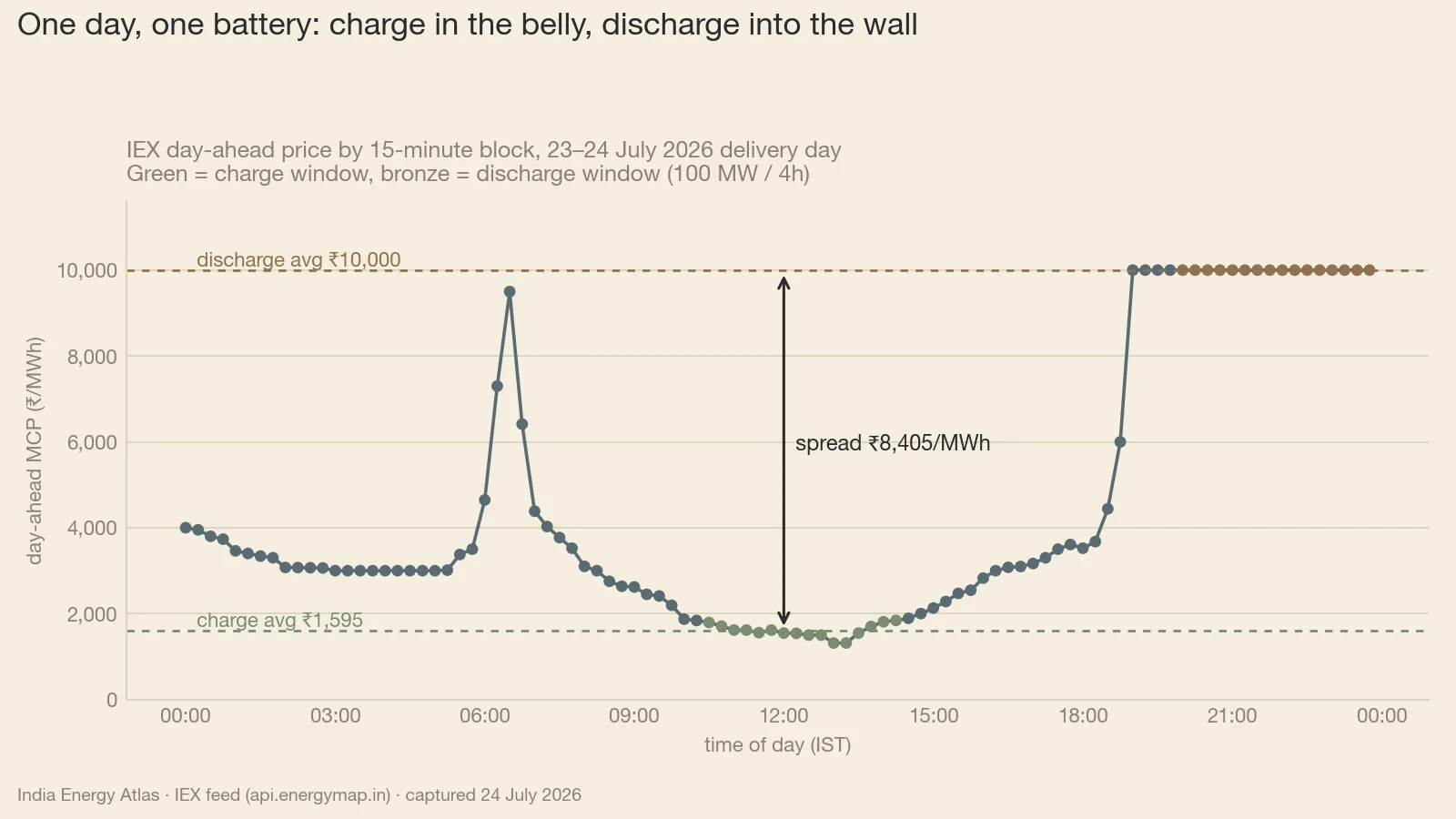
Take the 23–24 July delivery day. A 100 MW asset with four hours of storage cycles four hundred megawatt-hours — sixteen consecutive fifteen-minute blocks bought in the early afternoon, sixteen more sold after dark. The charge leg averages a little under ₹1,600 a megawatt-hour, the discharge leg lands exactly on the regulatory ceiling, and the spread between them is roughly ₹8,400 a megawatt-hour. Fig. 1 carries both windows and the prices inside them.
The discharge average lands on a round number because every block in that window cleared at the cap. The evening wall on the India Energy Atlas IEX feed holds ₹10,000/MWh across the peak — five straight hours of a price that has stopped moving.
A price pinned at the cap marks the point where the market stops discovering and starts rationing. A battery discharging into it is selling into an administered number, paid for scarcity the system could not otherwise resolve, and every rupee of that revenue is contingent on the scarcity persisting.
The charging window sits at the other end of the day, in the solar belly. Averaged by hour, the day-ahead price bottoms out a little under ₹1,500 a megawatt-hour in the early afternoon and holds inside a narrow band either side. The battery is paid to absorb the midday surplus that utility-scale and rooftop solar in Rajasthan, Gujarat and Karnataka push into a market with nowhere to put it, and paid again to hand it back after dark to load centres like Maharashtra and Delhi. The whole business is the vertical distance between those two clocks.
Two hours earns a wider spread and less money #
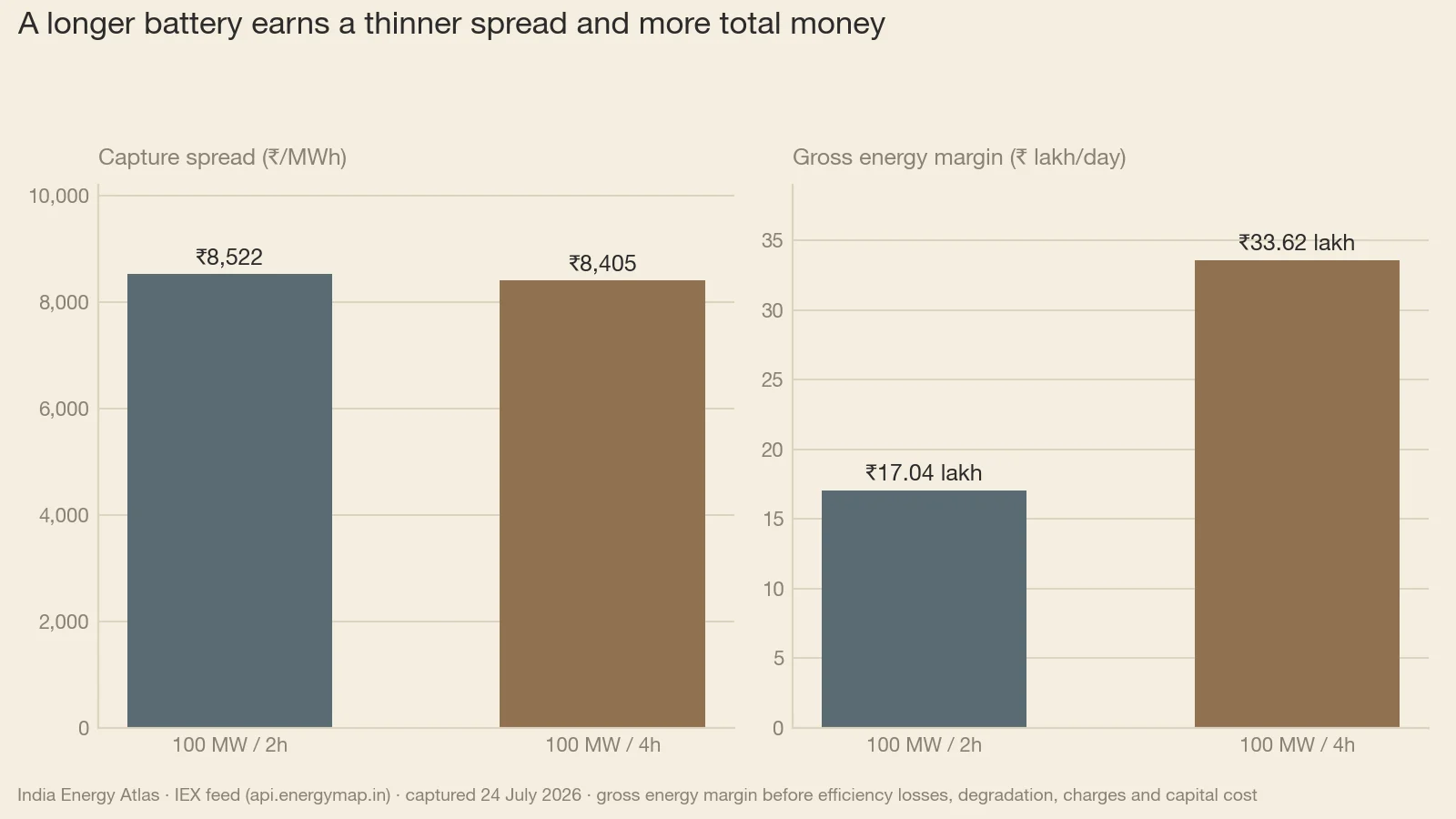
Shorten the asset and the per-megawatt-hour economics improve. A 100 MW battery with two hours of storage, trading the same day, charges over eight blocks in the deepest part of the belly and sells into the same ceiling. Its spread comes out a little over ₹100 a megawatt-hour wider than the four-hour asset's, and its daily margin is roughly half the size (Fig. 2).
The mechanism sits on the charging leg. The two-hour asset needs only eight cheap blocks, so it parks at the bottom of the trough; the four-hour asset must fill sixteen and pay up for the shoulder blocks either side. The ceiling stayed flat long enough on this day that both sold at the same price, so the whole difference in spread came from what they paid to charge.
Then the volume arithmetic settles it. The two-hour asset's price advantage is worth a few tens of thousands of rupees across the two hundred megawatt-hours it cycles; the extra two hundred megawatt-hours the four-hour asset puts through the meter is worth about seventy times as much.
Per-MWh spread is what a battery brags about. Megawatt-hours cycled is what services the debt.
For a tender designer the distinction is the whole specification. A duration requirement written in megawatts buys the sharper spread; one written in megawatt-hours buys the larger cheque. Fig. 2 sets the two side by side.
What one July day does to an annual forecast #
Take the trailing year of day-ahead prices — some forty-five thousand fifteen-minute observations, reduced to one national series by taking the median across price areas — and run a one-cycle-a-day trade on every day in it: the sixteen cheapest blocks of each day against the sixteen dearest, with perfect foresight and no requirement that the blocks be contiguous. That is a generous upper bound on what a four-hour asset can do, because no real bidder knows tomorrow's shape and no real battery charges in scattered fragments.
The modelled mean daily spread comes out near ₹6,400 a megawatt-hour, which over four hundred megawatt-hours a cycle is a modelled ₹93 crore a year of gross energy margin. Annualising the July day naively gives close to ₹123 crore. The modelled number is 24% lower, before a single cost is subtracted, and it remains an optimistic ceiling on what an achievable schedule could capture.
Three readings sharpen why the July print flatters.
It was a top-quintile day. Its spread sits near the eightieth percentile of the modelled daily spreads across the year. On the median day the dearest four hours clear below the ceiling and the cheapest four cost more, so the trade is thinner at both ends.
The cap is a rare price. Across the trailing year the day-ahead market sat at or above ₹10 a unit for 15.2% of the time, against an annual mean nearer ₹4,100 a megawatt-hour. A battery discharging four hours every evening occupies a sixth of the year's hours — a larger share than the cap binds in total, and not every capped block falls inside an evening window. There are simply not enough of them to fill a year of evening discharges.
The trade is seasonal. Monthly mean modelled spreads roughly double between the post-monsoon slack of October and the height of summer in June. The autumn quarter and the peak of summer are two different businesses wearing the same balance sheet.
The costs the spread still has to clear #
Every figure so far is a gross energy margin: energy sold at the exchange price minus energy bought at the exchange price. Four subtractions stand between it and a return.
Round-trip efficiency. Delivering a megawatt-hour requires charging more than a megawatt-hour. At a modelled 85% round-trip efficiency the effective cost of charging rises by close to a fifth, and the day's margin gives up more than a lakh.
Degradation. One full cycle a day is three hundred and sixty-five cycles a year against a warranted cycle life, and every extra rupee per megawatt-hour chased by cycling harder is borrowed from the end of the asset's life.
Exchange, transmission and state charges. A storage asset crosses the meter twice, once buying and once selling, and pays scheduling, transmission and applicable state charges on both legs. Treatment varies between states, so the same machine clears a different net spread across a border.
Capital. The Union Cabinet's storage outlay of May works out to close to ₹1,800 per kWh of announced public support — a measure of how much of the gap between arbitrage revenue and project cost the state currently expects to fill.
The fleet being built against this spread #
India is building storage at a pace that assumes the evening stays expensive. More than a hundred gigawatt-hours were tendered in a single year, the cumulative pipeline has since roughly doubled with about a third of it under execution, and installed capacity is roughly 8.5 GWh after an eleven-fold jump year on year. Against the Central Electricity Authority's projected requirement of 236.2 GWh for the start of the next decade, today's fleet is under four per cent.
That gap is the reason the spread exists and the reason it will narrow. Every gigawatt-hour that discharges into the evening window adds supply to the hours where the price is pinned, and the first effect of adding supply to a capped market is that the cap binds less often. A wide spread is a signal to build, and building against it consumes it. Whoever underwrites a twenty-year asset on a one-day print is underwriting the scarcity of a fleet nobody has built yet.
So what — who should act #
For the DISCOM and system planner. Storage procured for the evening block competes with a price pinned at the ceiling in the tightest hours and sitting far below it for most of the year. Contract the capacity for the evening window explicitly, on an availability basis with merchant upside priced separately, and check where your own state's evening ramp lands on /duck-curve before setting the tender's discharge obligation.
For the IPP and storage developer. Size the asset on energy. The four-hour asset out-earned the two-hour asset roughly two to one on the same day while accepting the narrower spread, and duration is what converts a scarcity signal into revenue. Underwrite the modelled annual mean spread, take an efficiency and degradation haircut off it, treat a July print as a good day, and site charging where the belly is deepest — the solar-heavy states of Rajasthan and Gujarat.
For the regulator. The ₹10,000/MWh cap truncates the top of the storage revenue stack in the exact hours storage is being built to serve, and it binds about one hour in seven. If the intent is for merchant storage to close the evening gap without ₹1,800/kWh of public support, the ceiling, the ancillary-services market and the charges levied on both legs of a storage trade are the three levers that decide whether it can.
For the trader and analyst. Track the daily gap between the sixteen dearest blocks and the sixteen cheapest as your storage-revenue index; the monthly average price hides it. It roughly doubles between the autumn slack and the summer peak, and it tells you months in advance whether the arbitrage book is a summer trade or a year-round one. Forward-looking price work sits at /iex-market-forecasts.
A battery can pay for itself on IEX. It cannot pay for itself at July's rate, and the honest number is the one that survives October.
Sources & method
Prices are IEX market clearing prices (MCP) in ₹/MWh from the India Energy Atlas market feed (api.energymap.in — day-ahead, duck-curve, price-duration and storage-arbitrage views), captured 24 July 2026. The single-day arbitrage figures are the Atlas storage-arbitrage model for a 100 MW asset at 4-hour and 2-hour duration on the 23–24 July 2026 delivery day: one charge window and one discharge window of contiguous fifteen-minute blocks, priced at the day-ahead MCP. ₹1,000/MWh = ₹1/kWh = ₹1 per unit; ₹10,000/MWh is the administered ceiling; 1 lakh = 100,000 and 1 crore = 10 million. Feed timestamps are UTC and are converted to IST (UTC+5:30). The annual figures are modelled by the author from 44,733 fifteen-minute price-duration observations over the 365 days to 24 July 2026, reduced to one national series of 96 blocks per day by taking the median across price areas, then differencing the mean of each day's sixteen dearest blocks against its sixteen cheapest — a perfect-foresight, non-contiguous upper bound on what an achievable schedule could capture. On that basis the modelled mean daily spread is ₹6,369/MWh and the modelled median ₹6,518/MWh, worth a modelled ₹93.0 crore a year over 400 MWh a cycle, against ₹122.7 crore for the naive 365-fold extrapolation of the single July day — 24% lower; the 23–24 July spread sits at about the 79th percentile of the 365 modelled daily spreads, and monthly mean modelled spreads run from ₹4,363/MWh in October 2025 to ₹8,493/MWh in June 2026. All revenue figures are gross energy margins before round-trip efficiency losses, degradation, exchange, scheduling, transmission and state charges, financing and capital cost; the 85% round-trip efficiency used in the cost section is an illustrative modelled assumption and is not measured in this dataset, and on it the charging cost per delivered MWh rises from ₹1,595 to ₹1,877, the spread falls to ₹8,123/MWh and the day's margin to ₹32.49 lakh. Share-of-time figures are reported as percentages of observed blocks because the price-duration set spans multiple price areas: over the trailing year the day-ahead MCP averaged ₹4,101/MWh with a median of ₹3,169, and sat at or above the ₹10,000/MWh ceiling 15.2% of the time, against the 16.7% of annual hours that four hours of nightly discharge would occupy. Storage build-out figures are from Saur Energy (https://www.saurenergy.com/solar-energy-news/indias-ess-shift-92-gwh-set-for-commissions-in-2026-after-130-gwh-of-tenders-in-2025-10993901) — more than 130 GWh tendered in 2025, 281 GWh cumulative by H1-2026 with 105 GWh under execution and about 9.2 GWh due to commission in 2026 — and Power Peak Digest (https://powerpeakdigest.com/india-adds-7-9gwh-bess-capacity-h1-2026/) for installed capacity of roughly 8.5 GWh, an eleven-fold rise year on year; the Central Electricity Authority projects a requirement of 236.2 GWh by 2031-32, against which today's fleet is 3.6%. The ₹1,800/kWh figure is the reported ~₹5,400 crore Union Cabinet outlay of May 2026 divided by the associated ~30 GWh.