
India's 8.7% green power premium and its limits
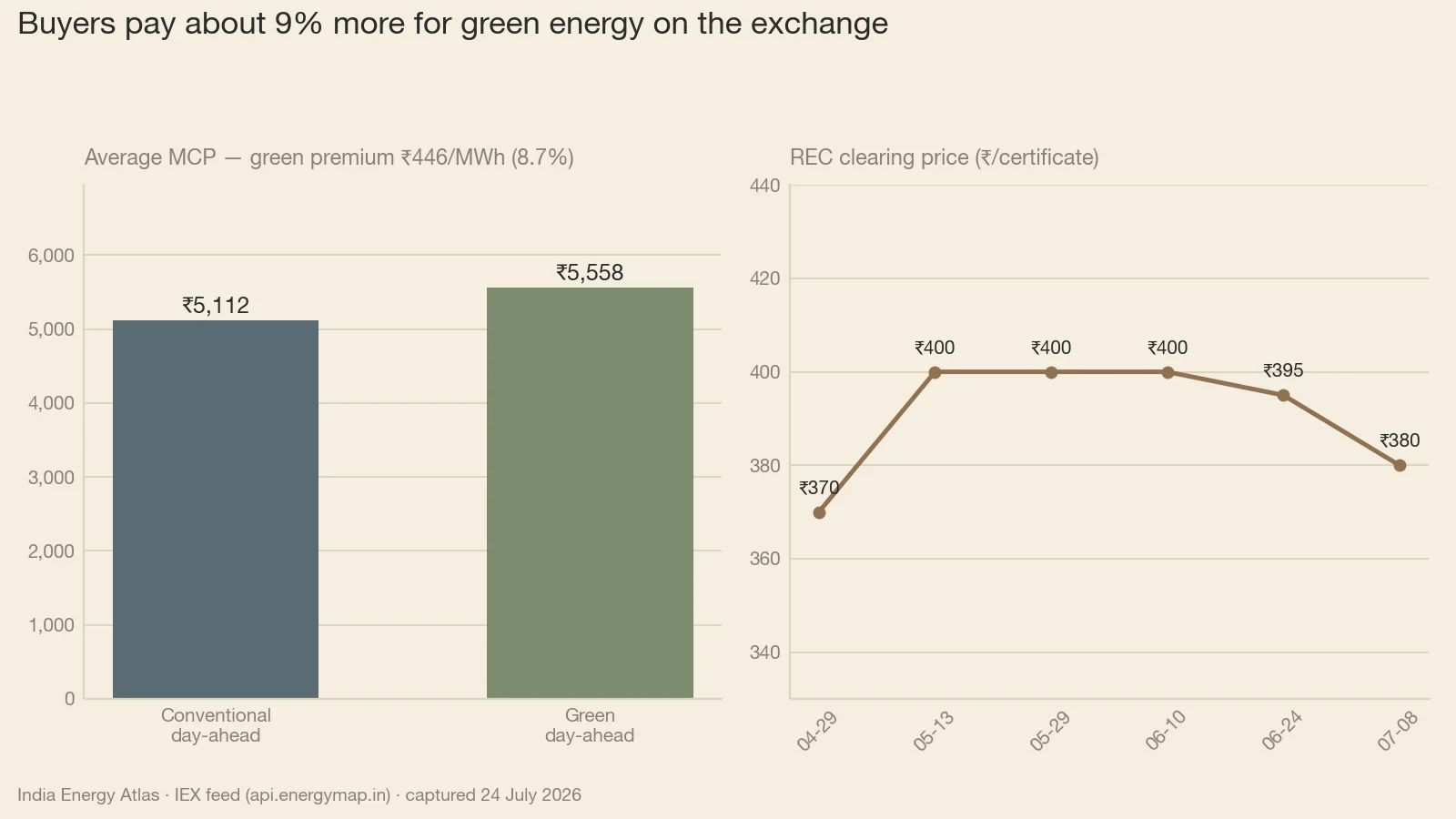
Green day-ahead power cleared 8.7% above the conventional book over the three months to 24 July 2026, and RECs settled at ₹380. Both price an annual claim. Neither reaches the evening, where the green book prices at the ceiling like everything else.
India's power exchange runs a separate order book for renewable energy, and buyers pay to use it. Over the three months to late July, buyers paid roughly a tenth more for green power on the day-ahead market than for conventional — about 45 paise on a unit of electricity that costs around five rupees (Fig. 1). That premium buys a clean, auditable claim on renewable generation. It leaves untouched the four hours each evening when India's grid is at its dirtiest and its market at its tightest.
The premium, measured honestly #
The green day-ahead series captured for this piece covers three months of fifteen-minute blocks to 24 July 2026. Its average clearing price sits about ₹450/MWh above the conventional comparison drawn from the same Atlas view (Fig. 1). Written into a retail tariff, that difference is small change. Written into the annual energy budget of an industrial buyer, it is real money.
Two caveats travel with the number, and both matter to anyone about to put it in a procurement note.
The first is the window. The green and conventional averages are drawn over different session windows. A separate day-ahead capture covering a single hot, tight week in late July put the conventional mean above the green three-month average — which is to say that the same premium computed across a different set of delivery days lands somewhere else entirely.
The second is depth. The conventional book clears roughly five times as much power in an average block as the green one does (Fig. 1). A thin market prices differently from a deep one: a handful of aggressive bids move a shallow sell stack in a way they never would in the main book. Part of the premium is that shallowness and part is genuine buyer willingness to pay for the attribute. The captured data cannot separate the two, and any number quoted without that caveat is quoting a composite.
So read the headline as an average observed over the capture window. It is not a fixed spread, and it is not a forward one.
Two routes to the same annual claim #
A buyer who wants renewable attribution has a second route: purchase conventional power in the ordinary way and retire a Renewable Energy Certificate against the consumption.
Certificates have cleared inside a narrow band all quarter. The most recent session captured here settled at ₹380 apiece on roughly a third of a million certificates, with buy bids running at better than twice the volume offered (Fig. 1). One certificate carries the environmental attribute of one megawatt-hour, which makes that price a price per megawatt-hour of attribution — directly comparable to the exchange premium.
Now put the two routes side by side. Green delivery on the exchange costs a little over four hundred rupees a megawatt-hour more than conventional delivery. Conventional delivery plus a retired certificate costs a little under that. The two land within a few tens of rupees a megawatt-hour of each other (Fig. 1).
Two mechanisms with entirely different plumbing — different registries, different settlement cycles, different counterparties — have converged on nearly the same price for the same annual claim. That convergence is the useful signal here. India's market has settled on a price for renewable attribution of about 40 paise a unit, and neither route asks what time of day the megawatt-hour arrived.
Where the green megawatt-hours actually sit #
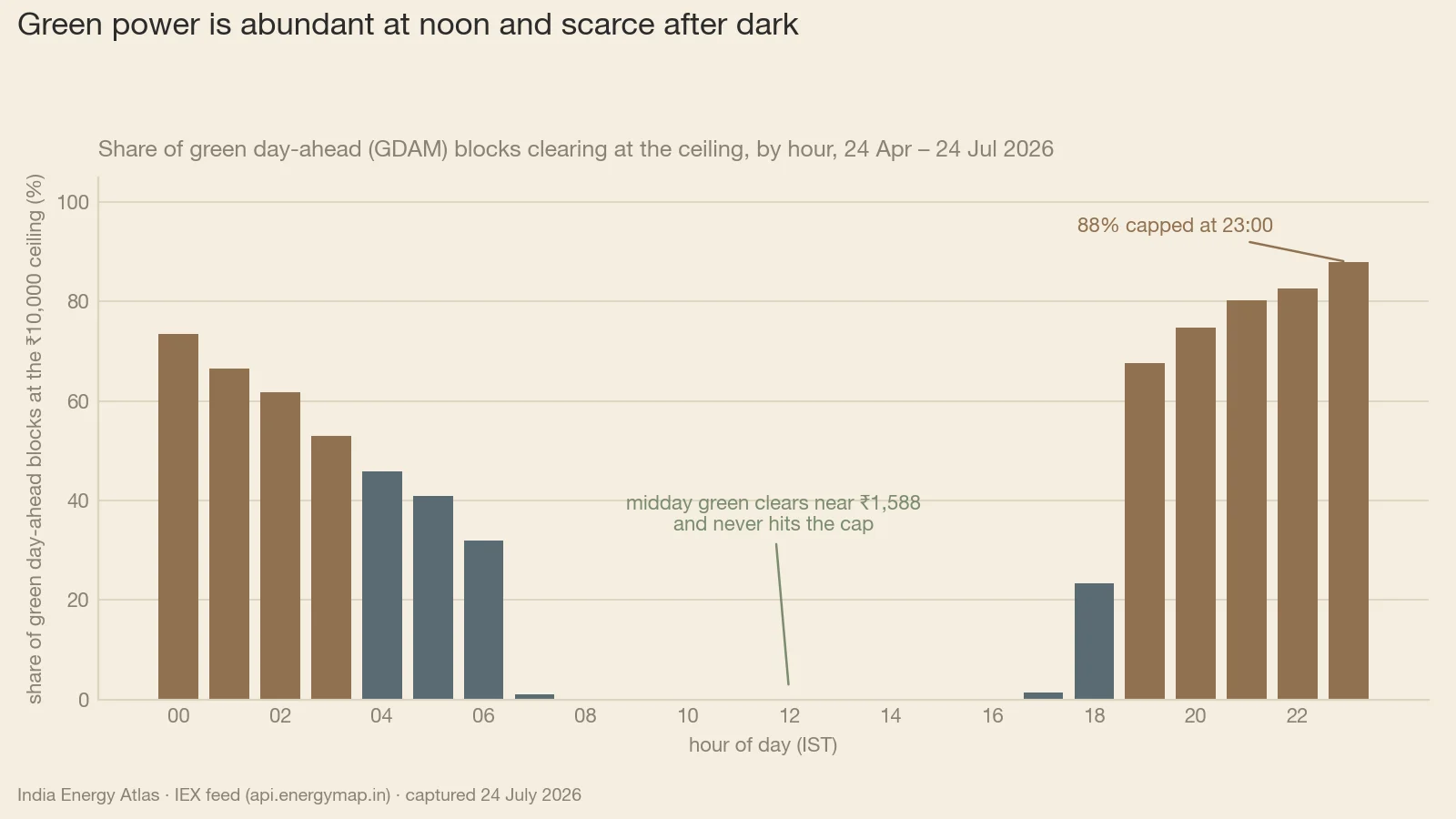
Average the green clearing price by hour of the Indian day and the shape is unmistakable (Fig. 2).
Through the middle of the day the green book clears close to ₹1,600/MWh, within a few per cent of the trough the conventional market prints in the same hour. Green power is cheap at midday because there is a great deal of it. Sell bids comfortably exceed what buyers take, and in the early-afternoon hour not one block touches the ceiling.
Walk forward ten hours and the book inverts. Green sell bids collapse to a fraction of their midday level. Purchase bids climb to more than ten times what is offered. Cleared volume falls to about a quarter of the midday figure, the average price for the hour runs close to ₹9,650/MWh, and the overwhelming majority of blocks in it print the administered ceiling (Fig. 2).
An annual green contract buys a claim about the year. The grid settles in fifteen-minute blocks.
The green market inherits the evening wall #
Across the captured window a third of all green blocks cleared at exactly the ₹10,000/MWh ceiling. The capped share climbs hour by hour from seven in the evening through to eleven at night, and by the last of those hours it approaches nine blocks in ten (Fig. 2). That is five consecutive hours in which the green market is rationing by price.
The conventional market does the same thing at the same time — better than a third of its blocks over the July capture week, and roughly one block in seven across the trailing year on our /iex-market read. The green order book inherits the scarcity. It does not resolve it.
Price the alternative and the scale of the gap becomes clear. Charging in the midday green trough and delivering into the late-evening green wall implies a time-shift value of about ₹8,000/MWh (modelled, before round-trip losses, degradation, charges and capital cost**)**. That is roughly eighteen times the attribution premium. A four-hour battery read on the most recent delivery day puts the achievable charge-to-discharge spread in the same territory, arrived at independently from the conventional book.
The price of attribution and the price of timing differ by more than an order of magnitude. A buyer who pays the premium has bought a certificate's worth of accounting. A buyer who pays the spread has bought an evening.
What hourly matching would actually cost #
The annual-netting convention is what makes a premium of well under a rupee a unit sufficient. Surplus midday solar offsets evening consumption on paper, and the paperwork balances at the end of the year. Under 24/7 carbon-free energy accounting — where consumption is matched to carbon-free generation in every hour, at the granularity the grid itself settles on — the same buyer has to source clean energy inside the evening window, where green sell bids thin to a few hundred megawatts and the price is pinned at the cap.
The cost of compliance then moves from the attribution price to the time-shift price. Modelled on the captured hourly green shape, that is a move of more than an order of magnitude, and it is the larger of the two figures that finances batteries, flexible hydro and shiftable industrial load. Every serious hourly-matching commitment in India is, underneath the accounting, a commitment to buy or build evening capacity.
It also changes which states are worth contracting in. The midday green surplus is manufactured in Rajasthan, Gujarat and Karnataka, where solar output is deepest and the belly is lowest. The unmatched evening hours belong to the demand centres — Maharashtra, Tamil Nadu, Uttar Pradesh — where air-conditioning and commercial load overlap after sunset. The carbon content of an evening megawatt-hour drawn in a coal-heavy system such as West Bengal is a different quantity from that system's annual average, which is why hourly emissions data (/carbon-intensity) and the hourly price shape (/duck-curve) have to be read together.
The national numbers frame the size of the task. India's tracked peak sits near 270 GW on the Atlas feed. At the all-time high set this May, renewables including hydro supplied about a third of it. Two-thirds of the hardest hour of the hardest day still came from plant that burns something.
So what — who should act #
For the DISCOM and system planner. A green premium applied to annual energy improves the renewable-purchase compliance position and changes very little about the evening procurement problem, where national green supply runs at a fraction of what buyers bid for. Separate the two budget lines explicitly: attribution at a few hundred rupees a megawatt-hour, and evening firmness at whatever the tender market says. Check where your own state's peak actually falls on /duck-curve before assuming the two lines can be merged.
For the IPP and storage developer. The modelled midday-to-evening gap inside the green book — some eighteen times the attribution premium — is the revenue case (Fig. 2). Structure offers as firm evening delivery with a green attribute attached, since that combination prices at the ceiling in the overwhelming majority of late-evening blocks. Charge in Rajasthan or Gujarat at the midday trough; sell into the wall.
For the regulator. Certificates and the green day-ahead premium are pricing the same annual attribute within a few tens of rupees a megawatt-hour of each other, which suggests the mechanisms are substitutes and that neither carries a time signal. A time-stamped or hour-banded certificate — an evening REC priced separately from a midday one — would put the scarcity into the instrument. The current design lets a buyer discharge a renewable obligation entirely out of hours, when the grid has surplus green energy to spare.
For the trader and analyst. Track the green-to-conventional spread hour by hour; a single headline percentage hides the shape. The average is composed of a near-zero midday spread and an evening spread that both books truncate at the ceiling, which means the true evening premium is unobservable for as long as that ceiling binds. Watch REC buy-to-sell bid ratios — better than two to one in the most recent session — as a leading read on compliance-season tightness, and pair them with the hourly price shape on /iex-market.
Green power in India is genuinely cheap, genuinely abundant, and genuinely on sale at midday for a fraction of what the evening costs. The premium buyers pay today is a fair price for saying so on an annual basis. Saying it hour by hour is a different purchase, at a different price, and the market has yet to build the instrument that quotes it.
Sources & method
Prices are IEX market clearing prices (MCP) in ₹/MWh read from the India Energy Atlas market feed (api.energymap.in), captured 24 July 2026. Green day-ahead statistics cover 8,733 fifteen-minute blocks from 24 April to 24 July 2026; the ₹5,111.99/MWh conventional comparison and the resulting ₹446/MWh (8.7%) premium are taken from the same Atlas green-market view. Because the green and conventional series are drawn over different session windows and clear very different volumes (1,238 MW versus 6,272 MW per block on the samples cited), the 8.7% figure is an observed average over the captured window and is not a fixed or forward-looking spread. The separate conventional day-ahead capture covers 400 blocks across the 20–24 July 2026 delivery days (mean ₹5,610/MWh, 37.2% of blocks at the cap); the 15.2% annual figure covers 44,733 blocks over the trailing 365 days. REC figures are from six IEX combined-session prints between 29 April and 8 July 2026; one certificate is treated as the environmental attribute of one megawatt-hour, the convention used throughout. ₹1,000/MWh = ₹1/kWh = ₹1 per unit; ₹10,000/MWh is the administered ceiling. Feed timestamps are UTC and are converted to IST (UTC+5:30) for all hourly profiles. Hourly figures are means of observed blocks in each IST hour. The ₹8,055/MWh midday-to-evening figure is modelled from the captured hourly green shape and is gross of round-trip losses, degradation, charges and capital cost; it illustrates an available spread and is not a return. National peak demand figures are from the Atlas national feed and, where cited, from Down To Earth.