
The Data Centre as a Grid Asset: Load Flexibility in Indian Power Markets
What a flexible data centre load is worth in Indian power markets, covering the measured evidence for workload deferrability, the direction of India's flexibility requirement, the market surfaces available, and why the value lies in grid access rather than
The short answer. A portion of data centre load is genuinely deferrable, and measured workload evidence establishes how much. India's flexibility requirement runs toward absorbing midday renewable surplus rather than reducing evening peak demand, which inverts the demand response product imported from other markets. The realisable value is principally in connection terms and tariff position rather than in market revenue.
This post sets out what load flexibility a data centre can offer, what the Indian system actually needs, which market surfaces pay for it, what participation is worth, and why the commercial case rests on something other than the revenue.
It is written for the operator assessing whether flexibility is worth engineering, the distribution or transmission planner receiving a large load application, and the energy manager who has to convert a technical capability into a contractual position.
The distinction that organises the analysis is between two questions that are usually merged. The first is whether a data centre can move load in time, which is a workload and instrumentation question. The second is whether anyone will pay for it, which is a market design question. In India the answer to the first is yes for a defined subset of load, and the answer to the second is currently limited, which is why the value has to be captured somewhere other than in a settlement.
1. The measured evidence #
Claims about data centre flexibility have historically been assertions. High-resolution measurement of accelerated computing workloads makes them testable.
Two findings bear directly on flexibility. The first is that facility power peaks materially below rated design even at full node utilisation, because no benchmarked workload sustains node thermal design power. The second is that training workloads already queue: on a large research cluster operating at moderate utilisation, a substantial proportion of submitted jobs waited hours before starting.
The second finding is the more consequential of the two, because it converts flexibility from a proposal into an observation. A workload that already tolerates a queueing delay of hours is a workload whose start time is not fixed by the user, and shifting that start time to a different hour is a scheduling change rather than a service degradation. The facility is not being asked to do something new; it is being asked to schedule against a price or a grid signal in addition to the criteria it already schedules against.
The distinction that matters operationally is between workload classes.
Workload class | Deferrable | Constraint |
Model training, batch | Yes, hours to days | Job completion deadline, checkpoint interval |
Batch inference and data processing | Yes, hours | Downstream delivery schedule |
Interactive inference | No | User-facing latency commitment |
Enterprise production workloads | No | Availability commitment in the tenant's own SLA |
Storage and replication | Partially | Recovery point objective |
A colocation operator does not control the tenant's workload mix and generally cannot observe it. This is the practical barrier to flexibility in a colocation facility, and it is contractual rather than technical: the operator can only offer flexibility that its lease permits it to exercise, and standard Indian leases do not address the question at all.
1.1 Queue behaviour at increasing utilisation #
The queueing finding is quantitative, and the shape of the relationship determines how much latitude a facility holds.
Average cluster utilisation | Share of jobs queued | Mean queue time |
20% | 0.00% | — |
40% | 20.15% | 0.59 hours |
60% | 44.86% | 2.58 hours |
80% | 75.64% | 6.54 hours |
Source: Vercellino et al., measured GenAI workload traces and simulated facility scheduling, April 2026.
Queueing is negligible at low utilisation and severe at high utilisation, so the latent deferral a system operator would draw on exists only in facilities already running busy. A facility in the lower band has no backlog to reorder, and shifting load there means delaying work that would otherwise have started immediately, which is a change to the service its users receive. The measurement rests on one hardware generation and one benchmark suite, so the proportions hold locally only once a scheduler record confirms them.
1.2 The deferrable fraction of a specific facility #
The workload table classifies and does not quantify. Converting a classification into a megawatt quantity that can be committed requires a derivation, and each step introduces an assumption that belongs on the record.
Model assumption — deferrable load and energy, 20 MW IT block
Step | Basis | Calculation | Value |
Contracted IT load | Reference block used across the series | — | 20 MW |
IT load drawn | Utilisation against contracted load at 85% | 20 × 0.85 | 17.0 MW |
Facility power | Drawn IT load at design PUE 1.40 | 17.0 × 1.40 | 23.8 MW |
Annual facility consumption | Facility power across the year | 23.8 × 8,760 | 208,500 MWh |
Deferrable IT load | Training and batch share of drawn load, assumed | 17.0 × 0.30 | 5.1 MW |
Deferrable facility load | Deferrable IT load at the marginal facility multiplier | 5.1 × 1.40 | 7.1 MW |
Deferrable energy | Deferrable share of annual consumption | 208,500 × 0.30 | 62,550 MWh |
Shiftable energy | Deferrable energy deadlines permit to move, assumed | 62,550 × 0.85 | 53,170 MWh |
The two assumed shares belong to the facility rather than to this series. The training and batch share is measured at hall or busway level against a mapping to workload classes; the shiftable proportion comes from scheduler records.
Field note. The quantity to commit is smaller than the quantity derived here, because the derivation produces an annual average and an event is called in a single block. Set it against the deferrable load available in the worst block expected, less a delivery margin.
2. The direction of India's requirement #
Demand response frameworks imported from North America and Europe are constructed to reduce demand at a system peak. India's binding flexibility problem increasingly runs in the opposite direction.
The Indian system carries a large and growing quantity of solar generation whose output is concentrated in the middle of the day. Where transmission to evacuate that generation is not yet commissioned, or where demand at that hour is insufficient, the surplus is curtailed. Submissions to CERC on draft power market amendments in 2026 describe down-regulation dispatched at gigawatt scale within a single fifteen-minute block, and a substantial quantity of transmission-connected renewable capacity requiring curtailment on most days.
The system condition supports the same reading. India's installed capacity is now large, and the proportion of it that is firm at any given moment is considerably smaller, which means the system is simultaneously long on energy at certain hours and tight on capacity at others.
System quantity | Position |
Installed capacity, 31 January 2026 | 520.5 GW |
Of which firm at any given moment | Approximately 280 GW |
Peak demand met, 25 April 2026 | 256.1 GW, at 15:38 IST |
Peak demand met, May 2026 | 270.82 GW |
Generation capacity added in FY2026 | 65 GW, the largest annual addition recorded |
Source: CEA Installed Capacity Report and Ministry of Power, via IDCR 2026, Chapter 5; May 2026 peak from Indian Energy Exchange market data, June 2026.
The April 2026 peak was the record when it was set and was exceeded the following month, so it is used here as a documented instance rather than as the standing maximum. Two features of it are directly relevant, and the timing of the later peak is not established in the sources used here. It occurred in the middle of the afternoon rather than in the evening, and solar contributed roughly a fifth of generation at that moment. A load able to shape itself toward the middle of the day is aligning with the hours in which the system has the most generation available and the greatest difficulty absorbing it.
This reverses the flexibility product. The proposition a data centre should take to an Indian distribution licensee is not a commitment to reduce load during the evening peak. It is a commitment to increase load during the solar window, and to shape away from the evening peak as a secondary characteristic. The first is worth something to a system paying to curtail generation. The second is worth something to a licensee managing a constrained network.
2.1 The daily shape and the two directions of flexibility #
Acting on the direction of the requirement means knowing which hours it applies to. The mechanism producing it is the divergence between demand and variable renewable output across the day, which is the quantity the system serves from dispatchable plant.
Period | System condition | What a load can offer |
Night and early morning | Net load moderate, thermal plant near technical minimum | Steady drawal, of limited value |
Solar window | Solar at maximum, net load lowest, down-regulation instructed | Increased drawal, displacing curtailment of generation already built |
Evening ramp | Net load rising steeply as solar output falls | Reduced drawal, lowering the ramping capability the system holds |
Evening peak | Highest net load, most expensive marginal plant | Reduced drawal, lowering peak capacity requirement and network loading |
The unit of expression is the fifteen-minute settlement block, which is also the resolution at which down-regulation is instructed, so a control path unable to act inside a block cannot deliver against an instruction issued for one.
The two directions are separate products. Upward flexibility requires sanctioned demand headroom to draw into, and sanctioned demand attracts a demand charge whether or not it is drawn, as Post 1 sets out, so the consideration offered has to exceed that charge. Downward flexibility is a statement about the maximum the facility will draw under stated conditions, which is the quantity the connection is sized against, so it reduces the standing charge instead. That asymmetry is why the realisable value in section 5 attaches to the downward product even though the system need runs upward.
The direction is a national reading. A state with limited solar capacity and a sharp evening peak will pay nothing for midday absorption, so obtain the licensee's own statement of its constrained hours first.
3. The market surfaces #
Six surfaces in the Indian market can in principle pay for load flexibility, and they differ in accessibility to a consumer.
Surface | Basis | Accessible to a data centre |
Exchange price arbitrage | Shifting consumption to lower-priced blocks | Yes, where the consumer is an open access customer |
Deviation settlement | Avoiding penal settlement by holding to schedule | Yes, indirectly, as an avoided cost |
Ancillary services | Tertiary reserve, primarily generator-provided | Limited; demand-side participation frameworks are developing |
Bilateral flexibility terms | Negotiated band with the distribution licensee | Yes, where the licensee will contract for it |
Demand response programmes | Where a state has notified one | Varies by state |
Dedicated or flexible connection terms | Reduced connection charge or accelerated timeline in exchange for curtailability | Yes, and this is the material one |
The first four are revenue or avoided-cost surfaces and are individually modest for a load of data centre scale. The last is not a revenue surface at all, and it is where the value concentrates.
3.1 Market segments ordered by gate closure #
The exchange segments differ in one property that governs which workload can back a commitment made in them, which is how far before delivery the commitment becomes firm. Post 7 treats these segments as a procurement channel; the treatment here is of the same segments as places to act on a scheduling decision.
Segment | When the commitment becomes firm | Workload that can back it |
Term-ahead contracts | Weeks to months before delivery | Work with a completion date beyond the contract horizon |
Day-ahead market | The day before the delivery day | Training and batch work already queued at gate closure |
Real-time market | Within the delivery day, shortly before the block | Queued work that is checkpointable at short notice |
Instruction under a bilateral flexibility term | On instruction, inside the agreed notice period | Determined by the notice period |
A commitment made earlier in the sequence absorbs more of the facility's own uncertainty, because the scheduler commits before it knows what work will arrive. Observed clearing prices set the spread available to a load that can move between segments.
Period | Day-ahead average, ₹/kWh | Real-time average, ₹/kWh |
FY2026 | 3.86 | — |
Q3 FY2026 | 3.22 | 3.26 |
April 2026 | 5.26 | 4.82 |
May 2026 | 4.88 | 4.16 |
Source: IEX monthly market updates, 2026. The green day-ahead segment averaged ₹3.59 per unit across FY2026.
The relationship between the segments is not stable in sign, so a scheduler deferring its commitment from one to the other as a standing policy has taken an open position rather than captured a reliable discount. Coupling of the day-ahead segment across the exchanges through a market coupling operator was directed in 2025, reclassified by corrigendum, appealed, and followed by a draft notification in April 2026. The segments still cleared separately at the edition cutoff.
3.2 Scheduling, revision and the deviation boundary #
An open access consumer's drawal is scheduled ahead of delivery in fifteen-minute blocks, and the schedule may be revised inside the limits the applicable procedure allows. Departure from the final schedule settles under the deviation mechanism at a rate varying with system frequency and with the direction and size of the departure, which Post 7 sets out.
Action | Instrument | Settlement consequence |
Shift decided before gate closure | Schedule submitted for the shifted profile | Energy price only |
Shift decided after gate closure, inside the revision window | Revision to the schedule | Energy price only |
Shift executed without a revision | Departure from schedule | Settled under the deviation mechanism |
Reduction on instruction under a bilateral term | Revision to the instructed profile | As the agreement specifies |
The third row is the common failure. A facility that reschedules its computing without rescheduling its drawal has performed the physical action and omitted the commercial one, and the resulting deviation charge can exceed the arbitrage value it was pursuing. The energy scheduling function and the workload scheduler have to act on one decision, which is an organisational requirement as much as a technical one.
3.3 Demand-side participation in ancillary services #
Ancillary services procure the ability to change output on instruction within a specified time. The Indian framework was constructed around generating units, so each qualification requirement assumes a property a scheduled generating unit has by construction and a load acquires only through deliberate engineering.
Requirement | Where a data centre stands |
A curtailable quantity declared block by block, ahead of the block | Requires the scheduler to report queue depth before declaration |
Response within a specified time, then sustained | Achievable by power capping; slower where jobs must reach a checkpoint |
Live telemetry at the resolution the system operator specifies | Requires a live path from the boundary meter described in Post 9 |
Verification against an agreed reference level | Requires a baseline, treated in section 3.4 |
A settlement basis for availability, energy, or both | Not established for demand-side participation in India |
The last row governs whether the others are worth engineering for. Availability and utilisation prices are not published in a form supporting an ex ante revenue estimate, and for at least one notified state programme the availability price was not publicly discoverable; the Maharashtra programme is carried as an open verification in this series for that reason.
3.4 Baseline methodology and its contested basis #
Payment for a reduction requires a counterfactual, because the quantity bought is the difference between what the load drew and what it would have drawn absent the instruction. The second term is unobservable, so every settlement rests on an estimate of a quantity that never occurred, and the choice of estimator determines which party gains from the error.
Method | Construction | Principal failure mode |
Averaging over recent days | Mean drawal in the same blocks across recent non-event days | Rewards raising consumption on the reference days |
Matching-day selection | Days chosen for similarity in weather and day type | Assumes a weather-driven load |
Regression on measured drivers | Load modelled on observable drivers | A scheduler-driven load has an unobserved driver |
Same-day adjustment | An averaging reference scaled by drawal just before the event | Corrupted by pre-positioning |
Control group | Reference taken from comparable non-participating sites | No comparable population at this scale in India |
Firm service level | No counterfactual; a maximum drawal is undertaken | Requires an absolute cap, a stronger commitment |
Four properties of data centre load weaken the first five methods relative to the industrial applications they were designed for. There is no weather driver, which removes the adjustment most published methodologies depend on. The load is scheduler-driven, so the participant sets its own reference and the counterparty cannot distinguish a job deferred from a job never submitted. Short-term variability is high, so settlement becomes dominated by estimation error. A facility inside its occupancy ramp carries a rising trend, so a backward-looking reference pays it for growth it would have had regardless.
The last row avoids all four by replacing the counterfactual with a measurement. Under a firm service level the participant undertakes that drawal at the connection point will not exceed a stated quantity during an event, and compliance is read from the boundary meter. That is the construction used by the connection commitment in section 5, which is a second reason the realisable value concentrates there.
3.5 Market institutions and the consumer's point of access #
Each surface in the table above is reached through an institution, and a consumer unable to name the institution behind a surface cannot act on it. The institutions differ in what they can be held to, which is the property deciding whether a flexibility action has a counterparty at all.
Institution | Function in the market | The consumer's point of access |
Power exchange | Clears the term-ahead, day-ahead and real-time segments and publishes the clearing price | Through a member acting on the consumer's instruction, or by registering in its own name |
Market coupling operator | Would determine one day-ahead clearing price across the exchanges | Not operative at the edition cutoff, so no route exists |
Nodal agency for open access | Receives the application, grants the approval and accepts the schedule | Directly, under the approval chain in Post 7 |
State load despatch centre | Issues despatch instructions within the state and prepares the energy account | Through the schedule submitted and the deviation account rendered against it |
Regional and national load despatch centres | Operate the interconnected system and instruct down-regulation | Only where the consumer is connected to the transmission system |
Distribution licensee | Supplies the consumer, owns the constrained network, and is the counterparty to a bilateral flexibility term | Directly, under the connection and supply agreements |
State transmission utility | Grants connectivity and holds the network study | Through the connection application treated in Post 3 |
Appropriate commission | Determines the licensee's charges and approves the schemes under which a concession is given | Through a filing made by the licensee |
The load despatch centres operate under the Indian Electricity Grid Code read with the applicable state grid code, and the entities they instruct directly are those scheduled in the system rather than consumers taking bundled supply from a licensee. A facility intending to receive instructions has to establish which of the institutions above is entitled to issue them under its own supply structure, because an agreement drafted against the wrong party is unenforceable in the only moment it matters.
The distinction governing a flexibility product is between an institution issuing a signal and an institution issuing an instruction. A price published by an exchange creates no obligation on either side, so a facility responding to it exercises an option and a facility ignoring it has breached nothing. An instruction issued by a licensee under an agreement creates obligations on both sides, and the facility's response is a performance rather than a choice. The same physical action therefore carries two different commercial characters, and the trigger clause in section 5.2 names the originating party for that reason.
The segments a consumer can act in are set by its supply structure rather than by its willingness to participate. Post 3 sets out the four supply structures and Post 7 sets out the charges attaching to each.
Supply structure | Segments the consumer can act in | Reason |
Licensee supply at a bundled tariff | None | The consumer submits no schedule, so it holds no position to adjust |
Third-party open access | Term-ahead, day-ahead, real-time, and the deviation account | The consumer schedules its own drawal against contracted generation |
Group captive | The same segments, for the difference between its entitlement and its drawal | The entitlement is scheduled and the residual is procured |
Supply under the consumer's own distribution licence | Those open to a licensee, including procurement for a supply area | The consumer has become a licensee and acquires a licensee's obligations |
Participation is intermediated at every point. A bid reaches an exchange through a member, a schedule reaches the despatch centre through a nodal agency, and each intermediary applies a cut-off earlier than the published one by the interval it needs to process what it receives. The facility's operative deadline is therefore earlier than the market's, and the difference sits in the mandate with the intermediary rather than in the market procedure. A scheduling function built against the published time will miss the internal one on the first day it tries to act late.
India has no established framework for the aggregation of demand-side resources. In markets where loads of this size participate in reserves, they generally do so inside a portfolio held by an aggregator, and the portfolio converts a set of individually unreliable quantities into one dependable quantity through diversity. A single Indian facility negotiates alone, carries the whole of the delivery risk and obtains none of that diversity, which is the second reason the committed quantity is sized from the lower tail of its own distribution rather than from its mean.
The diligence question is which institution issues the signal, under which instrument, and to whom the obligation is owed. An answer naming a price feed rather than a party describes an option, and an option is not the product a licensee is buying.
3.6 Revision mechanics and the product they permit #
A flexibility product is bounded by three intervals, none of which the facility sets, and the product that can honestly be offered is the one fitting inside all three.
Interval | What it fixes | Where its value comes from |
Settlement block | The resolution at which schedule, delivery and settlement are all expressed | The applicable regulations |
Revision lead time | The blocks between issue of a revision and the first block it affects | The scheduling procedure in force in the state |
Control path response time | The interval between the instruction and the measured change at the connection point | The facility, established by test rather than by specification |
Post 7 sets out the revision chain and the reason the blocks between recognition and effect settle as deviation whatever action is taken. The consequence for a flexibility product is that the shortest notice period the facility can accept is the sum of the steps below, and a notice period agreed without that arithmetic commits the facility to something the procedure will not let it deliver.
Step | What has to complete before the next begins |
Receipt | The instruction arrives on the agreed channel and the acknowledgement is recorded |
Decision | The site energy management system evaluates it against the commitment, the availability window and the plant state |
Revision | The scheduling function submits the revised drawal for the affected blocks |
Actuation | The workload scheduler and the power capping layer effect the change at the connection point |
Alignment | The first complete settlement block at the reduced level begins |
A notice period shorter than that sum produces one of two failures. The facility delivers the reduction without a revision, which converts a flexibility action into a departure from schedule and settles under the deviation mechanism. Or the facility submits a revision for a block the procedure will not accept, which leaves the schedule unchanged and produces the same settlement.
The last step is the one usually omitted. An event beginning inside a block delivers only part of that block at the reduced level, so a compliance test read from block averages records a failure in the first block of every event and in the last. Two drafting responses remove it: align the start and end of an event to block boundaries, or write the compliance test against complete blocks and exclude the partial ones. Where neither appears in the agreement, the participant is judged on blocks in which full delivery was arithmetically impossible.
The procedure also limits how many revisions may be submitted and how large a change each may carry. Those limits bound the number of events per day a facility can support commercially, whatever its workload could support physically, and an agreement cannot enlarge them. Obtain them from the procedure in force rather than from the counterparty.
The choice of segment and the choice of notice period are one decision. A commitment backed by a position taken in the day-ahead segment is fixed once that segment closes, so an instruction arriving later cannot be met by rescheduling the energy and can only be met by revising the schedule or by deviating. A commitment intended to absorb instructions inside the delivery day has to be backed by a position the facility can still change, which means the real-time segment or unhedged drawal.
The two directions of flexibility do not carry the same burden here. A downward instruction reduces drawal, and the revision follows the physical action. An upward instruction increases drawal, and the additional energy has to be procured as well as scheduled, so an upward product at short notice carries a procurement leg the downward product does not. That asymmetry compounds the demand charge asymmetry in section 2.1, and together they explain why the product the Indian system needs is the harder of the two to sell.
3.7 Flexibility action and the deviation account #
Deviation settlement is treated in Post 7 as a component of landed cost. Its relevance here is narrower: a flexibility commitment changes the deviation exposure of the facility giving it, at four distinct points of an event.
A commitment adds a second forecast. The facility already forecasts its drawal, and it now also has to forecast the reduction it will deliver and the drawal following the event. The account settles on the difference between the revised schedule and the metered drawal, and the variance of that difference exceeds the variance of the drawal forecast alone. A facility committing flexibility without improving its forecasting has enlarged its deviation exposure before earning anything against it.
The mechanism is constructed so that a departure supporting system frequency is treated differently from one opposing it. A reduction instructed by a licensee for a local network constraint is therefore not guaranteed to be a supportive departure at the system level, and the same physical action can settle favourably or unfavourably according to the condition prevailing in that block. Where the instruction and the system condition can diverge, the agreement states which party carries the settlement consequence.
The recovery after an event is the exposure most often missed. Work deferred during an event runs after it, so drawal exceeds the pre-event level until the backlog clears, and a schedule carrying the reduction without the recovery deviates afterwards by approximately the quantity it saved during the event. A recovery landing in the evening peak also reverses the value of the reduction to the system that paid for it.
Phase of an event | What the schedule has to carry | Exposure where it does not |
Before the instruction | Baseline drawal | Ordinary forecast error |
Between instruction and delivery | The transition | Departure across the blocks a revision cannot reach |
During the event | The committed reduced level | Under-drawal against an unrevised schedule |
After the event | The recovery, at the ramp the agreement permits | Over-drawal as the deferred work clears |
Resumption | Baseline drawal | Ordinary forecast error |
Two remedies apply to the fourth row. Schedule the recovery as part of the same decision that scheduled the reduction, and bound the recovery ramp in the agreement so the backlog cannot clear into the hours the counterparty was paying to protect. The second remedy is also a network requirement, treated from the network side in section 5.5.
A reduction can improve the deviation account and earn a payment under an agreement at the same time. The same physical action then earns twice, and a counterparty discovering the overlap will net one against the other at the first review. Declare it in the commitments register described in section 5.3 rather than allowing it to be found.
The boundary is the supply structure. A facility taking licensee supply at a bundled tariff submits no schedule and holds no deviation account, so none of this applies to it and the second row of the value stack in section 4 is zero for it.
4. The value of participation #
Model assumption — flexibility value on a 20 MW block, annual
Surface | Basis | ₹ crore per year |
Exchange price arbitrage | Shifting deferrable load into lower-priced blocks | 8 |
Deviation settlement avoided | Improved scheduling accuracy against actual load | 5 |
Ancillary participation | Where demand-side participation is permitted | 3 |
Bilateral flexibility band | Negotiated with the distribution licensee | 2 |
Total | 18 |
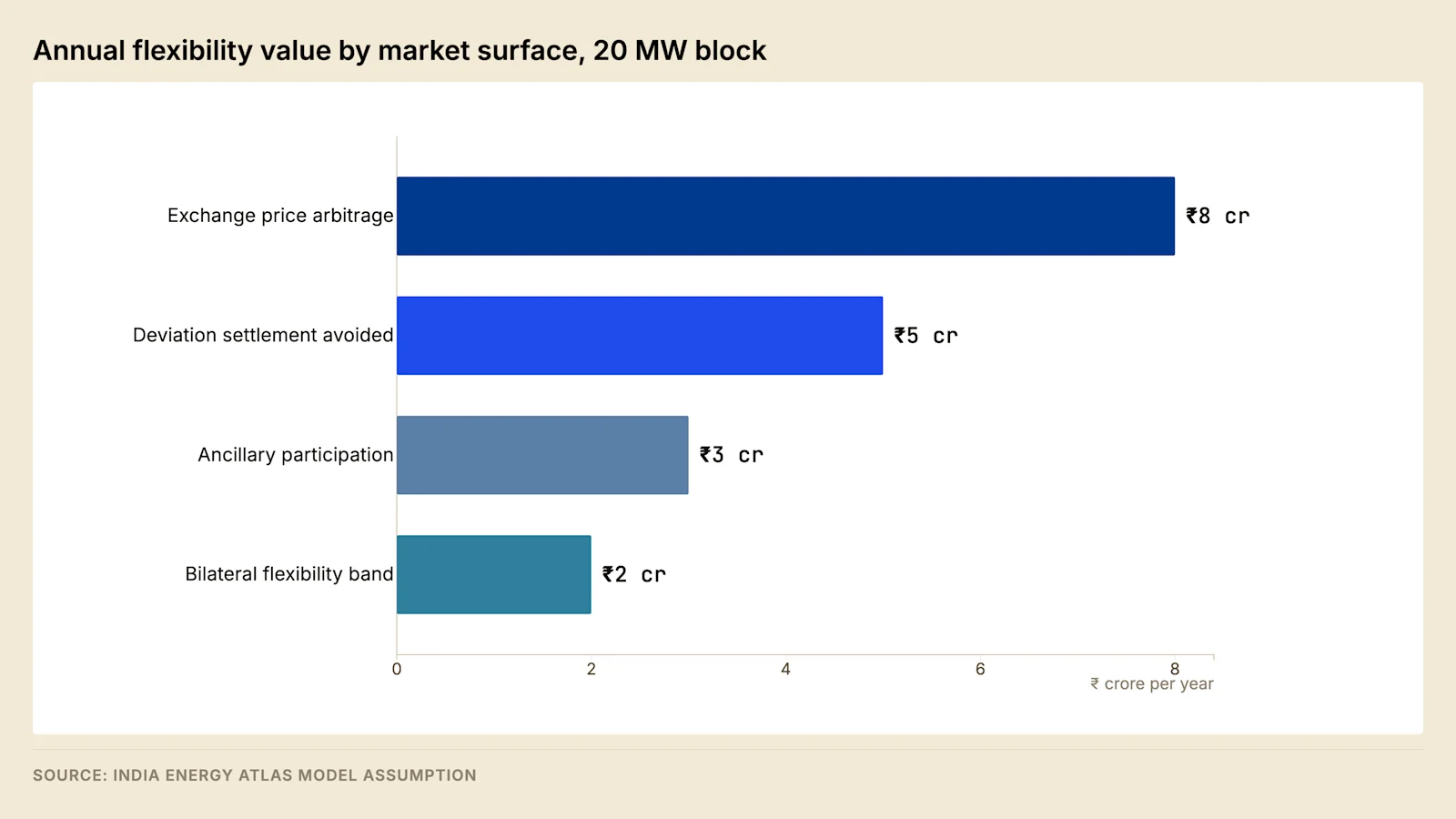
Set against the stabilised EBITDA of the same block modelled in Post 1, the flexibility stack is a single-digit percentage of earnings. It is real, it is worth capturing, and it does not by itself justify a significant engineering programme or a change to the leasing proposition.
4.1 Derivation of the arbitrage line #
The first row of the stack is the only one derivable from published prices, and setting it out shows what the other rows would need in order to be derived at all.
Model assumption — exchange price arbitrage, 20 MW block, annual
Step | Basis | Calculation | Value |
Annual facility consumption | From the derivation in section 1.2 | — | 208,500 MWh |
Deferrable share of consumption | Training and batch classes, assumed | 208,500 × 0.30 | 62,550 MWh |
Shiftable after deadline constraints | Share the scheduler can move, assumed | 62,550 × 0.85 | 53,170 MWh |
Spread captured per unit shifted | Block avoided against block moved into, assumed | — | ₹1.50/kWh |
Gross annual value | Shiftable energy at the captured spread | 53,170 × 1,500 | ₹7.98 crore |
The spread assumption is the step to interrogate. It is smaller than the difference between the highest and lowest price of the day, because the load cannot move all of its deferrable energy into the cheapest block, and larger than the average spread across the year, because shifting concentrates in the hours the scheduler can serve. Three conditions gate the row: exposure to a variable price, a scheduler able to act on it ahead of gate closure, and a drawal schedule revised to match.
4.2 The cost of participation and the boundaries of the stack #
The stack is gross. Six cost lines sit against it, and none appears in the flexibility proposals operators receive from vendors.
Cost line | Driver | Character |
Control and telemetry integration | Points count, resolution, systems interfaced | Capital, at design |
Workload scheduler modification | Priority classes, deadline handling, instruction interface | Capital, then maintenance |
Scheduling and forecasting function | Blocks scheduled and revised daily, and the staff to do it | Recurring |
Deviation exposure | Forecast error against the revised schedule | Recurring, variable |
Forgone throughput | Work delayed past the point at which delay has a commercial cost | Recurring, set by the workload |
Non-performance under an agreement | Events failed against the committed quantity | Contingent |
The first three are fixed and the last three scale with the quantity committed, and the marginal megawatt is the one available in the fewest blocks. The efficient commitment therefore sits at the quantity available in a high proportion of blocks, read off the distribution of deferrable load rather than its mean.
Row | Condition under which it is zero |
Exchange price arbitrage | A flat distribution tariff, so no price signal reaches the load |
Deviation settlement avoided | Licensee supply, so no schedule is submitted |
Ancillary participation | No demand-side framework open to the load, the present position |
Bilateral flexibility band | A licensee unwilling to contract, the position in most states |
Every row | Retail colocation with bundled power, or an inference anchor tenant, or metering that does not resolve the hall level |
4.3 Verification and settlement of a delivered response #
A response that cannot be evidenced has not been delivered, whatever the meter recorded. The chain below converts a physical action into money, or into the connection concession standing in place of money.
Step | Party performing it | Artefact it produces |
Event declaration | The declaring party named in the agreement | A timestamped instruction, with the acknowledgement against it |
Response execution | The facility | The internal dispatch record, at the resolution the control path works in |
Interval data collection | The metering arrangement at the connection point | Drawal by settlement block across the event and its margins |
Time alignment | Both parties | Records reconciled to one time source |
Reference determination | As the agreement provides | A firm service level, or a baseline under the named method |
Delivered quantity | The agreed formula | Performance stated block by block |
Availability determination | Where availability is remunerated separately | The declared quantity against the quantity tested |
Reconciliation | Both parties | An agreed record, or a dispute raised inside the window |
Settlement | The paying party | An invoice, a credit, or a certificate of compliance |
The last row takes a form the market surfaces do not. Where the consideration is a connection concession rather than a payment, settlement becomes a periodic demonstration that the commitment was met, and the sanction for failure is withdrawal of the concession rather than an adjustment to an invoice. The counterparty is then the licensee's planning function rather than its commercial one, the evidence is the same interval record, and the reporting period is usually the year rather than the month. A facility that has built its reporting around a monthly settlement statement will not hold the record an annual demonstration asks for.
The participant computes the delivered quantity independently and reconciles it against the counterparty's statement before accepting it. Differences arise in three places: the alignment of the two time references, the treatment of the partial blocks at each end of an event, and the treatment of an event terminated before its stated duration. A participant with no independent computation accepts whatever arrives, and holds no basis on which to raise a dispute inside the window.
The agreement states whether performance is tested per block, per event or per period, and the three give different answers on the same data. A per-block test penalises the transition blocks. A per-event test averages them away. A per-period test allows a failed event to be offset by successful ones, which is the construction a participant should seek and a counterparty buying reliability should resist. Naming the test matters more than naming the committed quantity, because the quantity is negotiated once and the test is applied at every event.
Events end early for two reasons that settle differently. The system condition clears, in which case the shortened event is a full performance. Or the facility invokes a carve-out, in which case it is a partial performance or a non-performance according to the carve-out relied on. The agreement distinguishes the two, and the instruction log records which occurred.
Where availability is remunerated, the counterparty needs assurance that the capability exists during periods in which no event is called. The instrument is a test instruction, and the agreement states how many are permitted in a period, what notice they carry and whether they settle as events. A test regime absent from the agreement becomes a dispute the first time the counterparty asks for a demonstration.
Retention runs to the dispute window rather than to the accounting year, for the reason given in section 6.2. A record discarded on the accounting cycle is discarded while a claim remains available against it.
The reason to engineer for flexibility is in the next section.
5. Connection terms as the realisable value #
The binding constraint on Indian data centre development is the connection timeline set out in Post 3, not the tariff and not the market revenue. A facility able to offer curtailability has something to trade against that constraint.
The trade takes three forms in practice.
A reduced firm capacity requirement. A facility that commits contractually to limit its drawal under defined system conditions requires less firm capacity than its full load implies. Since firm capacity under an N-1 contingency is what the substation screening in Post 2 tests against, a lower firm requirement can convert an unavailable site into an available one.
An accelerated position in the queue. A distribution licensee or transmission utility allocating scarce capacity between competing applications has a reason to prefer a load that can be managed over one that cannot. This is not a formal mechanism in most Indian states and it is a real consideration in the discussions that precede a connection agreement.
A tariff or cost allocation position. Where a load's characteristics reduce the network reinforcement it triggers, the attribution of that reinforcement cost, examined in Post 3, becomes negotiable on evidence rather than on argument.
None of these appears in a settlement statement, and all three are larger than the market revenue in section 4. A facility that reaches commercial operation earlier because it offered curtailability has advanced the entire occupancy ramp, and the ramp analysis in Post 1 establishes what that is worth relative to a few crore of arbitrage.
5.1 Firm capacity and the curtailability commitment #
The first of the three forms above can be quantified, and quantifying it uses the connection derivation in Post 2 rather than a new one.
Model assumption — firm capacity with and without a curtailability commitment, 20 MW block
Step | Basis | Value |
Contracted IT load | Reference block | 20 MW |
Firm requirement without a commitment | At the ratio derived in Post 2 | 31–33 MVA |
Curtailable IT load committed | Deferrable load from section 1.2, less a delivery margin | 5 MW |
IT load requiring firm cover | Contracted load less the committed reduction | 15 MW |
Firm requirement with the commitment | The same ratio on the reduced quantity | 23–25 MVA |
Reduction in firm capacity | Difference between the two requirements | ~8 MVA |
The table rests on a distinction between the connection rating and the firm requirement. The transformer, the bay and the cable remain sized for the full load, because the facility draws its full load whenever no event is in progress. What falls is the capacity the network must supply under the contingency the screening tests against, which is the quantity determining whether a substation can accommodate the connection at all. The reduction counts only where the commitment is available in the state the constraint arises in.
5.2 Contents of a flexible connection agreement #
No standard form exists in India, so the agreement is drafted from first principles each time. The clauses below are those whose absence has a consequence, ordered by the stage at which the consequence appears.
Clause | Consequence of absence |
Committed curtailable quantity | Different quantities settled after the first event |
Reference level and measurement point | Performance argued from a constructed baseline |
Trigger, declaring party and channel | Events called for conditions not priced against |
Notice period | Notice shorter than the control path can act on |
Maximum event duration | Events outlasting the checkpoint envelope |
Maximum events per month and per year | Cumulative exposure beyond what the workload absorbs |
Annual curtailed energy cap | Tenant throughput commitments breached |
Availability windows and carve-outs | Curtailment during a tenant service level event |
Verification, reporting form and period | Settlement disputed with no agreed record |
Non-performance consequence, and its cap | Unbounded liability, or a commitment priced at nothing |
The consideration given by the licensee | A commitment given for nothing |
Term, review and reopener | A commitment fixed against a changing workload mix |
Assignment and change of tenant | An obligation the incoming tenant will not accept |
Priority among conflicting instructions | Opposing instructions, with liability under both |
Two of these carry most of the negotiation. The consideration determines whether the agreement is worth signing, and it is expressed as something the licensee can deliver — a charge reduction, a capacity release, a queue position — rather than as an intention to expedite. The reference level determines whether performance is ever provable, and settling it after the first event means settling it in a dispute.
5.3 Diligence on a flexibility claim #
A claim of load flexibility is inexpensive to make and expensive to verify after the fact.
Question | What a satisfactory answer contains |
Which workloads constitute the committed quantity | Hall or busway metering mapped to workload classes, over a stated period |
What response time the control path has demonstrated | A record of a test instruction with the measured load trace against it |
What the lease permits | The clause, produced |
What happens when the anchor training programme ends | A quantity sized on the durable deferrable fraction, with a reopener |
What else the same megawatts are committed to | A register of commitments across surfaces and agreements |
The last question grows in importance as surfaces accumulate, because each counterparty will otherwise assume it holds the whole quantity.
Field note. The commitment has to be enforceable to be worth anything to the counterparty. That requires interval metering at the facility boundary, an automated control path that can act on a signal within a defined response time, and lease terms permitting the operator to exercise the commitment against tenant load. The metering described in Post 9 is the precondition, and a facility without it can describe flexibility but cannot contract for it.
5.4 Evaluation of a curtailability offer inside a distribution licensee #
An offer is accepted for reasons internal to the licensee, and an offer drafted without them is declined without a reason being given. The questions below are the ones a licensee works through, in the order they arise.
Question inside the licensee | What a satisfactory offer contains |
Which of my constraints does this relieve | The element, the node, and the hours in which the constraint binds |
Is the reduction available when the constraint binds | An availability profile across the day and the year, rather than an annual quantity |
Can I instruct it inside my own decision cycle | A notice period matched to how the licensee operates rather than to what the facility prefers |
Is it enforceable and measurable | A firm service level at the connection point, and a stated consequence for non-performance |
What does it let me defer or avoid | A named scheme in the investment plan, or a named purchase |
What do I give, and how do I recover it | A form of consideration the licensee can deliver inside its approved schedule of charges |
What happens if it fails | The fallback the licensee would otherwise have used, retained unchanged |
Must I offer the same terms to others | A basis general in its terms rather than personal to the applicant |
Three functions inside the licensee have to agree. The planning function values the deferral of an augmentation, the operations function values an instruction it can issue inside its own decision cycle, and the commercial function pays for both. An offer addressed to one of the three stalls at the other two, which is the ordinary fate of a flexibility proposal delivered as a commercial term sheet. The remedy is to state the network benefit, the operational interface and the commercial term as three documents that reference each other, each written for the function that has to sign it.
The regulatory constraint is the one an operator usually misses. A licensee's charges and its schedule of tariffs are determined by the appropriate commission under the Electricity Act, 2003, so a concession outside the approved schedule is either a scheme of general application or a matter requiring approval. A licensee will therefore prefer to give consideration in a form it already controls without a fresh determination: the sequencing of the connection, the position in the queue, the timing of an augmentation, the point of connection, or the voltage of supply. Those are operational decisions. A reduction in a charge is a tariff decision, and it is the slowest form of consideration to obtain and the least likely to be offered.
The licensee also compares the offer against the alternatives it already holds. It can shed load under its own emergency procedures, build the augmentation on its ordinary programme, or decline the connection. Declining costs the licensee nothing immediately and forgoes the revenue of a large consumer over the long run, so an offer is stronger where it quantifies the revenue the connection brings alongside the network benefit it provides. That figure comes from the tariff and the drawal, and the applicant holds both.
Evidence is discounted by project stage. A claim from a project at application stage rests on a design and a workload the licensee cannot inspect, and a licensee that has received such claims before treats it accordingly. A claim from an operating facility with an interval record is a different object entirely. A project can close part of that gap by offering a staged commitment: a small firm quantity from energisation, enlarged at defined review points on evidence produced from the facility's own metering. That construction matches the reopener in section 5.2 and follows the occupancy profile derived in Post 1.
The analysis stops holding where the binding constraint sits upstream of the licensee, in the transmission system. The counterparty is then the transmission utility, the benefit is measured against a different set of elements, and the governing document is the study in section 5.5.
5.5 The network study behind a reduced firm requirement #
The reduction set out in section 5.1 is credited by a study rather than by an agreement, and the study asks a narrower question than the commercial discussion does. Post 3 sets out the five studies in a connection assessment and what each determines. A curtailability commitment changes the input to two of them and leaves the remainder untouched.
Study | What a curtailability commitment changes |
Steady-state load flow | Nothing. The facility draws its full load whenever no event is in progress |
Contingency load flow | The demand assumed in the contingency case, where the reduction is delivered inside the time the affected element can sustain the overload |
Short-circuit | Nothing. Fault level is set by the sources feeding the node |
Protection coordination | Adds the scheme effecting the reduction, its settings, and the testing of it |
Dynamic study, where required | Adds the restoration of load after the contingency clears |
The governing quantity is time. Plant carries a short-time emergency rating for a stated duration, and a reduction credited in the contingency case has to be complete inside that duration. The notice period in the commercial agreement is irrelevant to this test, because the plant rating sets the requirement and a control path unable to meet it produces no reduction in the firm requirement whatever the agreement says. Where the permitted duration is short, only an automatic scheme qualifies.
Form of reduction | Acting interval | What it can be credited against |
Intertrip from the feeding substation | Within cycles | A contingency whose permitted overload duration is short |
Automatic scheme acting on a local measurement | Cycles to seconds | The same, where the measurement identifies the condition reliably |
Instructed reduction over an automated control path | Minutes | A contingency whose plant rating permits an overload across that period |
Instructed reduction over a manual path | Not determinable in advance | Nothing, because the study cannot assume a person is available |
The reduction relieves the element it sits downstream of and no other. A commitment expressed as a quantity without a location relieves nothing in particular, which is why the agreement names the measurement point and the study names the element. A facility fed from two substations may find its reduction relieves one of them and not the other, and the commitment is written against the one the constraint arises on.
Restoration is examined as carefully as the reduction. After the contingency clears the load returns, and a return at full rate can recreate the overload before the network has been restored to its normal configuration. The study therefore needs the restoration ramp, and the agreement has to bound it. That is the same object as the recovery in section 3.7 seen from the network side, and one ramp limit satisfies both.
A step change in a load of this size is itself a disturbance, which is why the dynamic study appears in the table at all. Measured accelerated computing load, described in the working note behind this series, carries substantial short-term variability at facility scale before any deliberate reduction is added. A reduction scheme designed without reference to that behaviour can be set to operate on an excursion the facility produces on its own.
Three questions close the diligence. Ask which element the reduction relieves, what emergency rating that element holds, and how long the rating may be used. Ask whether the utility will credit an instructed reduction or requires an automatic scheme for the contingency in question. Ask what restoration ramp the study assumed, and confirm that the agreement binds the facility to it. An answer to the first naming a voltage level rather than an element has not been given, because the contingency test in Post 2 turns on the specific circuit.
5.6 Flexible connection precedent and its transferability #
Flexible connection arrangements appear wherever connection requests at a node exceed what the network can carry and the operator has to choose between declining them, building ahead of them, and connecting them on terms short of firm. Post 2 records the growth of one utility's substation connection queue as the documented instance of that condition, and the condition is now present at Indian nodes where a data centre cluster is forming.
Such arrangements differ in detail across jurisdictions and settle the same six design choices. Reading a precedent usefully means reading it as a set of answers to these, because the answers transfer and the programme does not.
Design choice | The positions available | What the choice determines |
Firmness | Firm at all times, firm outside declared conditions, or non-firm | Whether the consumer can plan its own operations around the connection |
Compensation | Curtailment without payment, or payment beyond a stated cap | Which party carries the volume risk |
Duration of the non-firm status | Permanent, or until a named reinforcement | Whether the arrangement is a bridge or a product |
Order of curtailment among flexible parties | By seniority, pro rata, or by price | The exposure of the party connecting last |
Conversion to firm | Available on payment, or unavailable | Whether an exit exists |
Means of declaration | Automatic scheme, or instruction | The engineering required, per section 5.5 |
What transfers into Indian practice is determined by what the Indian arrangement already provides at the edition cutoff.
Feature of a flexible connection arrangement | The Indian position at the edition cutoff | What transfers |
A published non-firm connection product | No standard form, as section 5.2 records | The clause set transfers; the product does not |
Curtailment instructed by the system operator | The party entitled to instruct depends on the supply structure | Establish who may instruct before drafting the trigger clause |
Compensation above a curtailment cap | Payment requires a head of charge the commission has approved | The cap transfers; the payment usually does not |
Non-firm status until a named reinforcement | The strengthening programme and its dates, treated in Post 3 | Transfers directly, with the commissioning date as the reopener |
A capacity register published at each node | No published field carries injection headroom, as Post 2 records | The study has to be requested rather than read |
An order of curtailment among several parties | Nothing in Indian practice determines it | Must be written into each agreement |
Two features of the Indian arrangement have no counterpart in most precedents, and both push the outcome toward a bilateral agreement rather than a product. The distribution licensee holds a supply obligation and charges determined by a commission, so a concession has to be legible to a regulator before it can be given at all. The connection queue is managed inside the utility rather than published, so an applicant cannot establish its own position from public information and cannot price the concession it is asking for.
The operator's practical inheritance from the precedent is therefore narrow and usable. Take the distinction between the connection rating and the firm requirement, which section 5.1 applies. Take the practice of tying a non-firm period to a named reinforcement date, which converts an open-ended exposure into a bounded one. Take the six design choices above as a drafting agenda for section 5.2. Leave behind any expectation that a compensation mechanism, a published product or a settled curtailment order will be available, because none of the three exists here.
5.7 Storage as the basis of a firm flexibility product #
The commitment described so far is conditional. The quantity deliverable in a given settlement block is whatever deferrable load happens to be running in it, which is a distribution rather than a number, and every construction in this post that deals with the consequence — the delivery margin in section 1.2, the holdback in section 6.2, the sizing from the lower tail rather than the mean — manages a quantity the facility does not control. Storage removes the condition.
With storage installed, the reduction measured at the connection point is the sum of the workload reduction and the discharge, and the discharge depends on state of charge and converter rating rather than on queue depth. The committed quantity can then be sized against something the operator sets.
Property of the commitment | Backed by workload deferral | Backed by storage |
Quantity available in a given block | Set by queue depth at that moment | Set by state of charge and the converter rating |
Duration | Bounded by job deadlines and the checkpoint envelope | Bounded by usable energy above the reserved floor |
Marginal cost of delivery | Delay, and work lost since the last checkpoint | Cycle life consumed, and the round-trip loss |
Tenant consent | Required, through the lease | Not required |
Failure mode | An empty deferrable partition when the instruction arrives | A low state of charge when the instruction arrives |
Recovery after the event | The backlog clears at the workload's own rate | Recharge, at a time the operator chooses |
Three duties compete for the same asset. Post 6 establishes backup autonomy as the first, implemented as a hard floor in the control system rather than as an operating instruction, and treats the conflict between backup duty and grid service. Post 7 identifies the smoothing of short-term variability against a schedule as the second. The flexibility commitment described in this section comes third, and it is sized against the energy remaining above the floor once the second duty has been provided for. The ordering is fixed in the control system, and a commitment given against energy the floor protects is a commitment the control system will refuse to honour at the moment it is called.
The recharge is the part omitted from most proposals. Discharging into an event and recharging immediately afterwards moves the drawal rather than removing it, and a recharge landing in the evening peak converts a reduction the counterparty valued into an increase it did not. The recharge window is selected against the same daily shape as the discharge, set out in section 2.1, which in Indian conditions points to the solar window.
Storage is also the only instrument in this post capable of serving the direction the system actually needs. Charging during the solar window is a genuine increase in drawal rather than a rearrangement of it, so it absorbs surplus without requiring a workload willing to be moved into that hour. The sanctioned demand has to accommodate the charging power, and the demand charge on that headroom is the cost against which the consideration is measured, for the reason given in section 2.1.
Model assumption — sizing a storage-backed commitment
Step | Basis |
Committed reduction at the connection point | The quantity in the agreement, from section 5.1 |
Converter rating | The committed reduction, with any house load the converter also serves |
Energy per event | The committed reduction across the maximum event duration the agreement permits |
Usable energy | Energy per event, at the depth of discharge permitted above the reserved backup floor |
Installed energy at commissioning | Usable energy, enlarged for capacity fade across the warranted life, per Post 6 |
Events per year supported | Cycle life, allocated between the flexibility duty and the smoothing duty |
Recharge power | Installed energy across the recharge window the daily shape permits |
The ladder carries no values because two of its inputs come from the agreement rather than from this series. The maximum event duration and the permitted number of events are negotiated, and they determine the installed energy more strongly than the committed megawatts do. A counterparty seeking a long maximum event duration is asking for a much larger asset than one seeking a large quantity for a short period, and the two requests are usually presented as though they were interchangeable.
The capital required belongs in the comparison in section 5, against the connection benefit, rather than in the stack in section 4. The market surfaces do not pay for the asset, and a storage installation justified on the flexibility stack alone will not clear its own cost. Where the facility already holds storage for backup duty, the marginal capital is the enlargement above the reserve rather than the whole installation, and that is the case in which the arithmetic is most likely to work. Post 6 sets out the duties justifying the installation in the first place.
6. What prevents it #
Four obstacles stand between the capability and the contract, in the order they bind.
Lease terms. A standard Indian colocation lease commits the operator to deliver contracted capacity on demand and contains no provision permitting the operator to curtail tenant load. Until leases address flexibility explicitly, the operator has no right to exercise a commitment it might make to the utility.
Workload visibility. A colocation operator cannot observe which portion of tenant load is deferrable. Flexibility contracted without that visibility is contracted blind, and the operator carries the risk of failing to deliver.
Market design. Demand-side participation in Indian ancillary services is developing rather than established. The mechanisms that pay for flexibility in other markets do not all have Indian equivalents, and those that exist were designed for generation.
Response time and automation. A commitment to respond within a defined period requires an automated path from signal to load reduction. Manual response is not a product, and building the automated path requires the instrumentation and the control integration to be specified at design rather than retrofitted.
6.1 The signal-to-response path #
A flexibility commitment is a chain of six stages, and its response time is the sum of the six rather than the speed of the fastest.
Stage | Mechanism | Failure mode |
Signal ingress | Instruction or price received from the licensee, the system operator or a market interface | An unacknowledged channel, so non-receipt cannot be distinguished from non-performance |
Decision | Site energy management system evaluates the instruction against the commitment, the availability window and the tenant state | A step requiring human authorisation, which removes the product |
Dispatch | Instruction passed to the workload scheduler and the power capping layer | A scheduler with no interface for external instruction, the usual position |
Actuation | Admission halted, jobs suspended, or device power limits lowered | Suspension without a checkpoint, which discards work and ends tenant consent |
Measurement | Load change observed at the connection point | A metering interval longer than the event |
Verification | Response compared against the reference level and recorded | No agreed record, so settlement rests on assertion |
The decision stage is where most Indian facilities would fail today, because the site energy management system and the workload scheduler have no interface between them and the decision is taken by a person on a telephone. A manual path delivers a reduction. It does not deliver a committed response time, because the commitment would rest on a named person being available inside the notice period. The path is tested end to end before it is contracted.
6.2 Telemetry and workload scheduler integration #
The metering hierarchy a facility needs is set out in Post 9. A flexibility commitment adds requirements concerning the properties of the data rather than the depth of the metering.
Requirement | Basis |
Measurement at the connection point | The licensee's obligation and the facility's commitment are defined at the boundary |
Resolution finer than the settlement block | An averaged value cannot show the reduction was held throughout the block |
Delivery latency inside the event | Where the counterparty must observe the response, the path delivers during the event |
Common time reference | Records reconcile only where both parties synchronise to one source |
Retention across the dispute window | Evidence survives as long as the agreement permits a claim |
Attribution below the boundary | Hall or busway measurement, so the operator can determine which tenant delivered |
Deferral becomes real at the scheduler, and six elements have to be present for an instruction to act on anything.
A partition separating deferrable from non-deferrable jobs, so an instruction acts only on the first
A deadline on each deferrable job, past which the scheduler refuses to defer it
A checkpoint interval shorter than the maximum event, since a job suspended between checkpoints loses the work done since the last one
A power cap channel applying device power limits across the deferrable partition
A declaration channel reporting available deferrable capacity before the declaration deadline
A holdback between the available and the committed quantity, sized from the observed distribution
Control action | Effect on drawal | Cost to the workload |
Halt admission of new deferrable jobs | Drawal decays as running jobs complete, over hours | Delay only |
Lower device power limits on the deferrable partition | Immediate partial reduction, work continues | Extended time to completion |
Suspend deferrable jobs at the next checkpoint | Step reduction, at the checkpoint interval | Work since the last checkpoint, at most |
Suspend deferrable jobs immediately | Step reduction, within seconds | Work since the last checkpoint |
Migrate deferrable work to another site | Step reduction at this site, set by data volume | Transfer cost and the time to move state |
The first action is the cheapest and the slowest, which suits a commitment fixed a day ahead, and the fourth is the fastest and the most expensive.
6.3 Failure modes of a flexibility commitment #
Commitments that fail in Indian conditions fail in a small number of recognisable ways, and each is discoverable in advance of signature.
Failure | Stage usually discovered |
Quantity sized on nameplate rather than on measured deferrable load | The first live event |
Quantity sized on queue depth at a moment, not its distribution | Within the first year, when utilisation falls |
Tenant mix shifting from training toward inference | On lease renewal or tenant expansion |
Lease carrying no right to curtail tenant load | On the first instruction |
Checkpoint interval longer than the maximum event | The second event, when the tenant withdraws consent |
Metering interval equal to the settlement block | The first settlement cycle |
Curtailment offered in hours the network is not constrained | The first review, when consideration is withdrawn |
The same megawatts committed on more than one surface | The first block in which instructions coincide |
Six of the eight are removed by work completed before signature: measure deferrable load long enough to see its distribution, test the control path end to end, read the lease, and establish the hours in which the network is constrained.
6.4 The control hierarchy and the authority at each layer #
Section 6.1 describes the path as a sequence of stages in time. The same path is also a hierarchy of layers holding different authority, and most implementation failures are failures of authority rather than of engineering, because either two layers act on one signal or no layer does.
Layer | Function | Authority it holds | Authority it must not hold |
Counterparty: licensee, system operator or market interface | Originates the signal | To call an event inside the terms of the agreement | Any authority over plant inside the facility |
Signal interface at the facility boundary | Receives, authenticates, acknowledges and timestamps | To reject an instruction failing authentication | Discretion over whether a valid instruction is obeyed |
Site energy management system | Evaluates the instruction against the commitment, the availability windows and the plant state | The single decision to dispatch or to decline | Held here alone, so no exclusion applies |
Electrical power monitoring and building management systems | Report plant state and effect plant-side actions | To refuse an action breaching a plant limit | Any authority to call or decline an event |
Workload scheduler | Implements deferral across the deferrable partition | To select which jobs are affected and in what order | Any authority over the non-deferrable partition |
Node power management | Applies and holds device power limits | To enforce a cap that has been set | To release a cap the energy management system has set |
Boundary metering | Measures the result | None | Any control function |
The decision has exactly one home. Two layers acting on one signal produce conflicting actions and a record that cannot be reconciled afterwards, and no layer acting produces the manual response section 6.1 rules out. The site energy management system is the correct home because it is the only layer able to see the commitment and the plant state at the same moment. Post 9 sets the scope boundaries between the building management, electrical monitoring and infrastructure management systems, and the flexibility function is placed inside those boundaries rather than alongside them.
The hierarchy also has to resolve conflicts, because a flexibility instruction will eventually arrive during another event.
Condition | Precedence over a flexibility instruction | How the agreement treats it |
A life safety or fire condition | Absolute | A carve-out, with a notification obligation |
Loss of the utility supply and transfer to on-site generation | Absolute | The facility has already reduced grid drawal to zero |
A limit reached in the cooling or the electrical system | Absolute | Declared unavailable, with the record produced |
A tenant service level event | As the lease provides | An availability carve-out, drafted against the lease |
A declared maintenance window | Planned | Declared unavailable in advance of the period |
A conflicting commitment on the same megawatts | Commercial | Resolved by the register in section 5.3, before the event rather than during it |
The write path deserves separate attention. Most Indian infrastructure management deployments observe the compute estate without acting on it, and a flexibility product requires a path writing into the scheduler and into device power limits. That is a different security posture and a different change control regime from monitoring, and Post 9 owns the change control governing it. The write path is also the asset an attacker would want, because a single authenticated instruction on it reduces a large load.
Testing follows the hierarchy rather than the layers. The chain is tested by injecting an instruction at the boundary and observing the boundary meter, because layer-by-layer tests pass while the chain fails; the failures sit at the interfaces between layers and in the handover of authority across them. A manual path is retained as a fallback, exercised on a stated schedule, and its longer response time is written into the agreement rather than assumed away.
6.5 Latency, availability and integrity of the control path #
Each requirement on the control path derives from a term in the agreement rather than from a designer's preference, and stating the derivation is what makes the specification defensible when it is questioned.
Property of the path | Derived from | Consequence where it is not met |
End-to-end response time | The notice period, less the revision lead time and the block alignment allowance | The reduction arrives after the block it was called for |
Sustained response | The maximum event duration | The response decays as jobs complete or a cap is released |
Measurement latency | Whether the counterparty must observe delivery while the event runs | The counterparty cannot rely on the response in the period it needs it |
Channel availability | The availability window in the agreement | An event is missed and settles as non-performance |
Time synchronisation | The settlement block, with a drift budget small against it | Two records that cannot be reconciled |
Retention | The dispute window | Evidence unavailable at the moment a claim is made |
Channel availability is a stricter requirement than facility availability, and the two are commonly confused. The facility's own availability target concerns the load it serves. The channel concerns an obligation owed to a third party, and an obligation missed because a channel was unavailable settles as non-performance whether or not the facility could have delivered. The engineering response is a second channel on a different medium and an agreed fallback whose slower response is priced into the notice period rather than discovered during an event.
Acknowledgement is the artefact settlement rests on. Every instruction is acknowledged with a timestamp, because the acknowledgement distinguishes non-receipt from non-performance, and section 6.1 names the absence of it as the first failure in the chain. A dispute over a missed event turns on the acknowledgement record before it turns on the meter.
Authentication belongs to the instruction channel rather than to the telemetry channel, and the two carry different requirements. Telemetry has to be complete and confidential. Instructions have to be authentic and timely, because only the party named in the agreement may call an event and an unauthenticated instruction channel into a large load is a route to an unplanned reduction. The energy management system authenticates before it evaluates.
The fail-safe state is defined explicitly. On loss of the signal path the facility returns to the absence of an event and resumes normal drawal, because failing to a curtailed state converts a communications fault into a service failure for the tenant. The agreement states which state is the fail-safe one and how an instruction issued during a communications failure is treated, since the counterparty's assumption and the facility's default will otherwise differ.
A price signal and an instruction justify different engineering. A price signal is advisory, and losing it costs an opportunity. An instruction is binding, and losing it costs a penalty. A facility carrying both on one channel engineers that channel to the stricter of the two requirements, and a facility carrying only a price signal should not represent its path as instruction-capable.
The analysis stops at the measurement path. A control path acting correctly and producing no evidence settles as non-performance, which is why section 6.2 places the telemetry requirements alongside the control requirements rather than after them.
6.6 Scheduling changes inside the tenant #
The operator's control path terminates at an interface the tenant has to feed. The deferrable partition described in section 6.2 stays empty unless the tenant submits work that can be placed into it, and the changes required sit inside the tenant's own practice rather than inside the facility.
Change inside the tenant | What it enables | What it costs the tenant |
A declared deadline on every submitted job | The scheduler separates genuinely deferrable work from work that only appears deferrable | Discipline at submission, and a default excluding anything undeclared |
Priority classes mapped to the deferrable partition | An instruction acts on a defined and auditable set | A completion time distribution that widens for the deferred class |
A checkpoint interval shorter than the maximum event | Suspension costs at most the work done since the last checkpoint | Checkpoint overhead in runtime and in storage |
Restartable job construction | A suspended job resumes rather than restarts | Engineering inside the training or processing pipeline |
Reservation terms permitting deferral | Reserved capacity can back a commitment | A reservation that is no longer absolute |
A record of deferral events visible to the tenant | The tenant verifies that the operator kept inside the lease | Instrumentation and a reporting obligation |
The queue policy itself has to change, and the change is felt before any grid benefit appears. A first-come policy reorders nothing, while a deadline-aware policy reorders work continuously, so the completion time distribution moves in every period rather than only during events. The tenant experiences that change first and the value later, which is the order in which objections arrive. Establish the size of the change from the scheduler record under both policies before the policy is adopted, and put the result in front of the tenant rather than waiting for the tenant to find it.
The measured queue behaviour in section 1.1 is a property of a first-come policy on a busy cluster, and it should not be read as latitude available to a grid counterparty in addition to whatever the scheduler is already doing. A deadline-aware policy consumes part of that latitude for its own purposes, so the quantity a facility can commit is smaller than the observed queue depth implies. The measurement establishes that latitude exists, and it does not establish that the whole of it is unallocated.
Job property | Effect on the deferrable partition |
No declared deadline | Excluded by default, which is the correct default |
A deadline falling inside the maximum event duration | Excluded for the duration of that event |
A checkpoint interval longer than the maximum event | Included only where the event is shorter than the interval |
A dependency on an external delivery at a fixed time | Excluded, because the deadline is not the tenant's to move |
Capacity held under a reservation that does not permit deferral | Excluded until the reservation is renegotiated |
Interactive or user-facing work | Excluded by class, as section 1 sets out |
The tenant is granting an option on completion time, and an option granted without consideration is withdrawn at the first renewal. The lease prices it in whichever currency the tenant values: a reduction in rent, a share of the consideration the operator receives, or an allocation of capacity at a time the tenant wants. That is the same clause the first obstacle in section 6 identifies as missing from standard Indian leases, seen from the tenant's side of it.
Field note. The recurring failure is an operator that engineers the whole control path and never changes the submission interface. The path tests correctly against a job constructed for the test, and delivers almost nothing in a live event, because every real job in the queue was submitted without a deadline and defaulted to the non-deferrable partition. Discovery comes at the first event, after the commitment has been signed.
7. The planning-envelope problem #
A distribution or transmission planner and a developer frequently work from different numbers for the same pipeline, and the difference is definitional rather than factual.
Figure | What it measures |
26.3 GW by FY2031-32 | Additional grid load from data centre projects received by states — a planning envelope |
6.5 GW in 2030 | IDCR base case for operational IT load |
8.78 GW facility input | The same base case at PUE 1.35 |
Approximately 65 TWh annually | The same base case at 85% utilisation |
Source: Ministry of Power parliamentary reply reported by The Indian Express, and IDCR 2026, Chapter 5.
The planning envelope counts projects as received, before duplication, phasing, sanction, connection, commissioning and utilisation are resolved. It becomes comparable with operational capacity only after those adjustments. A planner sizing network investment against the envelope and a developer sizing a connection against operational load are both correct within their own frame, and the gap between the two frames is the space in which a flexible load negotiates.
A load that can demonstrate its actual profile, rather than asserting a contracted capacity, is arguing from evidence in a discussion where most parties are arguing from announcements. That is the practical use of the instrumentation described throughout this series.
7.1 The adjustment ladder between the two figures #
The two figures above are separated by a sequence of adjustments, each removing a defined quantity for a defined reason. Setting the ladder out is more useful than attempting a reconciliation, because no published national conversion rate exists for any step in it.
Adjustment | What it removes | Evidence that would quantify it |
Duplication across applications | The same project counted at more than one utility or at more than one node | The connection registers of the receiving utilities, matched on developer and site |
Applications that do not convert | Projects never reaching a connection agreement | The utility's own record of applications received against agreements executed |
Phasing of a sanctioned load | Load applied for as a whole and energised in stages | The staged sanctioned demand recorded in the connection agreement, as Post 3 describes |
Sanctioned demand to facility power | The margin between the demand contracted and the power drawn | The measured ceiling established in Post 2 |
Facility power to IT load | Cooling, distribution and house load at the design efficiency | The definitions set in Post 1 |
Utilisation against contracted IT load | The proportion of contracted IT capacity actually loaded | The occupancy and utilisation assumptions in Post 1 |
None of the six carries a published national figure, so the planning envelope and the operational base case cannot be reconciled arithmetically from public information. They can be reconciled at the level of a single utility holding its own register, which is the level at which the argument matters anyway, because a network is planned at a node rather than at a nation. Post 1 treats the reconciliation of published capacity estimates generally, and the same discipline applies here: state the measure, state the baseline, and do not convert between them without a stated rate.
Each party's error runs in a predictable direction. An applicant sizing its application against a design peak rather than a measured one inflates the envelope, and the demand charge levied on sanctioned demand is the only counter-incentive acting on it. A planner treating the envelope as a forecast builds ahead of a demand that may not arrive at that node. A planner discarding the envelope entirely under-builds where a cluster does form, and the transformer and bay lead times set out in Post 3 mean that error takes years to correct. Neither error is removed by choosing a better national number.
The practical rule follows from the level at which the ladder can be applied. Size a network study against the applications at the node, with the utility's own conversion record applied to them, and use the national envelope only to decide which nodes are worth studying at all. A developer arguing for a connection at a specific node is arguing against the applications at that node rather than against the envelope, and it holds evidence about its own load that no other applicant at that node has produced.
8. Workload mix and location #
The flexibility position interacts directly with the siting analysis in Post 2, because the workload that makes a facility flexible is also the workload that tolerates a remote location.
Training workloads are deferrable, latency-tolerant and power-sensitive. They can be located where power is available and shifted in time to where power is cheap. Interactive inference is none of these things.
A facility anchored on training therefore has both a siting advantage and a flexibility position, and can pursue the connection terms described in section 5. A facility anchored on interactive inference has neither and should not build a commercial case on flexibility it cannot deliver. The workload mix is the first thing to establish, and it determines whether the rest of this analysis applies at all.
8.1 Anchor workload and price exposure #
Two properties determine which parts of this post apply to a given facility. The anchor workload determines whether deferrable load exists at all, and the price exposure determines whether any of the market surfaces in section 3 reach it. Together they produce four positions.
Anchor workload | Price exposure | Position available |
Training and batch | Open access, or exchange participation | Arbitrage, scheduling accuracy, a connection commitment, and ancillary participation should it open |
Training and batch | A bundled distribution tariff | The connection commitment only |
Interactive inference | Open access, or exchange participation | Scheduling accuracy only, since no deferral exists to sell |
Interactive inference | A bundled distribution tariff | None of the surfaces in this post |
The second row is the common Indian case, and it is the row justifying the engineering. A facility on a bundled tariff receives no price signal, so the first row of the value stack in section 4 is zero for it and the second row does not arise. What remains is the connection commitment in section 5, which is worth more than the stack it replaces, and which requires the control path, the metering and the lease terms just the same.
Position | What to engineer at design | What to leave out |
Training with price exposure | The full control path, the declaration channel, and a scheduling function acting ahead of gate closure | Nothing in this post |
Training on a bundled tariff | The control path, boundary metering at the required resolution, and the lease terms | The market interface and the bidding function |
Inference with price exposure | Forecasting and scheduling accuracy against the drawal profile | The deferrable partition, the declaration channel and the power capping path |
Inference on a bundled tariff | Nothing drawn from this post | The whole of it |
A third property collapses the matrix wherever it is present. A colocation building let on retail terms with bundled power sits in the fourth row whatever its tenants compute, because the operator holds neither the right to act on tenant load nor visibility of it. The lease is therefore tested before the workload, and section 6 places it first among the obstacles for that reason.
The position is not fixed for the life of the asset. Post 11 describes the migration of a facility's workload from training toward inference as a model matures and serving displaces development, which moves a facility from the first two rows toward the last two over a period shorter than the term of a connection agreement. A commitment sized on the workload mix at signature and never reviewed becomes undeliverable without any decision having been taken to make it so. The reopener in section 5.2 and the durable-fraction question in section 5.3 are the two instruments handling it.
The rule following from the matrix is to establish the anchor workload and the supply structure before anything else in this post is costed. Two of the four positions justify a control path, one justifies a forecasting function, and one justifies nothing.
Forward look #
Three developments would change the position materially.
The first is whether demand-side participation frameworks in Indian ancillary services develop to the point where a load of this scale can participate directly. That would convert the third row of the table in section 4 from a limited surface into a substantial one.
The second is whether distribution licensees begin offering formal flexible connection products, under which a load accepts curtailability in exchange for a shorter connection timeline or a reduced charge. Section 5.6 sets out the six design choices such a product would have to settle and which of them transfer from precedent, and formalisation would convert what is currently a negotiation into a published term.
The third is whether colocation leases begin to address flexibility explicitly. The lease is the first of the four obstacles in section 6, and no market development on the other three matters until it is resolved.
FAQ #
Is data centre load actually flexible? A defined subset is. Training and batch workloads already tolerate queueing delays measured in hours, which makes rescheduling them a scheduling change rather than a service degradation. Interactive inference and enterprise production workloads are not deferrable.
What flexibility does the Indian grid need? Increasingly, absorption of midday renewable surplus rather than reduction of evening peak demand. Down-regulation is being dispatched at gigawatt scale and transmission-connected renewable capacity is being curtailed, which inverts the demand response product designed for other markets.
What is load flexibility worth in Indian markets? On the model in section 4, a single-digit percentage of stabilised EBITDA for a facility of the size modelled. It is worth capturing and does not by itself justify a significant engineering programme.
Where does the real value lie? In connection terms. A facility offering curtailability requires less firm capacity, has a stronger position in a constrained queue, and has evidence rather than argument in a cost allocation discussion. Reaching commercial operation earlier advances the entire occupancy ramp.
What prevents a colocation operator from offering flexibility? Principally the lease, which commits the operator to deliver contracted capacity and contains no right to curtail tenant load. Workload visibility, market design and response automation follow after that.
What does storage add to a flexibility commitment? It converts a conditional commitment into a firm one, because the deliverable quantity then depends on state of charge rather than on how much deferrable work happens to be running. Section 5.7 sets out the sizing ladder, the competing claims of backup duty and schedule smoothing on the same asset, and the recharge window that decides whether the commitment is worth anything to the counterparty.
Sources #
CERC, submissions on draft power market amendments, 2026
CEA, Installed Capacity Report, 31 January 2026, via IDCR 2026
Ministry of Power, peak demand statement April 2026, via IDCR 2026
Ministry of Power parliamentary reply on AI data centre grid load, reported by The Indian Express, via IDCR 2026
CERC, Deviation Settlement Mechanism Regulations and Ancillary Services Regulations
CERC, Indian Electricity Grid Code — named at instrument level for the operation of the load despatch centres
Electricity Act, 2003 — named at instrument level for the determination of a licensee's charges by the appropriate commission
Vercellino et al., measured GenAI workload power traces and queue statistics, arXiv:2604.07345, April 2026
India Data Centre Review 2026 (v2.3, edition cutoff 28 July 2026), Chapters 5 and 14 — India Energy Atlas
The flexibility value stack is modelled by India Energy Atlas and is labelled as a model assumption. IDCR 2026 figures are quoted at the locked edition snapshot of 13 July 2026; live Atlas products may carry newer records.
This post was revised against the measured GenAI load-profile analysis — see the working note for the load derivation, ramp rates and the peak-to-nameplate ceiling.
Read the full series — The Indian Data Centre Playbook, twelve parts from unit economics to exit.
Next in the series — Part 11: Monetization Architecture. What the same megawatt earns as wholesale colocation, retail colocation and GPU-as-a-service.
India Energy Atlas publishes DSM, ancillary services and exchange price series for India. See energymap.in/pricing.
Sources & method
- CERC, submissions on draft power market amendments, 2026 - CEA, Installed Capacity Report, 31 January 2026, via IDCR 2026 - Ministry of Power, peak demand statement April 2026, via IDCR 2026 - Ministry of Power parliamentary reply on AI data centre grid load, reported by The Indian Express, via IDCR 2026 - CERC, Deviation Settlement Mechanism Regulations and Ancillary Services Regulations - CERC, Indian Electricity Grid Code — named at instrument level for the operation of the load despatch centres - Electricity Act, 2003 — named at instrument level for the determination of a licensee's charges by the appropriate commission - Vercellino et al., measured GenAI workload power traces and queue statistics, arXiv:2604.07345, April 2026 - India Data Centre Review 2026 (v2.3, edition cutoff 28 July 2026), Chapters 5 and 14 — India Energy Atlas The flexibility value stack is modelled by India Energy Atlas and is labelled as a model assumption. IDCR 2026 figures are quoted at the locked edition snapshot of 13 July 2026; live Atlas products may carry newer records. Photography: - Photo by Dmitrijs Safrans on Unsplash (https://unsplash.com/photos/a-control-room-filled-with-lots-of-electronic-equipment-2CakbXfm_gM?utm_source=india_energy_atlas&utm_medium=referral)