

Capital Stack and Exit for Indian Data Centres: Underwriting, Tax and the Development Spread
How Indian data centre developments are financed and sold, covering sources and uses, the tests lenders apply, the 2026 tax provisions, the derivation of the development spread, what buyers discount at diligence, and the available exit routes.
The short answer. An Indian data centre development is built at a yield on cost in the mid-teens and sold at a materially lower stabilised yield. The difference between the two, applied to stabilised earnings, is the development spread, and it is the return the developer is actually pursuing. Most of the risk to that spread is concentrated in the period before energisation.
This post sets out how Indian data centre developments are financed, what lenders and buyers test, how the development spread arises and where it is lost, what the 2026 tax provisions changed, and which exit routes are available. It is written for the developer assembling the capital, the credit fund underwriting the construction, and the institutional buyer pricing the asset at stabilisation.
The development spread exists because a completed, let, operating asset is a different instrument from a construction project, and is priced by different capital at a different required return. The developer's business is converting the first into the second. Everything in the preceding eleven posts is either a mechanism for protecting that conversion or a way of losing it.
1. Sources and uses #
Model assumption — 20 MW IT block at ₹62 crore per MW
Uses | ₹ crore | Sources | ₹ crore |
Land and site development | 70 | Senior construction debt, 65% | 806 |
Civil, shell and core | 270 | Sponsor equity | 372 |
Electrical package | 480 | Mezzanine or preferred, where used | 62 |
Mechanical package | 290 | ||
Fire, security, BMS, cabling | 80 | ||
Soft costs and contingency | 50 | ||
Total | 1,240 | Total | 1,240 |
Two features of the uses column matter for the financing. The electrical and mechanical packages together are the majority of the draw and are spent over a compressed period in the middle of the programme, which concentrates the drawdown profile. And a substantial part of that spend is committed to long-lead plant ordered before the connection agreement is executed, as set out in Post 3, which means capital is at risk against a utility process that has not yet completed.
The financing structure follows from the asset's two lives. During construction and ramp the asset produces no earnings and the debt is sized against the sponsor's completion support and the contracted tenancy. At stabilisation it produces predictable, contracted, escalating cashflow and can support considerably more leverage on considerably better terms. A refinancing at stabilisation is therefore part of the plan rather than a response to conditions, and the construction facility is structured with that refinancing in view.
1.1 The construction facility #
The senior line in the sources column is a construction facility. It makes a commitment available over a defined period, releases it in tranches against certified progress, and converts to a term facility once completion conditions are met.
Element | What it fixes | Consequence for the sponsor |
Commitment | Maximum principal the lender will advance | Cost above it falls to the sponsor |
Availability period | The window within which drawings may be made | An overrun requires an extension, which reopens pricing |
Conditions precedent | Documents required before each drawing | An unsatisfied condition stops the drawing, not the works |
Drawdown mechanics | Notice period, minimum amount, certification | The lender's engineer converts progress into cash |
Interest during construction | Paid in cash, funded from a tranche, or capitalised | Sets the equity required before the asset earns |
Completion tests | The conditions on which the facility converts | Failure holds the facility on construction pricing |
The availability period is commonly negotiated against the construction sequence, while the binding constraint is the connection sequence, which runs to between twenty-six and thirty-four months on the critical path derived in Post 3. A period set against the building programme alone can expire with the works complete and the facility unenergised.
Conditions precedent operate at three levels: to signing, to the first drawing, and to each drawing after it. The first-drawing list shapes the equity requirement, and its failure mode is specific to this asset class. A list requiring an executed connection agreement sits against a procurement programme that must order transformers and switchgear before that agreement exists, for the reasons in Post 1 §2.1, so the sponsor funds those deposits from equity and peak equity arrives earlier than the sources table implies.
Interest accrues from the first drawing while the asset earns nothing. Where it is funded from the commitment rather than paid in cash it consumes headroom that would otherwise cover construction cost, so a delay raises the interest to be funded and reduces the contingency left to fund an overrun.
1.2 Completion tests and the release of sponsor support #
Completion is a sequence of separate events, and the facility documents distinguish between them because each releases a different obligation.
Test | What it evidences | Evidence |
Mechanical completion | Plant installed and tested individually | Contractor and vendor certificates |
Integrated systems testing | The facility performs as a system under load | Witnessed test report, load bank records |
Statutory clearance | The installation may lawfully be energised | Inspectorate approval, fire clearance |
Energisation | Supply available at the boundary | Energisation certificate, calibrated metering |
Commercial operation | The facility can accept tenant load | Handover and acceptance certificates |
Financial completion | Coverage achieved over a stated observation period | Compliance certificate showing the calculation |
The interval between commercial operation and financial completion is the period the sponsor funds. Financial completion requires operating history at a coverage level, which cannot exist at energisation, so completion support runs through the early ramp and falls away only once the ratio has been demonstrated rather than projected. That support takes four forms, and the form determines what the sponsor's balance sheet stands behind: a guarantee of the debt to commercial operation, a cost overrun undertaking, an equity contribution undertaking, and a debt service undertaking through the ramp.
The diligence question is which certificate the documents name for each test, and whether any depends on the act of a third party. Energisation does, which is why it belongs in an extension mechanism rather than an event of default.
1.3 The refinancing at stabilisation #
A stabilised data centre supports more debt on longer terms than the same asset under construction, and the refinancing that captures the difference is where the development spread is first realised in cash.
Term | Construction facility | Stabilised facility |
Sized against | Completion support and contracted tenancy | Contracted cashflow and asset value |
Tenor | The construction and ramp period | The weighted average lease expiry, or shorter |
Pricing basis | Construction risk | Operating asset risk |
Security | Full package, including sponsor support | Asset and cashflow, sponsor support released |
Amortisation | Interest only, or minimal | Scheduled, tested against coverage |
Covenants | Completion, cost and programme | Coverage, lock-up and sweep |
Two tests limit the proceeds, and the binding one differs by asset. A loan-to-value test measures the new debt against a valuation produced by the method in section 4, and so moves with the exit yield. A coverage test measures cashflow against debt service, so it moves with contracted rent and with the period over which the debt amortises. A compression in the exit yield relaxes the first test and leaves the second untouched, which is why a sponsor relying on yield compression to fund a distribution should establish which of the two governs before committing to it.
The refinancing requires a defined set of evidence: an operating record over a stated period, occupancy at or near the level the model calls stabilised, a weighted average lease expiry beyond the proposed tenor, a valuation from a valuer the lender accepts, and a clean compliance record under the construction facility. Each is assembled during construction and operation rather than at the point of application.
1.4 The mezzanine tranche and the intercreditor position #
The sources column carries a mezzanine line because senior debt sized against completion support and contracted tenancy stops short of the total cost, and the sponsor is unwilling to fund the remainder from equity. Mezzanine occupies that interval. It is priced above the senior facility because it is repaid after it, and it is sized against the gap rather than against the asset.
The instrument takes one of three forms, and the form determines where the claim sits rather than how it is priced.
Form | Where it sits | Basis of subordination | What it ranks behind |
Subordinated loan to the borrower | Inside the project company | Agreement between the creditors | Senior debt, on the terms of the intercreditor agreement |
Preferred instrument in the project company | Inside the project company, in the capital column | Its own terms on distribution and liquidation | All debt of the borrower |
Loan to a holding company | Above the project company | Structure, because the only access is to distributions | Everything at the borrower, including trade creditors |
The third form is the one most often mispriced by a sponsor. A holding company loan is structurally subordinated, meaning that it is serviced only from cash the senior covenant package permits to leave the borrower, so the distribution lock-up described in section 2.1 determines whether it is serviced at all. A lock-up that traps cash inside a performing borrower is nonetheless a payment default at the holding company.
The intercreditor agreement converts the ranking into an operating rule, and it is the document that decides what the junior creditor can actually do when the project underperforms.
Intercreditor term | What it fixes | Consequence for the junior creditor |
Ranking of claims and of security | The order in which proceeds are applied | Recovery only after the senior claim is discharged |
Permitted payments | Which payments to the junior may be made, and on what conditions | Coupon paid in cash, or accrued and compounded |
Payment blockage | Suspension of junior payments on a senior default | Cash coupon converts to accrual without a junior default |
Standstill | The period before the junior may enforce | Enforcement controlled by the senior creditor throughout |
Turnover | Amounts received out of order | Receipt held on trust and paid over to the senior |
Enforcement control | Which creditor instructs the security trustee | Junior consent confined to defined matters |
Release on a distressed disposal | Discharge of the junior claim and security on an enforcement sale | Claim released whether or not proceeds reach the junior |
Option to purchase | The junior's right to acquire the senior debt at par | The only route to control, and it requires fresh funds |
Two consequences follow for the sponsor's plan. Where the coupon accrues rather than being paid in cash, the balance compounds through construction and ramp, so the refinancing described in section 1.3 has to clear a junior claim larger than the sources table shows. And the release provision means the junior's security is discharged on an enforcement sale whether or not the sale realises enough to reach it, which is why a junior creditor negotiates the valuation and process requirements attached to that provision rather than the ranking itself.
Where the mezzanine is a preferred instrument, it can sit in the equity column of a lender's presentation while ranking ahead of ordinary equity in the distribution waterfall. The diligence question is which column the instrument occupies in the loan-to-value test and which position it occupies in the waterfall, because the two are set by different documents and the answer is frequently inconsistent between them.
A contractual ranking is a contract between creditors. It is given effect in an insolvency only so far as the statutory process permits, and in India that process runs under the Insolvency and Bankruptcy Code, 2016. The intercreditor position therefore governs conduct outside insolvency with certainty and governs the outcome inside it conditionally, which is the reason a junior creditor's protection is built from payment blockage and standstill periods rather than from the ranking clause alone.
1.5 Equity structuring and the shareholders agreement #
Sponsor equity is a single figure in the sources table and several instruments in the documents. The split matters because the instrument determines the ranking on a liquidation, the form in which a return is paid, and how the holding is treated when the asset is sold.
Equity is subscribed in some combination of ordinary shares, an instrument convertible into ordinary shares, and shareholder debt subordinated to the senior facility. Where a subscriber is a foreign investor, the choice of instrument is constrained by the rules applying to foreign investment as well as by commercial preference, and the applicable requirement belongs in the term sheet rather than in the documentation phase.
The shareholders agreement governs the relationship between the subscribers. In a development it is tested during construction rather than at exit, because the events it addresses are cost overruns and funding calls rather than sale mechanics.
Provision | What it governs | Interaction with the finance documents |
Board composition and observer rights | Who sits on the board and who attends | The lender may require an independent director or an observer |
Reserved matters | Acts requiring investor consent | A covenant obliging the borrower to act is only as reliable as that consent |
Funding obligations | Who contributes further capital, when, and in what proportion | Mirrors the equity contribution undertaking given to the lender |
Consequence of a failure to fund | Dilution on a stated formula, or a default loan from the funding shareholder | Determines whether the lender's undertaking is supported by more than one balance sheet |
Business plan and budget | The plan the company operates to, and the threshold for changing it | The lender's base case and the shareholders' plan should be one document |
Anti-dilution and pre-emption | Protection on a new issue | A rescue issue during a cost overrun engages both |
Transfer restrictions | Lock-in, right of first offer, tag and drag | Change of control is an event under the facility |
Information rights | What each shareholder receives, and when | Overlaps the reporting covenant on a different timetable |
Deadlock and exit | What happens when a consent is withheld | An unresolved deadlock can breach an action covenant |
The funding clause carries the most weight in a development, because the event it addresses is the event the programme makes likely. A cost overrun requires a further contribution at a point when the asset produces no earnings, and the agreement decides whether a shareholder that will not fund is diluted, lent to, or left in place. A lender takes an equity contribution undertaking from a named party for that reason, and where the undertaking is given by a sponsor whose co-investors are under no obligation to fund alongside it, the undertaking rests on one balance sheet rather than on the shareholding as a whole.
The alignment question is the one to run at documentation. The finance documents impose obligations on the borrower, and the shareholders agreement determines who can cause the borrower to perform them. Where an act required by a covenant sits on the reserved matters list, the covenant is performable only with the consent of whoever holds that reserved matter, and a lender that has not read the reserved matters list holds a covenant of unknown reliability.
1.6 Minority protections, drag and tag rights #
A minority shareholder cannot direct the company, so its position is held through consent rights over defined acts and through rights that operate on an exit. Consent rights protect the value of the holding during the hold. Exit rights determine whether the holding can be realised, and on whose timetable.
Right | Who holds it | What it delivers at exit | What defeats it |
Reserved matters consent | The minority | A veto over acts that would change the asset before a sale | A list that omits the act in question |
Information rights | The minority | The record needed to test a proposed price | Rights that stop at statutory accounts |
Pre-emption on a new issue | The minority | Protection against dilution during a funding round | A carve-out for a lender-required or emergency issue |
Tag-along | The minority | The right to sell alongside the majority on the same terms | A trigger threshold set above the stake the majority intends to sell |
Right of first offer or refusal | The other shareholders | A pre-sale process the seller must run | A process long enough to deter a third-party bidder |
Drag-along | The majority | The ability to deliver the whole of the equity to one buyer | A price floor, a lock-in, or a warranty position the dragged holder will not accept |
Lock-in | All parties | Certainty of ownership through construction | An expiry arriving before stabilisation |
The drag-along is the provision a buyer of a stabilised asset reads first, because it determines whether the seller can deliver what is being offered. A buyer paying a stabilised yield for a whole asset wants one counterparty, one warranty schedule and one covenant standing behind them. Where the drag cannot be exercised, the transaction becomes a sale of the majority stake with a minority left in place, which is the partial stake route in section 7 and is priced on a different basis.
The conditions attached to a drag are where the negotiation sits. A threshold holding fixes who may exercise it. A minimum price, or a valuation mechanism that produces one, protects the dragged holder against a sale at a level it would not have accepted. A requirement that every holder receives the same form of consideration prevents a structure in which the majority takes cash and the minority takes paper. A cap on the warranties a dragged holder gives, with liability limited to its share of the proceeds, determines whether the dragged holder can complete at all, because a minority holder cannot support a warranty package sized against the whole of the equity value.
Enforceability runs through two documents. The restriction binds the shareholders as a contract between them. It binds the company, and therefore the register of members, only where it has been carried into the articles of association. Where the articles are silent, a transfer made in breach of the agreement can still be registered, and the injured shareholder is left with a claim in damages rather than with the shares.
An exercise of the drag is itself a change of control, so it engages every consent listed in section 7.3 and every change-of-control provision in the finance documents. The order to run is the consent position first and the drag second, because a drag exercised into a transaction that cannot complete for want of a licensee's consent leaves the dragged holder committed and the buyer released.
2. What lenders test #
Test | Typical requirement | Where it fails in India |
Contracted capacity at financial close | A substantial proportion of phase one pre-leased | Speculative development cannot clear it |
Weighted average lease expiry | Long enough to cover the amortisation profile | Retail colocation portfolios run short |
Tenant credit | Investment grade or hyperscaler parent | Single-tenant concentration is penalised |
Energisation certainty | Connection agreement executed, deposit paid, long-lead plant ordered | The critical path in Post 3 |
Power cost certainty | Contracted supply or tariff visibility over the tenor | Open access exposure without a hedge |
Land title and approvals | Clean, contiguous, unencumbered | Frequently the longest diligence item |
Completion support | Sponsor guarantee to commercial operation | Prices the sponsor's balance sheet |
Energisation certainty warrants particular attention because it is the test most specific to this asset class in this market. A lender is underwriting a facility that cannot generate revenue until a state transmission utility energises it, on a timeline the sponsor does not control and cannot accelerate with money.
What satisfies the test is documentary rather than narrative: an executed connection agreement, a paid deposit, purchase orders for transformers and switchgear, and a right-of-way position that has been secured rather than assumed. The India Data Centre Review 2026 states the underwriting rule directly, which is to underwrite commercial operation from power evidence rather than from the announcement date.
The Review's own falsification table is usable as a diligence checklist.
What the Review predicted | What the July 2026 evidence shows | Diligence implication |
Capital would arrive before the grid | Commitments remain large while interconnection and reinforcement questions dominate delivery risk | Underwrite commercial operation from power evidence |
State competition would become a race for executable frameworks | The policy register separates operative instruments from launches and proposals | Price legal-status risk separately from incentive value |
Substations would become the market's most valuable diligence object | Named substation context and a time-aware tracker, demonstrated at state scale | Promote sites only once network identity and project stage are auditable |
A corridor thesis would need granular proof | Screening surfaces rank where to investigate, with explicit warnings against reading a score as headroom | Use screening to allocate diligence effort, never to approve capex |
Annual research would need a live evidence layer | Book claims hand off to dated product snapshots and policy matrices | Treat any edition as a versioned baseline and monitor for change |
Source: IDCR 2026, Chapter 14.
2.1 The covenant package #
The tests above are applied once, at credit approval. The covenants carry them into the documents for the life of the facility.
Covenant | What it measures | When tested | Consequence of breach |
Debt service coverage ratio | Cash available for debt service against debt service in the period | Each payment date, historic and projected | Lock-up at one level, default at a lower level |
Loan life coverage ratio | Present value of cash available over the remaining loan life against debt outstanding | Periodically, on a forecast | Lock-up, and a lender review |
Distribution lock-up | Whether cash may leave the borrower | On each proposed distribution | Cash trapped inside the borrower |
Cash sweep | Proportion of surplus cash applied to prepayment | Each payment date | Prepayment ahead of schedule |
Reserve accounts | Cash held against debt service and major maintenance | Continuously | A drawing is itself a lock-up event |
The treatment of the ramp is the most heavily negotiated part of the package. A facility at first-year occupancy produces earnings below its debt service, as shown in Post 1 §6.1, so the coverage ratio either is not tested until a stated date, or is calculated against contracted rather than occupied capacity, or is supported by a reserve the sponsor funds. Which of the three applies determines who carries ramp risk, and it is a more consequential negotiation than the level at which the ratio is set.
The numerator is where the ratio is most often overstated in this asset class. Where energy is recovered from tenants at landed cost, the recovered amount appears in revenue and in cost in equal measure, and including the receipt without deducting the payment inflates the ratio by the whole energy line, whose accounting treatment is set out in Post 1 §3.2.
Three points establish whether a coverage covenant means what a model assumes: the cash flow definition on which the ratio is calculated and whether recovered energy sits inside it; whether the denominator carries scheduled amortisation or interest alone; and whether the test looks backward, forward, or both.
2.2 Security and its enforceability in India #
The security package follows the standard project finance form. What it delivers on enforcement is governed by what a purchaser could operate, rather than by what the components would realise.
Security | Asset secured | Perfection requirement |
Mortgage | Land and buildings | Stamping at the rate of the state in which the land sits, and registration |
Hypothecation | Electrical and mechanical plant, spares | Charge created and filed against the company |
Charge over accounts | Project and reserve accounts | Account bank acknowledgement |
Assignment | Leases, construction contract, insurances | Notice to and acknowledgement from each counterparty |
Share pledge | Equity in the project company | Delivery, with transfer on enforcement subject to consents |
Two features of the asset class limit what the package is worth. The plant has little break-up value against its installed cost, because transformers, switchgear and cooling plant are specified for a particular point of connection and a particular building. The value is the operating facility, which is a bundle of consents held by the borrower.
The connection agreement, the sanctioned load registered against a named consumer, any open access approval and any group captive qualification attach to the borrower rather than to the land. Where the connection agreement does not permit assignment without the licensee's consent, a lender enforcing the mortgage acquires a building without a supply, and so does a purchaser at enforcement. The mechanism that addresses this is a direct agreement with the licensee recording the lender's right to step in and to procure a transfer to a nominee, and whether one exists should be established in diligence rather than assumed.
Enforcement through the share pledge preserves the consents, because the borrower survives and only its ownership changes. It substitutes a different exposure, in that every change-of-control condition set out in section 7.3 is triggered by the enforcement itself.
2.3 The financial model and the cases run on it #
The tests set out above are applied to the outputs of a financial model, and the model is the object on which the credit decision is actually taken. Its structure follows a common form, and so do its defects.
Module | What it converts | The input that governs it |
Assumptions | Every input, held in one place | Version control, because a case is a set of assumptions rather than a file |
Construction and funding | The drawdown profile into a funding schedule | The programme, and the order in which equity and debt are applied |
Interest during construction | The outstanding balance into accrued interest | A resolved circularity, since interest depends on the balance and the balance on the interest |
Operations | Occupancy and rent into revenue | The ramp, and the lease terms in Post 1 §3.1 |
Cost | Energy and non-energy cost into operating expenditure | The recovery basis for energy, in Post 1 §3.2 |
Debt service | Cash into interest, fees, amortisation and coverage | The definitions in the credit agreement rather than the model's own |
Tax | Accounting profit into cash tax | The depreciation position in section 3.1 |
Outputs | Everything above into ratios and returns | The case selected |
Three cases are run on that structure, and each answers a different question.
Case | Who sets it | Question it answers | What is moved |
Sponsor base case | The sponsor | What the equity earns if the plan holds | Nothing; it is the plan |
Lender case | The lender, agreed with the sponsor | How much debt the asset can carry | A defined set of assumptions, each moved against the borrower |
Downside cases | The lender | Whether the facility survives | One variable at a time, then combinations of them |
The lender case matters procedurally as well as analytically, because it is locked at financial close and used thereafter for every forward-looking test. The projected coverage ratio, the loan life ratio and any cash sweep calculation are run against it, so an assumption conceded during negotiation is conceded for the life of the facility rather than for the credit approval alone.
What separates the sponsor's case from the lender's is a short list, and each item on it is the subject of an earlier post.
Assumption | Where the sponsor sits | Where the lender sits | Post |
Energisation date | The date recorded in the connection agreement | That date with the utility's observed variance added | 3 |
Occupancy ramp | The sponsor's leasing plan | A slower profile, or contracted capacity only | 1 |
Rent at renewal | Market rent at the renewal date | Passing rent held flat, or discounted to it | 11 |
Energy line | Recovery at landed cost, with the procurement structure in place | Recovery without the structure until it is evidenced | 7 |
Non-energy operating cost | The budget | The budget with escalation and a maintenance allowance | 9 |
Terminal or refinancing assumption | Refinancing at the sponsor's exit yield | A higher yield, or full amortisation within the tenor | 12 |
A case that moves one of these in isolation understates the exposure, because the variables are not independent of one another. A delayed energisation extends interest during construction, postpones the start of the ramp, and pushes the first renewal beyond the tenor, so a case that moves the energisation date should move the dependent assumptions with it. The correlation runs in one direction only: the events that delay energisation are the events that delay the ramp.
The reproducibility requirement is the part sponsors most often underestimate. A borrower demonstrates covenant compliance by re-running the agreed case with actual figures substituted for forecasts, so a model that cannot be operated by whoever holds it at the fourth test date has become a compliance problem rather than a modelling one. Post 1 §6.2 sets out the reconstruction procedure for the operating model, and the same discipline applies to the financing model built on top of it.
2.4 Sensitivity, break-even and switching values in credit analysis #
Sensitivity analysis in a credit context differs from the ordering exercise in Post 1 §7, which ranks variables by their effect on return. A lender runs the same mechanics against a threshold, and the output is a distance to a covenant rather than a change in the internal rate of return.
The sensitivity. One input is moved, everything else is held, and the resulting ratio is recorded. The output is an ordering of inputs by effect, which is a statement about where diligence money should be spent rather than a statement about the asset.
The break-even. The value of an input at which a stated outcome occurs, being the ratio equal to its covenant level or the facility failing to repay within the tenor. It is expressed in the unit of the input, which makes it precise and makes it incomparable across inputs.
The switching value. The proportional movement in an input required to reach that break-even, expressed against the base assumption. This is the credit-useful form, because a rent assumption and an energisation date cannot be compared in their own units and can be compared as the proportion by which each may move before a covenant is breached.
The leverage the sources table implies can be read against the two denominators a lender uses, and the two behave differently for the reason given in section 1.3.
Model assumption — leverage implied by the sources and uses table
Measure | Calculation | Result |
Senior debt against stabilised EBITDA, times | 806 ÷ 191.8 | 4.2 |
Senior and mezzanine against stabilised EBITDA, times | 868 ÷ 191.8 | 4.5 |
Senior debt against value at the exit yield used here, per cent | 806 ÷ 1,918 | 42.0 |
Senior and mezzanine against value at the exit yield used here, per cent | 868 ÷ 1,918 | 45.3 |
The first pair is the measure a refinancing is sized on where the coverage test binds. The second pair is the measure it is sized on where the loan-to-value test binds. A compression in the exit yield moves the second pair and leaves the first untouched, which is the mechanism of section 1.3 expressed as a ratio rather than as a description.
A downside case combines movements rather than testing them singly, and the combination that matters in this asset class is a late energisation together with a slow ramp, because the two share a cause. Where a model treats them as independent, the probability attached to the combined outcome is understated by the product of two probabilities that are not in fact independent, and the case the committee believes it has stressed is milder than the case the asset can produce.
2.5 The independent technical adviser and the scope of its report #
A credit committee cannot assess an electrical design, and the sponsor's own engineers are not independent of the sponsor. The independent technical adviser closes that gap. It is an engineering firm appointed by the lenders, paid by the borrower, and reporting to the lenders, and its work divides into a report before financial close and a certification function afterwards.
Report area | What the adviser establishes | Owning post for the underlying subject |
Design against the stated availability class | Whether the topology delivers what the leases commit to | 4 |
Cooling design and the annualised efficiency claim | Whether the design efficiency figure rests on a defensible basis | 5 |
Backup power and its consent position | Whether the plant is sized and permitted for the duty | 6 |
Capital cost and contingency | Whether the estimate and the contingency match the programme and the procurement status | 1 |
Construction programme and float | Where the critical path runs, and what float remains | 3 |
Connection programme | Whether the energisation date is supported by the utility's own process | 3 |
Contracting structure | Scope gaps between packages, liquidated damages, performance guarantees, retention | — |
Operating cost and maintenance regime | Whether the operating budget supports the regime the design requires | 9 |
Permits and consents | What has been obtained, and what remains outstanding | 3 |
Water and environmental position | Supply security, allocation conditions, discharge and generator consents | 5 |
Technology position | Whether the building supports the rack density the market will require | 11 |
After financial close the adviser's function changes from assessment to certification, and each certificate releases something.
Stage | What the adviser certifies | What the certificate releases |
Each drawdown | Progress achieved against the schedule, and the cost to complete | The tranche requested |
A variation | Whether the change sits within the contingency and the scope | The variation order, and any increase in the facility |
Mechanical completion | Plant installed and individually tested | The first of the completion tests in section 1.2 |
Integrated systems testing | Performance under load as a system | The commercial operation test |
Cost overrun | The revised cost to complete against the remaining commitment | A call on the sponsor's overrun undertaking |
The adviser's two most consequential outputs are its contingency view and its programme view, because the facility's contingency line and its availability period are set from them. An adviser appointed late, after the design has been frozen and the construction contracts signed, can report a scope gap between packages and cannot cause it to be closed, and the gap then falls into the sponsor's cost overrun undertaking rather than into any contractor's scope.
A buyer at exit needs the same comfort, and its own lender will appoint its own adviser. Whether the original report can be relied on by a transferee is a matter of the reliance letter rather than of the report, and a seller that did not secure extended reliance at the outset presents the buyer with a technical diligence exercise that has to be run from the beginning, on the seller's timetable.
2.6 The model audit #
The model audit is a separate appointment, usually to an accounting firm, and its subject is the financial model rather than the asset. Its purpose is narrower than the name suggests: it establishes that the model computes what the finance documents define, rather than that the assumptions fed into it are correct.
Scope area | The question | The instance specific to this asset |
Logical integrity | Formula consistency across rows and columns, absence of hardcoded values, resolved circularity | Interest during construction, where the circularity sits |
Arithmetic accuracy | Whether the calculations produce what the formulae state | Capitalisation of an accrued mezzanine coupon |
Consistency with the finance documents | Whether the modelled ratio matches the defined ratio | Recovered energy inside the coverage numerator, per section 2.1 |
Consistency with the tax position | Whether cash tax follows the tax computation rather than the accounting charge | Accelerated depreciation and any notified benefit, per section 3 |
Sensitivity behaviour | Whether outputs respond correctly when inputs are moved | A slipped energisation date that leaves the ramp unchanged |
Reproducibility | Whether the agreed case can be re-run by a third party | The compliance certificate at each test date |
The third row is the row that justifies the appointment. A covenant is tested on the definition in the agreement, so a model computing a coverage ratio on any other definition produces a number that is not the covenant, and the divergence surfaces at the first test date. A model audit moves that discovery forward to a point at which the definition can still be negotiated.
Five defects recur in models built for this asset class, and each is visible to an auditor who knows where to look.
Defect | How it presents | Effect on the decision |
Recovered energy grossed into the numerator | Coverage ratio higher than the asset supports | Debt sized above what the cash covers |
A ramp stated as an annual average and applied as an opening occupancy | Revenue recognised earlier than it arrives | Coverage overstated in the first tested year |
Energisation date and commercial operation date entered separately | A slip in one leaves the other where it was | Downside cases understate the delay exposure |
Escalation applied to a contractually fixed rent | Revenue growth the leases do not provide | Terminal value and refinancing quantum overstated |
A tax benefit applied without a condition switch | The benefit taken in every case | Post-tax return overstated while notification is pending |
The output is an opinion addressed to the lenders and a model that becomes the agreed base case annexed to the credit agreement. From that point the model is a contractual document, and a change to it is an amendment rather than a revision.
2.7 Insurance during construction and operation #
Insurance appears three times in the finance documents: as a condition precedent, as a continuing covenant, and as an assigned asset in the security package. The programme is negotiated once, at the outset, against a risk profile that changes materially at energisation.
Phase | Cover | What it responds to |
Construction | Contractors' and erection all risks | Physical damage to the works and to plant during installation |
Construction | Marine cargo and transit | Loss or damage to imported plant between the works and the site |
Construction | Delay in start-up, or advance loss of profits | Revenue lost because insured physical damage delayed completion |
Construction | Third-party liability and workmen's compensation | Injury and third-party property damage arising from the works |
Operation | Property damage and machinery breakdown | Damage to the building, and failure of insured plant |
Operation | Business interruption | Revenue lost while insured damage is reinstated |
Operation | Public and product liability | Third-party claims arising from operation |
Operation | Terrorism, where required | An otherwise excluded peril, written back |
Field note. Delay in start-up cover responds to a delay caused by insured physical damage. A delay caused by a licensee not energising the connection, or by an approval that has not issued, involves no physical damage and falls outside the policy. The risk with the highest probability of postponing revenue in this asset class is therefore the risk the construction insurance package does not reach, and a sponsor that has bought delay cover has bought nothing against the delay described in Post 3.
The operational indemnity period is the term most worth negotiating, because it runs against reinstatement rather than against repair. Reinstating a failed EHV transformer is governed by a manufacturing lead time set out in Post 3, and an indemnity period negotiated against the time to rebuild a building is short against the time to replace the plant inside it.
A lender requires a defined set of endorsements, and each addresses a way in which a policy can fail the lender rather than the insured.
Requirement | What it addresses |
Lender named as co-insured and loss payee | Proceeds paid to the lender's account rather than to the borrower |
Broker's letter of undertaking | Notice of non-renewal, cancellation or material change |
Non-vitiation and severability | An act of the borrower voiding the lender's interest |
Waiver of subrogation | Recovery pursued against a contractor the project depends on |
Reinstatement basis rather than indemnity basis | Settlement at depreciated value against replacement cost |
Sum insured tested against reinstatement cost | Underinsurance, where a claim is reduced in proportion |
Insurer and reinsurer financial standing | A policy written by a carrier that cannot pay |
Placement follows the local market. A risk located in India is written by an insurer regulated by the Insurance Regulatory and Development Authority of India, with reinsurance placed offshore, so a lender seeking the covenant strength of an international reinsurer looks to the reinsurance arrangements and to the broker's undertaking rather than to a direct offshore policy. That structure also fixes the claims path, which runs through the local insurer whatever the reinsurance says.
Underinsurance is the defect most likely to be discovered at a claim rather than at renewal. The sum insured is set at placement against a cost estimate, and the electrical and mechanical packages are substantially imported, so a currency movement between placement and claim can leave the sum insured below replacement cost even where nothing about the asset has changed. The remedy is a periodic reinstatement valuation rather than an indexation clause, because an index tracks a general price level and not the plant.
At exit, cover is replaced at completion and the diligence item is the claims history rather than the policy. Section H of the data room carries it, and a declined claim or an uninsured loss is a finding that runs to the maintenance record rather than to the insurance programme.
2.8 Interest rate and currency hedging #
Two market exposures sit inside a construction financing, and both convert a price movement into a coverage movement rather than into a cost the sponsor can absorb out of margin.
Interest rate. A floating rate facility drawn across a construction period converts a rate movement into an increase in interest during construction, and that increase consumes the same headroom a cost overrun consumes, for the reason set out in section 1.1. The hedge is either a swap fixing a proportion of the projected balance across the drawdown profile, or a cap bought for a premium.
Feature of a construction-period hedge | Mechanism | Consequence |
Sizing against a projected profile | The hedge notional follows the forecast drawdown | A delay leaves the position over-hedged against the actual balance |
Mark to market on termination | The swap carries a value that becomes a break cost | The refinancing in section 1.3 is a prepayment, and the break cost is a cost of it |
Ranking of the termination amount | The hedge counterparty shares the senior security | The intercreditor in section 1.4 fixes whether it ranks with or ahead of principal |
Currency. Revenue is denominated in rupees, and two exposures run against that.
The first is the capital exposure, and it is specific to this asset class. A substantial part of the electrical and mechanical package is imported and ordered before the connection agreement is executed, then paid in instalments against a delivery schedule, so a movement between the order date and the payment dates changes the cost line directly. A forward series covering the payment schedule converts an unknown cost into a known one. The diligence question is whether the forward series follows the delivery schedule or the original programme, because a delayed delivery leaves forwards maturing against payments that have not fallen due.
The second is the debt exposure. Where the facility is denominated in a foreign currency and the revenue is not, a currency movement restates the liability while leaving the asset where it was, so the coverage ratio and the loan-to-value ratio both move on a price in which the borrower does not participate. Indian regulation of foreign currency borrowing carries its own hedging expectations under the Reserve Bank of India's external commercial borrowing framework, and the applicable requirement belongs in the term sheet rather than in documentation.
A natural hedge exists only to the extent that a lease is denominated in the currency of the exposure, and the denomination of each lease should be established from the lease rather than inferred from the currency in which market rent is quoted. The match is partial in every case, because the operating cost base and the debt service are not denominated in the same proportions as the revenue.
The exposure that cannot be hedged is the one embedded in the exit yield. A foreign buyer converting rupee earnings into its own currency prices a country and currency premium, which is the second component described in section 4.1, and no instrument available to the seller removes it. What moves that component is the composition of the buyer pool, which is the subject of section 7.
3. Tax #
The Union Budget 2026 and the Finance Act 2026 changed the after-tax position materially, and the conditions attached to the changes determine which structures qualify.
The Finance Act conditions access to notified data centre benefits on the facility being established under a scheme notified by the Central Government and on its being owned and operated by an Indian company. Both limbs are conditions rather than preferences, and the ownership limb constrains the structuring available to foreign capital, which supplies the majority of the sector's funding.
The Budget introduced a tax holiday extending to 2047 for eligible foreign cloud service providers operating through Indian data centre infrastructure. The beneficiary of that provision is the tenant rather than the operator, which makes it a demand-side measure: it improves the economics of operating from India for exactly the counterparties that dominate absorption, and therefore supports the rent line rather than the operator's own tax position.
Data centres are also referenced in the Budget as critical digital infrastructure eligible for infrastructure lending rates and accelerated depreciation. The first affects the cost of debt and the second the timing of tax deductions, and both improve returns without changing pre-tax earnings.
Diligence note. Notification is a condition precedent that operates at facility level. A financial model applying notified-data-centre benefits to a facility that has not been notified under a qualifying scheme is applying a benefit the facility does not have. The status should be evidenced rather than assumed, and where notification is pending, the model should carry both cases.
3.1 Accelerated depreciation and the timing of the deduction #
An accelerated depreciation allowance changes when a deduction is taken and not how much is deducted across the life of the asset. The benefit is the time value of the tax deferred, so it is worth more where the discount rate is higher and worth nothing where there is no taxable profit to absorb it.
Indian depreciation is computed on blocks of assets at prescribed rates under the Income-tax Act, so an allowance depends on the block an asset enters rather than on the line it occupies in a capital expenditure table. The allocation between building and plant is made in the fixed asset register, and it is a diligence item in its own right, because it sets the profile of the deduction and is capable of being challenged.
Model assumption — the uses table read by depreciation character
Uses line | Character | ₹ crore |
Land and site development | Land, with site works capitalised to it | 70 |
Civil, shell and core | Building | 270 |
Electrical, mechanical, fire, security, BMS and cabling | Plant | 850 |
Soft costs and contingency | Capitalised to the assets they relate to | 50 |
Total | 1,240 |
The land line carries no allowance at all. The building line and the plant line attract different rates, and the plant line is the larger of the two by a wide margin, which is why the allocation matters more in this asset class than in most real estate. Soft costs follow the assets they relate to rather than forming a class of their own, so a soft cost allocated to the shell is deducted on a building profile and the same amount allocated to the electrical package is deducted on a plant profile.
The condition that limits the benefit is the availability of profit to absorb it. A facility in construction and early ramp has none, so an accelerated allowance enlarges a loss carried forward rather than reducing a payment, and the value of that loss depends on when profits arise and on the period for which it survives. The ramp derived in Post 1 §5 therefore governs the tax benefit as well as the revenue, and the two move together in the same direction.
Where a minimum tax computed on book profit applies, part of the timing benefit is recovered in exactly the years the allowance is largest, because that is where book depreciation and tax depreciation diverge most. Whether such a computation applies to a given company is a question for the tax adviser, and it belongs in the model as a parallel computation rather than as an assumption folded into the effective rate.
The accounting consequence follows from the same divergence. The tax charge in the accounts and the tax actually paid differ, and the difference is carried as deferred tax. A coverage covenant is computed on cash, so a model that takes the accounting charge produces a ratio moving with an accrual rather than with cash, and it will diverge from the compliance certificate in both directions across the life of the facility.
Two diligence questions establish whether the modelled position is the real one. The first is whether the model computes cash tax from tax written-down values rather than from book depreciation. The second is whether any loss carried forward has been tested against the period for which it survives, because a loss that expires unused was never worth what the model credited to it.
The interaction with the notified benefit is the item most often modelled additively. An allowance deducted against income that is exempt or reduced under a notified benefit produces no cash saving, so the two provisions are modelled in sequence rather than added. Where notification is pending, the case without it carries the allowance at full value and the case with it does not, which is a second reason for the two-case discipline in the diligence note above.
3.2 Infrastructure lending status and the terms it reaches #
Classification of data centres as critical digital infrastructure operates on the terms available from a regulated lender rather than on the credit assessment itself. It changes the shape of the debt a bankable project can raise, and it does not make an unbankable project bankable.
What the classification reaches | Mechanism | What it leaves unchanged |
Tenor available | Longer maturities permitted for an infrastructure exposure | The lender's view of the asset's cash flow |
Amortisation profile | Repayment shaped to a long-life asset | The coverage level required at each test |
The lender's own capital and provisioning treatment | The exposure classified as infrastructure on the lender's book | The security package required |
The pool of participating lenders | Institutions with an infrastructure mandate able to lend | The diligence each of them runs |
Pricing | A lower margin for a given risk, where the classification lowers the lender's own cost | The tests set out in section 2 |
Tenor and amortisation are the two variables the classification reaches that move a coverage test at an unchanged quantum. Lengthening the tenor reduces scheduled amortisation in each period, which raises the ratio without any change to the asset, and so relaxes the coverage constraint on the refinancing described in section 1.3. Where the loan-to-value test binds instead, the same lengthening changes nothing, which is why the question of which test binds should be settled before an infrastructure tenor is treated as an improvement.
The mismatch to test is between the tenor available and the weighted average lease expiry. Debt maturing beyond the lease profile is repaid in part from rent that has to be re-let inside the tenor, and a lender prices that as re-letting risk, usually by requiring amortisation to a balloon rather than by shortening the tenor. The balloon is then refinanced, which returns the exposure to the same market conditions that set the exit yield, and the sponsor has converted an operating risk into a capital markets risk without removing either.
3.3 The ownership condition and the structures it reaches #
The ownership limb constrains the vehicle rather than the source of capital, and the distinction is the one to establish first. A condition drafted at the level of the company that owns and operates the facility is satisfied by an Indian company whatever the residence of its shareholders, unless the condition is drafted to look through the shareholding. Which reading applies is a question for the instrument and for the notification issued under it, and it should be evidenced rather than assumed.
Structure | How the condition engages it | Consequence where the condition is failed |
Indian company owning and operating, with foreign shareholders | Both limbs met at the entity, subject to how the condition is drafted | Benefit available, with the drafting point evidenced |
Offshore vehicle owning the facility directly | The ownership limb engaged at the owner | Benefit unavailable at the facility |
Indian owner with a separate operator under a management agreement | Read conjunctively, neither company both owns and operates | Benefit unavailable to either company |
Owner and operator in the same group but different companies | The same conjunctive point, inside a group | Benefit turns on which company is named in the notification |
A reorganisation between notification and completion | The facility moves to a company other than the notified one | Benefit lost on a transfer that was otherwise neutral |
The last row is the row that connects the tax position to the exit. A notification attaches to a facility established under a scheme and to the company named in it, so a group reorganisation undertaken for an unrelated purpose, or a transaction structured as an asset sale, can move the facility out of the notified entity without anyone intending that result. Section 7.3 treats the same problem for the connection agreement, the open access approval and the group captive qualification, and notified status belongs on that list alongside them.
The model consequence is a switch with two positions rather than a rate. The diligence note above already requires both cases to be carried through the development. The addition here is that the switch has to be re-tested at completion, because the transaction itself is capable of moving it, and a benefit assumed in a buyer's model that the transaction extinguishes is a deduction from price discovered after signing.
4. The development spread #
Development cost and stabilised EBITDA are taken from the operating model in Post 1, which is where they are derived and where the assumptions behind them are stated. This post takes them as inputs and adds only the exit.
Model assumption — the same 20 MW block at stabilisation
Line | Source or calculation | Result |
Development cost | Post 1, capex model | ₹1,240 crore |
Stabilised EBITDA | Post 1, operating model | ₹191.8 crore |
Yield on cost | EBITDA ÷ development cost | 15.5% |
Value at a 10% stabilised yield | EBITDA ÷ 0.100 | ₹1,918 crore |
Development spread | Value less cost | ₹678 crore |
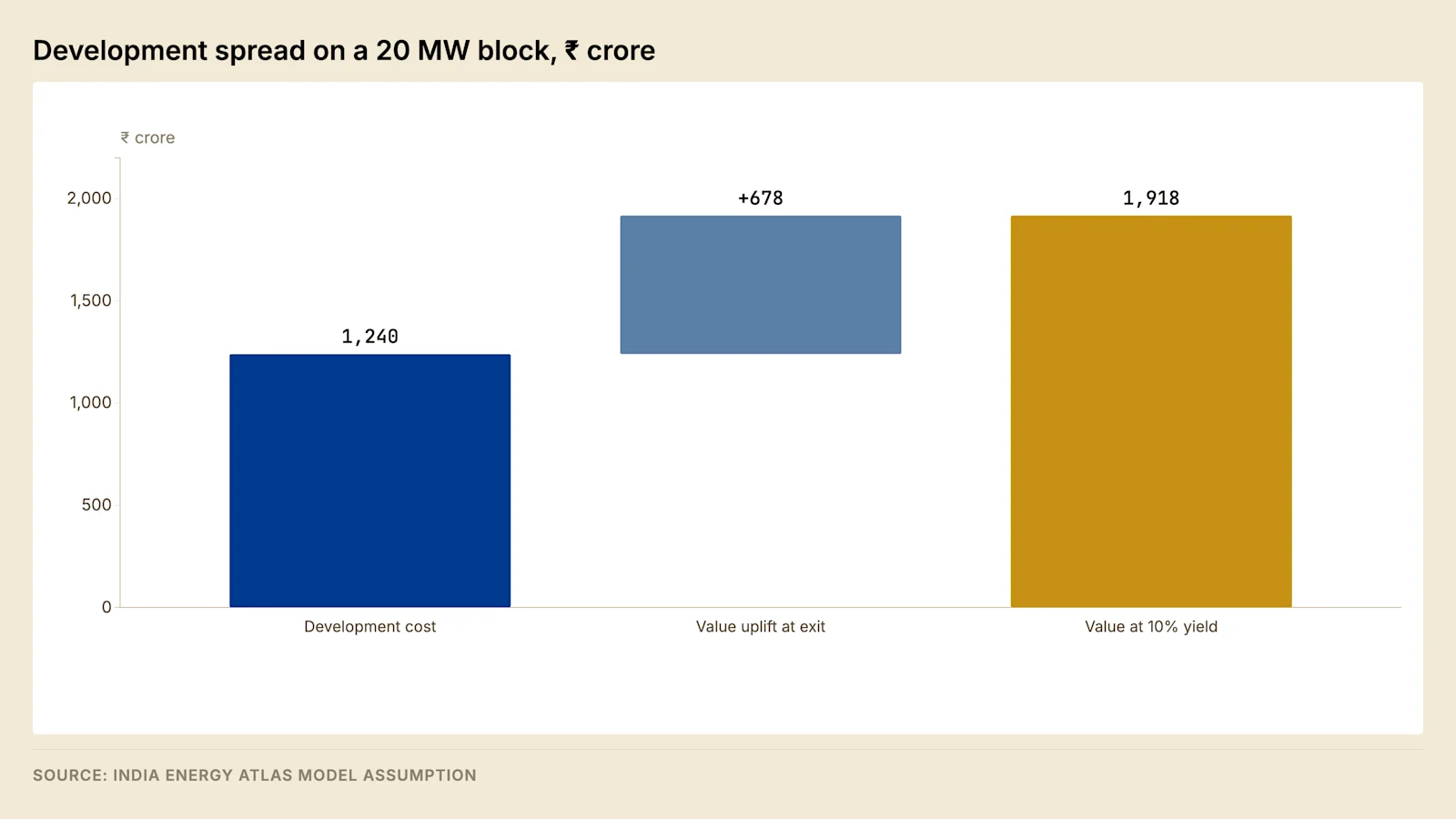
The spread is a function of two variables and neither is the operating performance of the asset. The first is the gap between the yield at which the asset is built and the yield at which it is sold, which is set by the market's view of stabilised data centre risk relative to development risk. The second is stabilised EBITDA, which the preceding posts address.
The exit yield is the more sensitive of the two and the less controllable. A change of one percentage point in the yield a buyer applies moves the value of this asset by a larger amount than a change of the same proportion in EBITDA, because the yield operates as a divisor. This is why the sector's exit assumptions are the first thing a credit committee should test and the last thing a development plan should take for granted.
4.1 The income approach and the components of the exit yield #
The valuation applied at exit capitalises a sustainable earnings figure at a yield. The earnings figure is contested first, because it determines what the yield is applied to.
Earnings basis | What it contains | Treatment by a buyer |
Trailing twelve months | Actual earnings, including any period below stabilised occupancy | Evidence, but not the capitalisation base for a ramping asset |
Run rate | The most recent period annualised | Tested for non-recurring items and for capacity let but not yet paying |
Contracted | Earnings from executed leases at full take-up | Discounted for take-up dates that have not arrived |
Stabilised | Earnings at the occupancy the asset is expected to hold | The base used, after a maintenance allowance and a normalised energy line |
The yield is assembled from four components, and a seller should establish which of them a buyer is moving when a yield is quoted. The first is the return available on a long-dated claim carrying little risk in the currency of the cashflow. The second is the premium for the country and the currency in which the earnings are denominated, which is where a foreign buyer's yield diverges from a domestic buyer's, and it is the component that moves as the capital mix rebalances toward domestic sources. The third is a premium for the sector and for the illiquidity of a single asset in a market with few transactions. The fourth is an asset-specific adjustment covering tenant credit, remaining lease term, the technical position of the building against the density the market requires, and the security of the power position, and it is the only component within the seller's control.
4.2 Capitalisation yield and the EV/EBITDA multiple #
A capitalisation yield and an earnings multiple describe one relationship from opposite sides, and converting between them reconciles the exit assumption used above with the multiples quoted for Indian platforms.
Model assumption — conversion between an exit yield and an earnings multiple
Exit yield | Implied EV/EBITDA multiple |
9.0% | 11.1× |
10.0% | 10.0× |
11.0% | 9.1× |
12.0% | 8.3× |
IDCR 2026 places implied Indian EV/EBITDA between eighteen and twenty-five times, and that multiple values a different object. It values a platform: an operating business with a development pipeline, a land position, a connection portfolio and a demonstrated ability to repeat the development. Applying its reciprocal to a single stabilised asset would value that asset as though it carried the platform's growth. The gap between the two is the value the market attributes to the pipeline rather than to the building, and it is why a platform sale and an asset sale price differently on the same underlying capacity.
Comparable evidence for the single-asset yield is scarce in India. Most disclosed transactions are platform-level or partial-stake, terms are rarely published, and the assets differ from one another in tenant credit, lease length and power position by more than the yield difference being estimated. An exit yield in a model is therefore either imported from another market and adjusted, or built up from a required return. The diligence question is which of the two has been done, because a required return presented as a market observation is not evidence of what a buyer will pay.
4.3 Sensitivity of value to the exit yield #
Model assumption — the same stabilised earnings capitalised at different yields
Exit yield | Value = EBITDA ÷ yield, ₹ crore | Spread over development cost, ₹ crore |
9.0% | 2,131 | 891 |
9.5% | 2,019 | 779 |
10.0% | 1,918 | 678 |
10.5% | 1,827 | 587 |
11.0% | 1,744 | 504 |
12.0% | 1,598 | 358 |
Development cost is fixed while value moves with the reciprocal of the yield, so the spread is geared to the yield in a way the value is not. Across the range in the table, value falls by roughly a sixth. The spread over development cost falls by close to half, so a credit committee testing the operating case in detail and accepting the exit yield as given has examined the smaller of the two exposures.
4.4 Break-even exit yield and the margin against stabilised earnings #
The spread disappears at the exit yield equal to the yield on cost, because both quantities are stabilised earnings divided by development cost. That identity supplies a break-even requiring no assumption beyond the two inputs already taken from Post 1, and it is the first of the two break-evens a credit committee should hold.
Model assumption — break-even points on the block in section 4
Break-even test | Calculation | Result |
Exit yield at which value equals development cost, per cent | 191.8 ÷ 1,240 | 15.5 |
Stabilised EBITDA at which value equals development cost at the exit yield used here, ₹ crore | 1,240 × 0.100 | 124.0 |
Headroom in stabilised EBITDA above that point, ₹ crore | 191.8 − 124.0 | 67.8 |
Headroom as a proportion of stabilised EBITDA, per cent | 67.8 ÷ 191.8 | 35.3 |
The two break-evens sit at different distances from the base case, and that difference is the shape of the exposure. The exit yield would have to rise by more than half from the level assumed here before the spread vanished. Stabilised earnings would have to fall by rather more than a third. Both movements are large against the sensitivities derived in the preceding posts, which is the reason a base case shows a spread at all rather than an accident of the assumptions chosen.
The combined case is the one worth documenting, because a movement in the exit yield reduces the earnings headroom without touching earnings. The break-even earnings figure is development cost multiplied by the yield, so it rises as the yield widens.
Model assumption — break-even earnings at two exit yields
Exit yield, per cent | Break-even stabilised EBITDA, ₹ crore | Headroom against stabilised EBITDA, per cent |
10.0 | 124.0 | 35.3 |
12.0 | 148.8 | 22.4 |
At the upper end of the range used in section 4.3 the earnings headroom falls to under a quarter, so a yield expansion arriving alongside a ramp shortfall consumes the spread considerably faster than either movement does alone. The two arrive together more often than independence would suggest, because a market that reprices data centre risk upward is a market in which absorption has slowed.
The same arithmetic produces the switching values described in section 2.4. Each variable can be expressed as the proportion by which it may move before the spread is exhausted, which puts a yield assumption and an earnings assumption on one scale and allows a committee to rank them. Ranked that way, the exit yield governs, which is the conclusion section 4.3 reaches from the other direction.
5. Erosion of the spread #
The spread is not realised automatically, and the mechanisms that erode it are the subjects of the preceding posts.
Mechanism | Effect | Post |
Delayed energisation | Postpones the start of the ramp, compounding through subsequent years | 3 |
Slow occupancy ramp | Extends the period below cost of capital | 1 |
Topology limiting the tenant pool | Sustained vacancy or a rent discount | 4 |
Energy cost benefit passing to the tenant | Removes a recurring margin from the operator's line | 7 |
Efficiency improvement funded but not captured | Operator funds an improvement in the tenant's cost base | 9 |
Unhedged tariff exposure at exit | Buyer discounts for a cost the seller could have fixed | 7 |
The last row is the one that most often surprises a seller. A buyer underwriting a twenty-year hold prices the risk that energy cost rises over that period, and a facility with contracted supply presents a lower risk than one exposed to tariff revision. The discount applied for that exposure is capitalised at the exit yield, so a recurring cost difference becomes a capital difference roughly ten times its annual size.
The same capitalisation works in the other direction, which is the argument for treating procurement as a capital activity rather than an operating one.
Model assumption — capitalisation of a recurring saving at a 10% exit yield
Recurring item | Annual value | Capitalised value |
Group captive structure against DISCOM supply | ₹44.4 crore | ₹444 crore |
State tariff subsidy at ₹1 per unit | ₹20.9 crore | ₹209 crore |
Against a development spread of ₹678 crore, a procurement decision taken during development is worth a substantial fraction of the entire spread. This is why Post 7 belongs in the capital plan rather than in the operating budget, and why procurement structuring undertaken after stabilisation captures a fraction of what the same structuring captures before a sale.
5.1 Conditions under which a recurring item capitalises #
The multiplier applied to a recurring saving is the reciprocal of the exit yield, so at the yield used here an annual amount is worth ten times its size when the asset is sold. The multiplier applies only where three conditions hold.
Durability. The saving persists over the period the buyer underwrites. A contract expiring inside the buyer's hold assumption capitalises over its remaining term only.
Transferability. The saving survives the transaction. A group captive structure depends on the ownership and consumption conditions set out in Post 7, and a change of control at the consuming or the generating entity can break them.
Evidence. The saving is visible in audited accounts, in metered records, or in a contract the buyer can read. A saving traceable to none of the three is treated as a forecast, and a forecast is not capitalised.
Recurring item | Condition it depends on | What breaks it |
Group captive tariff advantage | Ownership and consumption thresholds | Change of control, or a change in the consuming entity's draw |
Open access supply at a contracted rate | Approval validity and the charge stack applicable | Renewal, a tariff order revising surcharges, waiver step-down |
State tariff subsidy | Eligibility conditions in the policy instrument | Transfer, or a change in the qualifying investment |
Efficiency improvement | Whether the lease returns the saving to the tenant | A pass-through energy clause |
The fourth row reverses the sign of the investment that produced it. Where energy is recovered at landed cost, an improvement funded by the operator reduces the tenant's bill and leaves the operator's earnings unchanged, so the capitalised value accrues to the tenant while the capital was spent by the seller.
5.2 Irreversibility of each loss mechanism #
Every mechanism in the table above has a point before which it is a decision and after which it is a price. The interval between the two is short for some and runs the length of the programme for others, and knowing which is which determines where a developer's attention is worth spending.
Mechanism | Last point at which it can be prevented | What it becomes afterwards | Post |
Topology limiting the tenant pool | Design freeze, before the electrical package is ordered | A rent discount or sustained vacancy, capitalised at the exit yield | 4 |
Energy benefit passing to the tenant | Execution of the anchor lease, which sets the form the rest follow | A recurring margin recoverable only through a lease variation | 7 |
Procurement structure not established | Before commercial operation, because approval and qualification take time | A saving that accrues to the buyer rather than to the seller | 7 |
Delayed energisation | Site selection, before the connection application is lodged | A ramp that starts late and compounds through the hold | 3 |
Slow occupancy ramp | Pre-leasing, before the first operating year closes | An extended period below the cost of capital | 1 |
Unhedged tariff exposure | Before the data room opens | A capitalised discount applied by the buyer | 7 |
The cost of a given defect rises through the programme in a defined way. A leak prevented at design costs a design change, priced in competition before any contract is let. The same leak prevented during construction costs a variation, priced by a contractor already on site and facing no competitive tension. The same leak identified at diligence costs a capitalised deduction, which is the annual amount multiplied by the reciprocal of the exit yield and is therefore the largest of the three by the multiple set out in section 5.1.
Two of the six cannot be reversed at all once the counterparty holds the benefit. A lease that returns the energy saving to the tenant, and a lease carrying an efficiency commitment the operator cannot evidence, are both positions the tenant would have to be persuaded to give up, and a tenant approached during a sale process understands why the approach is being made.
The sequencing consequence for a seller runs against instinct. The findings a seller can still fix in the months before a process are the documentary ones, being an incomplete metering record, a missing calibration certificate, or an unregistered charge. The findings that move the price are the contractual ones, and those were fixed or lost years earlier, at the design freeze and at the anchor lease. A seller who begins preparing at the point of appointing an adviser has access to the first set and none to the second.
6. What buyers discount #
An institutional buyer conducts diligence against a defined list, and each unresolved item is priced rather than negotiated away.
Power evidence. A signed connection agreement, sanctioned load, the energisation certificate, and the metering arrangement. A facility whose sanctioned load exceeds its measured peak, as examined in Post 2, carries a recurring demand charge the buyer will identify and price.
Contracted cashflow. Lease tenor, escalation, tenant credit, break rights, and the treatment of the energy line. A portfolio with a short weighted average lease expiry is discounted regardless of its current occupancy.
Efficiency and its contractual treatment. Measured annualised PUE under a stated measurement category, any PUE cap and its calibration, and whether the metering exists to demonstrate compliance. A cap the seller cannot evidence is a liability the buyer assumes.
Water and environmental position. Assured supply under drought conditions, any allocation constraint, and the consent position for the generator plant. The regulatory exposure on generation described in Post 6 is a known unpriced item, and a buyer aware of it will price it.
Land and approvals. Title, contiguity for future phases, and the status of every approval on which occupancy depends.
Field note. The documentary output of the connection process described in Post 3 is a financing and sale asset in its own right, not merely an engineering record. Developers who assemble that evidence continuously through construction present a diligence pack that supports the exit yield. Developers who reconstruct it at sale present gaps, and gaps are priced.
6.1 The data room #
A seller assembles the same evidence the lender required, in the order a buyer's advisers will read it. Each absent item is a finding rather than a gap.
Section | Contents | What an absence signals |
A Corporate and title | Constitutional documents, shareholding chain, title chain, encumbrance searches, contiguity | A title question that will become a condition to completion |
B Power | Connection agreement, sanctioned load record, energisation certificate, metering and calibration, tariff orders, open access and captive documentation, demand and penalty history | An unevidenced power position, priced at the most expensive plausible case |
C Construction | Contract and variations, completion certificates, integrated systems test reports, statutory clearances, as-built drawings | An installed condition that cannot be verified without survey |
D Leases and tenants | Executed leases, take-up schedules, escalation and break provisions, service level history | A weighted average lease expiry the buyer will compute conservatively |
E Operations | Annualised PUE and WUE with the measurement category stated, DCIM exports, incident log, maintenance records | A performance commitment that cannot be demonstrated |
F Environment and water | Consents, water allocation and its conditions, generator consent position, fuel and emissions records | A regulatory exposure the buyer assumes and prices |
G Financial and tax | Audited and management accounts, energy reconciliation, notification status, litigation | An earnings figure that cannot be normalised |
H Insurance | Policies, claims history, reinstatement basis | Cover the buyer replaces at completion |
Section B carries the most weight because a buyer cannot reconstruct it independently. Every document in it originates with a utility, a licensee or an inspectorate and is dated. Section E is the one most often assembled retrospectively, and a PUE record produced from a spreadsheet rather than from metered data under a stated ISO/IEC 30134-2 category evidences the calculation and not the performance.
6.2 Vendor due diligence and its limits #
Vendor due diligence is a set of reports commissioned by the seller before a process opens, covering the financial, tax, legal, technical and environmental position, and written so that a buyer and its lenders can be given reliance on them.
The value sits in timing rather than in content. A finding surfaced by the seller's own advisers arrives while the seller still controls the remedy and while no price is on the table. The same finding surfaced by a bidder's advisers arrives after a non-binding offer has been made, at a point where the only available response is an adjustment to that offer.
Workstream | What the report can establish | What a buyer will verify independently |
Financial | The earnings basis, the energy reconciliation, the working capital position | The normalisation adjustments, against the underlying ledgers |
Tax | The filing position, open assessments, the notified status | The conditions attaching to any benefit, and their survival on a transfer |
Legal | Title chain, encumbrances, contract summaries, litigation | The connection agreement and every consent depending on it |
Technical | Design against the availability class, condition, capital expenditure forecast | The metered performance record and the spares position, on site |
Environmental and water | Consents held, allocation conditions, generator position | The discharge and abstraction position against actual operation |
The reliance letter determines what the reports are worth. A report addressed to the seller alone is background reading for a buyer and is not underwritable by the buyer's lender, which will appoint its own technical adviser regardless, for the reason given in section 2.5. Reliance is normally extended on payment and against a liability cap, and the cap is itself a diligence item, because a report whose author's liability is capped well below the exposure it addresses supports the timetable rather than the price.
Three items in this asset class are re-run by every serious bidder whatever the vendor pack contains. The power position in Section B is re-run because the documents originate with third parties and a buyer will want them from the source. The metered performance in Section E is re-run because a measurement is verified at the meter rather than in a report, which is the subject of the site visit in section 7.5. The title chain in Section A is re-run because a buyer's counsel will not take another firm's search.
The scope is read before the findings. A workstream omitted, or a period excluded, is itself a finding, and a buyer's advisers begin by comparing the scope of each report against the checklist in section 6.1. The omission most common in this asset class is a technical scope that covers the building and stops at the point of supply, leaving the connection, the metering and the utility relationship outside the report, which is the section of the pack a buyer cannot reconstruct on its own.
7. Exit routes #
Route | Typical buyer | What it prices | Constraint |
Asset sale at stabilisation | Infrastructure fund, pension capital | Contracted cashflow at a stabilised yield | Requires stabilisation and a clean diligence pack |
Platform sale | Strategic operator, larger platform | The operating business and its pipeline | Requires scale and a repeatable development capability |
Public listing | Public market | The platform at a market multiple | Requires scale, governance and disclosure |
Partial stake sale | Institutional co-investor | The same asset, retaining operational control | Values the asset without releasing the sponsor |
Several Indian operators are pursuing listings. A listing prices a platform carrying both colocation and accelerated compute revenue at a blend of the two multiples rather than at the higher, which is the mechanism behind the separate-vehicle argument in Post 11.
The capital position supporting these exits has shifted. Foreign institutional investors supplied the substantial majority of capital deployed through 2024, and the domestic conglomerate wave since then is rebalancing that mix. A more domestic buyer base changes both the currency in which returns are assessed and the exit yield applied, and the direction of that change is not yet established.
7.1 Locked box and completion accounts #
Both mechanisms produce a price. They differ in the date from which the buyer owns the economics, and in who carries the risk between signing and completion.
Feature | Locked box | Completion accounts |
Price fixed by reference to | A historic balance sheet at the locked box date | Accounts drawn up at completion |
Economic transfer | From the locked box date | At completion |
Risk between signing and completion | Buyer | Seller |
Protection for the intervening period | Leakage covenant, permitted leakage, interest ticker | Not required |
Price certainty at signing | Complete | Provisional, subject to adjustment |
Dispute exposure | Leakage claims | The adjustment mechanism itself |
Three features of a data centre make the choice consequential. Recovered energy is consumed continuously and billed in arrears, so unbilled energy and the corresponding payable sit in working capital in amounts that are large against the rent line and that move with the tariff. Fit-out accruals close to completion are material, and their cut-off determines who funds them. Tenant deposits and prepaid rent are cash inside the borrower that is not the seller's to extract.
Under a locked box each is handled in the definition of leakage and permitted leakage rather than by adjustment. Under completion accounts each requires an accounting policy stated in a schedule and ranked above the seller's historic practice, because practice on the energy line varies between operators for the reasons in Post 1 §3.2.
7.2 Warranties, indemnities and the limitation architecture #
Warranties and indemnities allocate different classes of risk and are qualified differently. A warranty is a statement of fact, is qualified by what the seller discloses, and produces damages measured by the reduction in the value of what the buyer acquired. An indemnity is a promise to pay on a defined event, is not qualified by disclosure, and produces a payment measured by the loss actually suffered.
The limitation architecture is negotiated as a set: a de minimis below which an individual claim cannot be brought, an aggregate threshold below which claims cannot be recovered, a cap on total recovery, and time limits that differ between title, tax and general warranties. Disclosure operates against the warranties, so a matter fully disclosed is a matter the buyer has accepted, which is why the disclosure letter is negotiated with the attention given to the warranty schedule.
The warranties specific to this asset are the ones a general corporate schedule omits: that the sanctioned load and the connection agreement are as stated and in good standing; that energisation and the statutory clearances have been obtained; that measured annualised PUE for a stated period under a stated ISO/IEC 30134-2 category is as represented; that any PUE or availability commitment in a lease can be demonstrated from installed metering; that the consents for the generator plant are in force; and that the water allocation is as stated and unconditional. Each corresponds to a diligence item in section 6, and an item the seller cannot warrant will reappear as a deduction from price.
Escrow, retention and warranty and indemnity insurance secure recovery, and the choice follows the seller's position after completion. A fund vehicle distributing proceeds to its investors cannot stand behind a warranty for several years, so a buyer requires a retained fund or an insurer in place of the seller's covenant.
7.3 Change-of-control consents and conditions to completion #
A transfer moves a bundle of consents, and each consent depending on a third party's discretion belongs in the conditions to completion rather than in the warranties, because a warranty compensates after the event while a condition secures the position before it.
Item | Why a transfer affects it | Consequence if not obtained |
Connection agreement and sanctioned load | Registered against a named consumer; assignment needs consent | A building without a supply, or a fresh application |
Open access approval | Granted to a consumer for a period against stated conditions | Reversion to utility supply at the higher landed cost |
Group captive qualification | Depends on ownership and consumption conditions | Loss of the tariff advantage, capitalised at the exit yield |
State incentives | Granted against conditions attached to the investor or the investment | Loss of the subsidy, and sometimes recovery of amounts received |
Leases | Tenant change-of-control provisions and operator-specific undertakings | A tenant consent right, or a break |
Generator and environmental consents | Issued to a named operator | Operation without a consent |
The group captive row carries the largest capitalised consequence, because the qualifying conditions attach to ownership as well as to consumption and are set out in Post 7. A share sale preserves the borrower and its consents and triggers every change-of-control provision. An asset sale leaves those provisions untouched and requires each consent to be obtained afresh. Neither route avoids the consent question.
7.4 The sale process from teaser to completion #
A sale runs through a defined sequence, and each stage exchanges a quantity of information for a quantity of commitment. The seller's leverage is highest early, when the information released is smallest, and falls as disclosure accumulates.
Stage | What the seller provides | What the seller receives | What moves the price |
Preparation | Vendor diligence, the data room, a valuation view | Nothing | Findings fixed before disclosure |
Teaser | Capacity, occupancy, tenant profile and power position, without identification | A population of interested parties | Consistency with what the data room will show |
Confidentiality agreement | Access to the information memorandum | A named counterparty | Nothing |
Information memorandum | The full commercial description | Indicative interest | The earnings basis presented, per section 4.1 |
Non-binding offers | Nothing further | Price, structure, conditions and funding evidence | The quality of the disclosure so far |
Data room access | Sections A to H | Written questions, which reveal each bidder's concerns | Every absence, per section 6.1 |
Management presentation and site visit | Access to the operator and to the facility | The bidder's technical assessment | The physical position against the record |
Confirmatory diligence | Answers and further documents | Advisers' reports on the bidder's side | Findings the vendor pack did not cover |
Binding offers | The sale agreement, for mark-up | Price, and the legal position each bidder will accept | The warranty and indemnity position |
Exclusivity | Sole access | A committed counterparty | Leverage transfers to the buyer here |
Signing | An executed agreement | Certainty of terms | Nothing further, absent a material adverse change |
Conditions to completion | Consent applications | Third-party consents, per section 7.3 | A consent refused or made conditional |
Completion | Transfer, and release of the seller's security | Proceeds, subject to the mechanism in section 7.1 | The adjustment, or a leakage claim |
Two features distinguish this sequence for a data centre. The conditions to completion are dominated by third-party consents, so the interval between signing and completion is set by a licensee and a state rather than by the parties, and the long-stop date has to be negotiated against the consent with the longest recorded history rather than against an average of them. The second feature is that a teaser is a capacity statement, which makes the definitions in Post 1 §1.1 binding on it. A teaser quoting built capacity against a data room evidencing energised capacity produces a reconciliation at the first bidder question, and a reconciliation at that stage costs more than the capacity it appears to recover.
A non-binding offer is priced on what the seller disclosed and not on what is true, so a high indication won by omission is a price reduction deferred rather than avoided. The reduction lands during confirmatory diligence, at a point when the bidder population has narrowed and the competitive tension that produced the indication has fallen away.
Exclusivity is the point at which leverage transfers. Everything the seller intends to resist should be resisted before it is granted, because after that point the seller's alternative is to restart a process that every remaining bidder will know has failed once.
Completion in this asset class carries a mechanical step a corporate completion does not. The metering, the connection documentation and the utility relationship transfer as records and as a relationship rather than as assets, and a completion that moves the shares without moving the utility contact, the meter calibration file and the demand history leaves the buyer unable to evidence its own position at the first tariff revision it faces.
7.5 The management presentation and the site visit #
The management presentation tests the operator against the data room. The site visit tests the data room against the building, and it is the more consequential of the two, because a physical finding cannot be answered with a document.
The presentation covers the operating history and the incident log, the capacity position across the states defined in Post 1 §1.1, the customer relationships and the renewal outlook, the maintenance regime and its record, and the plan for the phases not yet built. A bidder is listening for two things: whether the operator's account of an incident matches the log filed in the data room, and whether the renewal outlook is supported by anything a tenant has actually said.
The site visit is attended by the buyer's technical adviser, and its scope follows the physical chain from the point of supply inward.
What the visit tests | Evidence sought on site | Consequence of a gap |
Incoming supply and metering | The metering installation, its calibration record, and where it sits in the system | The demand and energy record cannot be tied to the accounts |
Transformers and switchgear | Installed rating, condition, and the spares held | A replacement exposed to the lead time in Post 3 |
Uninterruptible supply and batteries | Installed capacity, battery age, and the last discharge test | Replacement capital expenditure inside the buyer's early years |
Generator installation | Plant condition, fuel arrangement, and the consent position | The regulatory exposure described in Post 6 |
Cooling plant | Whether the design condition is achieved at the observed load | An efficiency claim the plant does not support |
Containment and airflow | The arrangement described in Post 5 §3.4, as built | A density limit lower than the marketed figure |
White space | Deployed density against design density | Stranded capacity, in the sense used in Post 9 |
BMS, EPMS and DCIM | The instrumentation behind the reported efficiency figure | Section E of the data room cannot be verified |
Section E is the section the visit exists to verify, because a measurement category can be confirmed only by identifying the meters and the boundary on which they sit. The adviser asks to be shown the instrument producing the reported figure and the point in the distribution system it occupies, and the measurement category defined in Post 9 §4 cannot be evidenced without both.
Two items on the list convert directly into the buyer's own capital plan rather than into a price adjustment. Battery age sets the date of a replacement the buyer will fund, and the spares position sets what the buyer must hold against a lead time it does not control. Both are read at the visit and neither appears in a data room index.
Sequencing matters more than the content of the visit. A site visit held after binding offers converts every physical finding into a renegotiation of the sale agreement rather than into a price input, and a seller who resists an early visit has told the bidder where to look.
8. What would change the calculation #
Three developments would alter the analysis at the level of the spread rather than at the level of individual line items.
The first is any compression or expansion in the exit yield applied to Indian data centre assets. The spread is a function of the gap between construction and exit yields, and the exit yield is set by capital market conditions rather than by anything a developer does.
The second is whether energisation risk is reduced systemically, through the Data Centre Economic Zones under consultation or through the wider adoption of the distribution licence route described in Post 3. A reduction in that risk raises what a buyer will pay for a de-risked asset and reduces the development spread available, because the spread is partly compensation for carrying the risk.
The third is the sector's capital requirement against the capital available. The Review places the cumulative capex required for its base case in the tens of billions of dollars, with roughly half already committed, and Deloitte's projection for cumulative Indian data centre investment by 2030 is larger again. A shortfall against that requirement supports the spread. A surplus compresses it.
8.1 Decision triggers and the evidence that would confirm each #
Each of the three developments is observable before it appears in a transaction, and each has a source that would register the change first.
Trigger | Observable | Where it would appear first | Effect on the spread |
Exit yield compression or expansion | A completed single-asset transaction with disclosed terms | Transaction disclosure, and the platform multiples in IDCR 2026 | Direct, through the divisor in section 4 |
Energisation risk reduced systemically | Data Centre Economic Zones moving from consultation to an operative instrument | The policy register, which separates operative instruments from proposals | Reduces the risk premium, and reduces the spread available |
Wider adoption of the distribution licence route | A second and a third licence granted on the precedent described in Post 3 | State cabinet decisions and licence registers | The same direction, at a slower pace |
Capital mix rebalancing toward domestic sources | The share of committed capital sourced domestically | Capital tracker records, per IDCR 2026 | Moves the country and currency component in section 4.1 |
Capital requirement against capital available | Committed capital measured against the sector requirement | IDCR 2026 and the Deloitte projection | A shortfall supports the spread, a surplus compresses it |
Listing outcomes | A completed listing at a disclosed valuation | Public market disclosure | Establishes a platform reference the asset market lacks |
The horizon over which these resolve is uneven. A single completed transaction with disclosed terms would change the exit yield assumption immediately, because the market currently has none, and one credible observation will carry more weight than its sample size deserves for exactly that reason. The policy and licence triggers resolve over a longer period and are visible in stages, so they can be monitored rather than awaited. The capital mix moves continuously and is observable only in arrears.
The discipline this imposes on a model is the discipline of the Review's own falsification table in section 2. An assumption is recorded together with the observation that would falsify it, and it is re-tested on a stated cycle rather than at the point where a transaction forces the question and the answer arrives too late to act on.
FAQ #
What is the development spread on an Indian data centre? The difference between development cost and the value of the completed asset at a stabilised exit yield. On the model in section 4, an asset built at a mid-teens yield on cost and sold at a stabilised yield of ten percent produces a spread of ₹678 crore on the block modelled there.
What do lenders test before financing an Indian data centre? Contracted capacity at close, weighted average lease expiry, tenant credit, energisation certainty, power cost certainty, land title, and sponsor completion support. Energisation certainty is the test most specific to this asset class in this market.
What changed in Indian data centre tax in 2026? The Finance Act conditions notified-data-centre benefits on the facility being established under a notified scheme and owned and operated by an Indian company. The Budget introduced a tax holiday to 2047 for eligible foreign cloud service providers and referenced data centres as critical digital infrastructure.
Why is procurement a capital decision rather than an operating one? Because a recurring saving is capitalised at the exit yield when the asset is sold. A saving secured during development is worth roughly ten times its annual value at exit, and the same structuring undertaken after stabilisation captures a fraction of that.
What do institutional buyers discount at diligence? Unevidenced power position, short weighted average lease expiry, PUE commitments that cannot be demonstrated from metering, unresolved water and environmental exposure, and incomplete land and approval records. Each is priced rather than negotiated away.
What does a construction lender require before the first drawdown? A defined list of conditions precedent covering corporate authority, land title, the construction contract, the connection agreement and approvals, insurance, the security package and its registration, legal opinions, and evidence that the agreed proportion of equity has been contributed. The list governs how much of the programme the sponsor funds before the lender is committed to fund anything.
Sources #
Finance Act 2026 and Union Budget 2026 provisions on notified data centres
Houlihan Lokey, Data Center India Edition, December 2025, via IDCR 2026
Global Data Center Hub, Q1 2026 capital tracker, via IDCR 2026
Deloitte, India data centre investment projection to 2030, via IDCR 2026
India Data Centre Review 2026 (v2.3, edition cutoff 28 July 2026), Chapters 4, 12 and 14 — India Energy Atlas
Sources and uses, the development spread, the loss mechanisms and the capitalisation table are modelled by India Energy Atlas and are labelled as model assumptions. IDCR 2026 figures are quoted at the locked edition snapshot of 13 July 2026; live Atlas products may carry newer records.
This concludes The Indian Data Centre Playbook. The series index and the underlying models are at energymap.in. For the measured GenAI load profile analysis underpinning Posts 2, 3, 4, 6, 7 and 10, see the working note.
India Energy Atlas builds India's grid intelligence layer — substation headroom, interconnection queues, market prices and carbon intensity in one place. See energymap.in/pricing.
Sources & method
- Finance Act 2026 and Union Budget 2026 provisions on notified data centres - Houlihan Lokey, Data Center India Edition, December 2025, via IDCR 2026 - Global Data Center Hub, Q1 2026 capital tracker, via IDCR 2026 - Deloitte, India data centre investment projection to 2030, via IDCR 2026 - India Data Centre Review 2026 (v2.3, edition cutoff 28 July 2026), Chapters 4, 12 and 14 — India Energy Atlas Sources and uses, the development spread, the loss mechanisms and the capitalisation table are modelled by India Energy Atlas and are labelled as model assumptions. IDCR 2026 figures are quoted at the locked edition snapshot of 13 July 2026; live Atlas products may carry newer records. Photography: - Photo by Lukas Kienzler on Unsplash (https://unsplash.com/photos/a-view-of-a-city-with-tall-buildings-G0jaBkyOmkw?utm_source=india_energy_atlas&utm_medium=referral)