
India's Data Center Market at a Glance
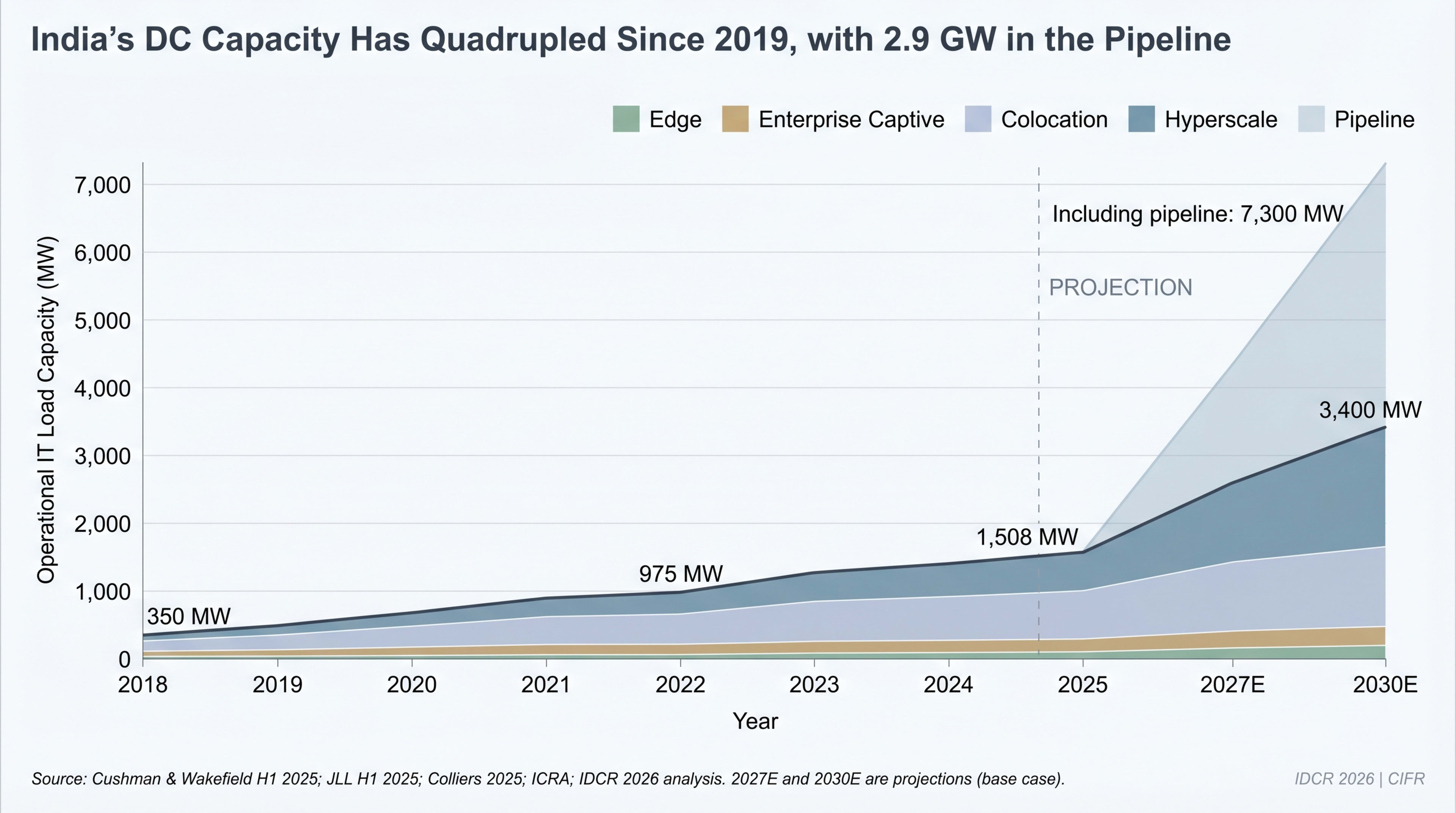
India's data centre market has quadrupled from 350 MW to approximately 1.5 GW in six years, with a further 3.8 GW under construction or in advanced planning. Three hyperscalers — AWS, Microsoft, and Google — have collectively committed $45.2 billion in cloud and data centre infrastructure since October 2024, signalling a phase transition from opportunistic deployments to strategic, decade-long infrastructure bets. Vacancy rates in core markets have compressed to 4.3%, well below the APAC average, confirming structural undersupply. This chapter maps the forces driving the boom, quantifies execution risk by hyperscaler, examines geopolitical tailwinds from MENA instability, and presents scenario-weighted projections through 2030. The central finding: India's binding constraint is not demand but supply — specifically power grid capacity, water infrastructure, and regulatory throughput.
Operational IT load
end-2025; ~4× the 2018 baseline
Pipeline through 2030
under construction or advanced planning
Hyperscaler pledges
AWS + Microsoft + Google, since Oct 2024
Core-market vacancy
vs ~8.5% APAC average
July 2026 Evidence Review
The 2026 outlook identified power connections, legally effective approvals, water-secure sites, and commissioned network assets as the principal capacity-delivery requirements. Evidence available in July 2026 includes state policy instruments, utility proceedings, mapped substations, and project lifecycle records.
| January 2026 assessment | Evidence available by 13 July | Status | Additional evidence required |
|---|---|---|---|
| Grid connection is a principal delivery constraint | State policy updates specify power treatment; large-load cost allocation is entering regulator and utility proceedings; network projects can be monitored between annual editions | Trend confirmed | Executed connection agreements, sanctioned MVA, completed bays, and energisation dates |
| Announced capacity requires a conversion adjustment | The Substations map identifies candidate assets and the Substation Tracker records observed lifecycle signals; the locked snapshot excludes published bus-level headroom | Partially evidenced | Utility studies reporting transformer and bay availability and upstream reinforcement obligations |
| State competition depends on implementation capacity | Andhra Pradesh, Maharashtra, and Gujarat instruments in the July policy register provide further detail on approvals, power, and implementation status | Trend confirmed | Comparable clearance time, connection time, and realised capacity by state |
| New markets require verifiable infrastructure corridors | Odisha can be screened through mapped substations, a ranked demand grid, and time-aware project signals | Screening evidence available | Project-specific land, water, fibre, environmental, and utility evidence |
| Large-load reinforcement requires defined cost allocation | Dedicated-facility and large-load policy proceedings are available in India and in enacted or proposed frameworks in other jurisdictions | Emerging in India | Final Indian tariff orders and connection agreements allocating dedicated and upstream costs |
The July review confirms increased availability of infrastructure and regulatory evidence. Mapped assets, tracker signals, and policy announcements require supporting records on capacity, commissioning, and legal status. The update records available evidence and identifies the information required for project-level verification.
Market Capacity and Investment Growth
India's data-centre investment commitments increased substantially in 2025. Between October and December 2025, AWS, Microsoft, and Google collectively announced $67.5 billion in cloud and data-centre infrastructure commitments for India. Eighty percent was announced in December (Washington Post· Washington PostDec 2025). Approximately $45.2 billion is attributable to data-centre investment: AWS $12.7 billion, Microsoft $17.5 billion, and Google $15 billion. Amazon's broader $35 billion India commitment also includes retail, logistics, and consumer financial services.
India's total operational IT load reached approximately 1,520 MW by end-2025 according to JLL· JLLH1 2025. Cushman & Wakefield· Cushman & Wakefield2025, using a narrower colocation methodology, reports approximately 1,300 MW. Reported capacity is approximately four times the 2018-19 baseline of 350 MW, representing CAGR above 25%. CBRE's 2026 outlook· CBRE2026 projects 1.7–2.0 GW operational by year-end, supported by $30 billion of deployment and approximately 500 MW of new supply in 2026 (CBRE via Business Today· Business TodayApr 2026).
Pipeline visibility through 2030 stands at approximately 3.8 GW under construction or in advanced planning. If executed on schedule, India's installed base would exceed 5.3 GW by end-2030, placing the country among the top three Asian markets after mainland China and Japan. The execution lag has compressed from 24 months in 2023 to 18-24 months today; faster, but still well outside the 12-month metronome that hyperscalers run elsewhere. Live snapshots of grid load and fuel mix that frame DC build-out are tracked across India Energy Atlas state pages; the data-centres dashboard aggregates them at a national level.
Why 2025 Became an Inflection Point
Three structural factors converged:
- US–China decoupling narrative. US cloud providers face political pressure to reduce exposure to TSMC fabs and PRC manufacturing. India positions as a politically acceptable alternative for AI compute, soft-hosted cloud, and edge workloads. AWS's prior $3.7 B India footprint anchors an additional $12.7 B by 2030 committed in late 2025 (CNBC, AWS Q1 2026· CNBCApr 2026).
- Talent and regulatory arbitrage. India's all-in cost structure (power, cooling, labour) is 40-50% below Singapore for equivalent colocation. Layered on top, India's data-localisation mandates — RBI payment-systems rules, the DPDP Act 2023, and the IT Rules 2021 amendments — require operators serving Indian users to host domestically. Compliance mandates capacity, which justifies hyperscaler investment.
- Global AI inference boom. Training centralised (mostly US); inference distributed (everywhere). India's population, e-commerce density, and fintech base create the world's largest single-language inference market. Google's December 2025 announcement bundled $15 B of AI infrastructure with the America-India Connect subsea programme to Singapore, South Africa, and Australia; it also confirmed a gigawatt-scale Adani-partnered campus in Visakhapatnam plus expansions in Noida (Business Today, Apr 2026· Business TodayApr 2026).
Grid carbon intensity is also more favourable than the headline coal-share suggests. Live national average is currently 906 gCO₂/kWhlive · 03 Oct 2026, 01:30 IST, although annual renewable matching does not by itself establish 24/7 carbon-free operation. The India Energy Atlas carbon-intensity dashboard publishes the same series at hourly resolution.
Keep reading — free, takes 30 seconds
India's Data Center Market at a Glance continues with 2,222 words and 8 figures.