
ESG, Sustainability, and the Transparency Gap
India's data centre operators disclose less than any comparable market. The regulatory framework taking shape — and what it will require.
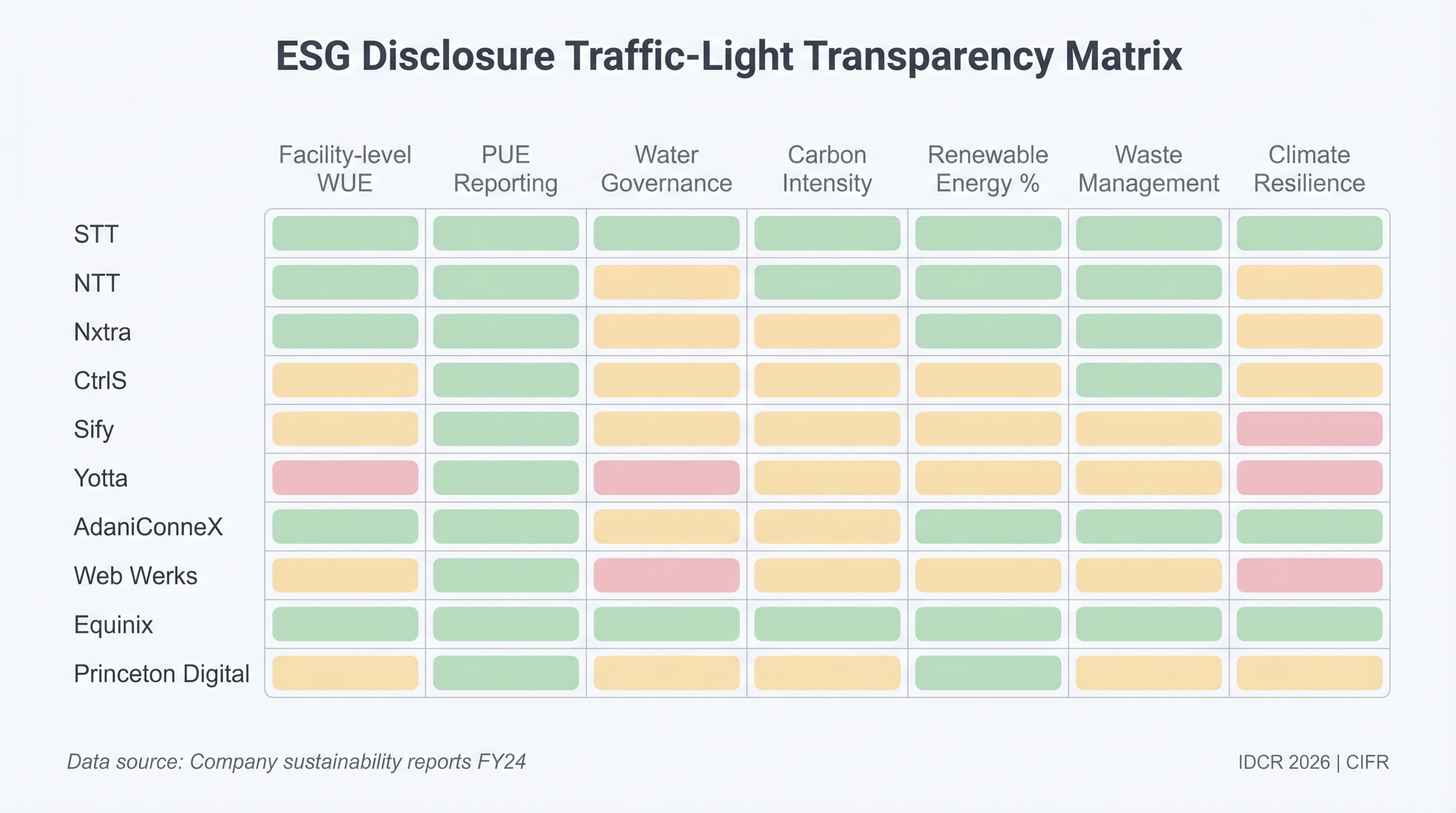
India's data centre industry consumes ~13 TWh of electricity and ~150 billion litres of water annually --- yet no Indian operator publicly reports facility-level water usage effectiveness. This transparency deficit is the single largest impediment to India's data centre sector accessing the next wave of green infrastructure capital.
Operators reporting facility-level WUE
zero — across all India
DCs in water-stressed zones
S&P Sustainable1 high or extreme
Grid emission factor
tCO₂/MWh (CEA v21.0; FY24-25)
Indian DC investment, 2030E
Deloitte; ESG-mandated capital share rising
Atlas references: live grid intensity 906 gCO₂/kWhlive · 03 Oct 2026, 01:30 IST · /carbon-intensity · /carbon-markets · methodology.
No Indian Operator Publicly Discloses Facility-Level Water Usage
The Earth Journalism Network· EJN and Down To Earth· Down To Earth2025 investigation (2025) found that no major Indian data centre operator publicly reports facility-level Water Usage Effectiveness (WUE). State water-stress context: Maharashtra, Karnataka, Tamil Nadu, Telangana — all four DC hubs are in 'High' or 'Extremely High' WRI Aqueduct stress bands. Operators cite aggregate water consumption in corporate sustainability reports, but facility-level disclosure — the standard enabling meaningful comparison and accountability — remains absent (Source: Down To Earth/EJN, 2025).
The available water data is fragmentary and insufficient for benchmarking. Sify Technologies reported total water consumption of 6.1 million kilolitres in FY2024, the most granular disclosure from any Indian operator. STT GDC India reported 419,204 kilolitres --- but this figure covers its entire India portfolio without facility-level breakdowns. Nxtra by Airtel disclosed 216,357 kilolitres in its 2025 ESG report but did not publish 2023 or 2024 figures, making trend analysis impossible. AdaniConneX's parent company Adani Enterprises reported total water withdrawals of 4,390 million litres across all business operations --- a 59% increase from 2022 --- but does not disaggregate data centre water use from other industrial operations (Source: Down To Earth/EJN, 2025; company ESG reports).
The disclosure gap is a market-access constraint. Global institutional investors managing green infrastructure mandates increasingly require facility-level environmental metrics as a condition of capital deployment. Indian operators seeking to raise international capital at competitive rates face disadvantage relative to peers in Singapore, the Nordics, and the US, where facility-level PUE and WUE disclosure is becoming standard practice (Source: CEEW, 2025).
Keep reading — free, takes 30 seconds
ESG, Sustainability, and the Transparency Gap continues with 1,633 words and 18 figures.