
Fiber Connectivity and Submarine Cable Infrastructure
India's lit submarine capacity surged 60% in a single year — yet the country still hosts just 1% of global cable landing stations.
Lit submarine capacity
end-Dec 2025; +60% YoY
International cables
across 14 landing stations
Cities with CLSs
Mumbai, Chennai, Cochin, Tuticorin, Trivandrum
Bandwidth demand by 2028
TRAI CAGR projection: 38%
Atlas context for the connectivity layer: infrastructure overlays at /infra · transmission and corridor map at /energy-infrastructure.
India's Lit Submarine Capacity Surged 60% in 2025, Yet Concentration Risk Persists
India's total lit submarine cable capacity reached 309 Tbps by December 2025 (TRAI· TRAI2025; SubmarineNetworks.com· SubmarineNetworks), a 60% year-on-year increase from 193 Tbps at end-2024. Maharashtra's Versova landing concentrates ~60% of national capacity; the Tamil Nadu (Chennai) and emerging Andhra Pradesh (Visakhapatnam) hubs are the deconcentration play. Activated capacity rose even faster, climbing 81% over the same period. Three next-generation cable systems drove this surge: 2Africa Pearls (180 Tbps, Meta/Airtel), MIST (200+ Tbps, NTT), and SEA-ME-WE 6's initial pairs (132 Tbps, Airtel/SubCom), landing between October 2024 and March 2025. Together, they doubled the incremental capacity India added in the prior three years.
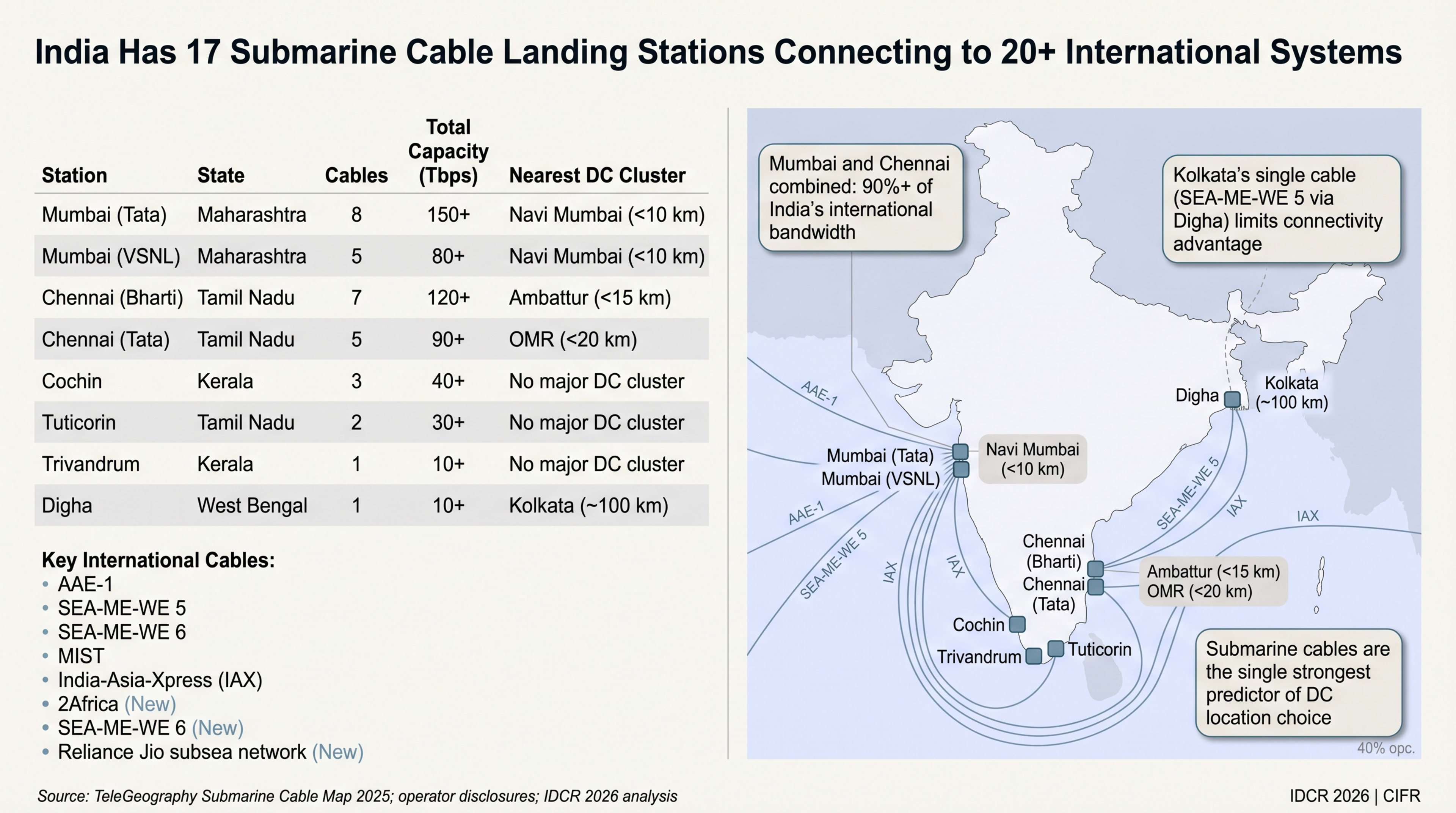
India's structural vulnerability is stark. The country hosts 17 international submarine cables across 14 landing stations in only five cities: Mumbai, Chennai, Cochin, Tuticorin, and Trivandrum. India accounts for just 1% of global cable landing stations, compared with Singapore's 26 cables across three sites serving 6 million people (TRAI Chairman Anil Kumar Lahoti, March 2025). The vast majority of India's cables converge at Versova, Maharashtra --- a single-point-of-failure concentration flagged by regulators and operators as a national security concern.
| India's Submarine Cable Landing Stations — Operational Inventory (March 2026) | ||||
|---|---|---|---|---|
| Landing City | Cables | Key Systems | Operators | Capacity (Tbps) |
| Mumbai (Versova/Andheri) | 10+ | MIST, 2Africa, i2i, TGN-EA, FALCON, EIG, SMW-3/4/5 | Tata, Airtel, Reliance, NTT | 180 |
| Chennai | 6+ | SMW-6, SMW-4, Telin-3, MIST, AAG, BBG | Airtel, Tata, NTT, BSNL | 90 |
| Cochin (Kochi) | 2 | SAFE, Falcon | Tata, Reliance | 15 |
| Tuticorin | 1 | SMW-4 (branch) | BSNL | 5 |
| Trivandrum | 1 | SAFE (branch) | BSNL | 3 |
Source: SubmarineNetworks.com; TRAI Submarine Cable Recommendations, June 2023; Operator disclosures. Capacity figures are CIFR estimates based on publicly reported lit capacities.
Mumbai and Chennai together account for over 90% of India's international submarine cable capacity. Any disruption at Versova --- whether from a natural disaster, construction accident, or sabotage --- could degrade up to 60% of the country's international bandwidth. This geographic concentration is the single largest infrastructure risk facing India's data center industry.
Keep reading — free, takes 30 seconds
Fiber Connectivity and Submarine Cable Infrastructure continues with 2,833 words and 18 figures.