
Outlook and Strategic Recommendations
Forecast comparison, three capacity scenarios for 2030, infrastructure delivery requirements, and recommendations for principal stakeholders.
India's data-centre sector has strong demand, available capital, and stated policy support. Capacity delivery depends on power, water, cooling, network, and approval infrastructure. This chapter presents three scenarios for 2030 and recommendations for operators, utilities, investors, and government.
Base case 2030
50% probability; operational IT load
Cumulative capex required
for the base case; ~half already committed
Deloitte 2030 projection
cumulative Indian DC investment
Lost per 6-mo grid delay
every interconnection slip removes pipeline
Forecast Comparison at 28 July 2026
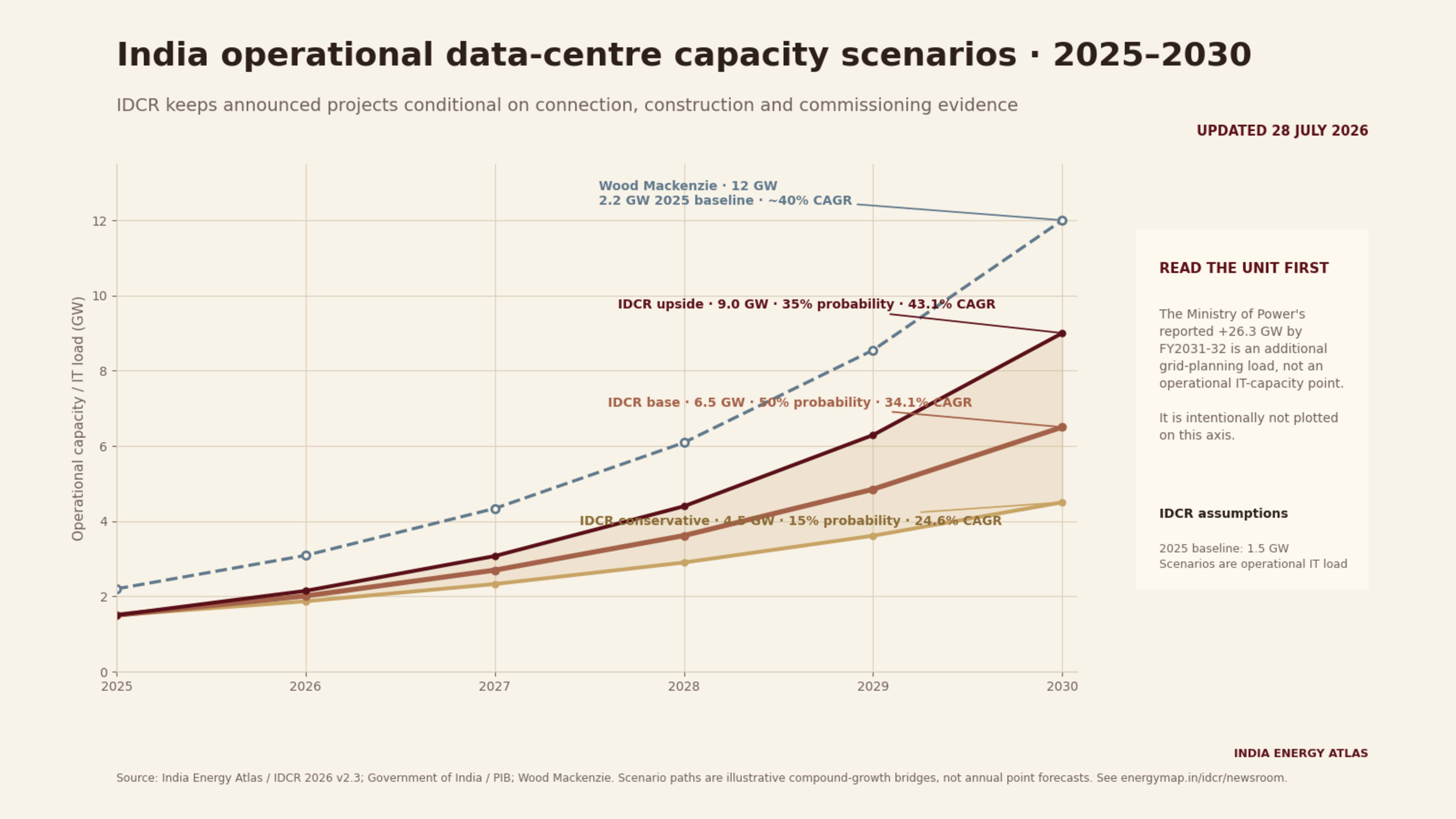
The 28 July edition retains three IDCR operational IT-load scenarios: 4.5 GW conservative, 6.5 GW base, and 9.0 GW upside by 2030. Wood Mackenzie forecasts 12 GW of operational capacity in 2030 from a 2.2 GW 2025 baseline (Wood Mackenzie· Wood MackenzieJul 2026). A parliamentary reply reported by The Indian Express indicates 26.3 GW of additional AI data-centre grid load by FY2031-32 based on projects received by states (reported Ministry of Power reply· The Indian ExpressJul 2026).
The IDCR and Wood Mackenzie figures describe operational capacity. The 26.3 GW figure describes additional grid load from a project list. The IDCR base is 45.8% below Wood Mackenzie's 12 GW forecast. The IDCR upside is 25% below that forecast. Compound annual growth is 34.1% for the IDCR base, 43.1% for the IDCR upside, and approximately 40% for Wood Mackenzie. The public IDCR media resources page provides the calculations, CSV, source links, chart, and citation guidance.
At 1.35 PUE and 85% average utilisation, the three IDCR cases translate into 6.1 / 8.8 / 12.2 GW of facility input and approximately 45 / 65 / 90 TWh of annual energy. These measures are reported separately throughout the power chapter.
Evidence at July 2026 Cutoff
The Review assesses capacity delivery through dated infrastructure and regulatory evidence. At the July cutoff, state rules provide additional implementation detail, large loads are entering utility and regulator processes, and grid assets can be monitored by project stage and evidence date.
| Review assessment | Evidence as of July 2026 | Application |
|---|---|---|
| Capital commitments exceed confirmed grid delivery | Hyperscaler commitments remain large; interconnection, dedicated-facility, and reinforcement requirements remain principal delivery risks | Base commercial-operation assumptions on power evidence and commissioning schedules |
| State competition would become a race for executable frameworks | The policy register now separates operative instruments from launches, reported amendments and proposals across the latest state cycle | Price legal-status and implementation risk separately from incentive value |
| Substation evidence is required for project diligence | EnergyMap provides named substation context and a time-aware tracker; Odisha demonstrates the workflow at state scale | Require auditable network identity and project stage before site approval |
| Corridor screening requires asset-level evidence | Demand-score cells rank areas for investigation and identify data limitations | Use the heatmap to allocate diligence effort; require asset evidence for capital approval |
| Annual research would need a live evidence layer | Book claims now hand off to /substations, /substation-tracker, policy matrices and dated snapshots | Treat this edition as a versioned baseline; monitor the live products for change |
The July evidence supports the direction of the forecast. Project-level capacity remains subject to sanctioned connections, required network works, cost allocation, and energisation schedules. Projects without this evidence require a higher execution-risk adjustment.
Atlas indicators used for scenario monitoring: peak demand 248.1 GWlive · 03 Oct 2026, 02:11 IST · grid carbon intensity 906 gCO₂/kWhlive · 03 Oct 2026, 01:30 IST · day-ahead price ₹3,420/MWhlast known. Related pages: /forecast · /energy-security · /infra · /developer.
2030 Capacity Scenarios and Conditions
| Parameter | Conservative (4.5 GW) | Base Case (6.5 GW) | Upside Case (9+ GW) |
|---|---|---|---|
| Capacity (2030) | 4,500 MW | 6,500 MW | 9,000–9,200 MW |
| Power assumption | Grid bottlenecks persist; 36+ month interconnection queues remain; no dedicated DC feeder programme | Moderate grid upgrades; 18-month interconnection target met in 3 of 7 markets; select 220 kV substations fast-tracked | National DC feeder programme launched; interconnection queues reduced to 12 months; captive RE + battery at scale |
| AI adoption | AI demand plateaus after initial wave; enterprise adoption slower than projected | Steady AI growth; IndiaAI scales to 58K GPUs; 2-3 large sovereign AI clusters operational | AI demand accelerates; India captures regional AI training workloads; 100K+ GPUs deployed |
| Policy execution | National DC policy delayed; state incentives fragmented; 30+ approvals persist | National policy enacted; single-window clearance in 5+ states; DCEZ pilot operational | Full national policy with enforcement; standardised incentives; DC REIT framework |
| Investment required | $20–25B cumulative | $30–40B cumulative | $45–55B cumulative |
| Probability | 15% | 50% | 35% |
Source: Council for Independent Frontier Research (CIFR) scenario analysis. The base case aligns with CBRE/JLL projections, the upside case with Nomura (9.2 GW), and the conservative case with Colliers (4.5 GW).
CIFR ESTIMATE This Review assigns 50% probability to the base case (6.5 GW by 2030, 4.3x growth from 1,500 MW), 35% to the 9+ GW upside, and 15% to the conservative case. The base case requires $30--40 billion in cumulative investment; approximately half is committed or under construction. The principal constraints are grid delivery and regulatory execution. Every six-month interconnection delay removes 200--300 MW from the 2030 pipeline.
The July update specifies evidence conditions for each scenario. Utility studies, network works, and legally effective allocations determine project inclusion in the connectable base case. The locked Atlas snapshot records mapped substations and project signals. Bus-level headroom remains outside the published dataset.
Geopolitical Tailwind: The March 2026 Inflection
This Review is published during severe global digital infrastructure disruption. The Strait of Hormuz and Red Sea closures, military strikes on hyperscale facilities (AWS UAE/Bahrain, 1 March 2026), and force majeure declarations by LNG suppliers have redrawn the risk map for data-centre investment. These events postdate most chapter edits; this section provides overlay.
India faces asymmetrically positive impact. The $33.8 billion MENA data-centre investment planned through 2030 (PwC) now competes against war-risk premiums absent at 2026 start. Lloyd's Joint War Committee redesignated the Arabian Gulf as a conflict zone (3 March 2026); insurance premiums surged over 1,000% for maritime and infrastructure risks (S&P Global; Insurance Journal, March 2026). AWS advised customers to migrate from the Middle East (CBS News, March 2026). India --- $45.2 billion in confirmed hyperscaler commitments, democratic governance, no proximate conflict, world's second-largest internet base --- is the natural beneficiary.
The flight-to-stability thesis is materialising. Capacity Media (10 March 2026) reported a potential "data-centre exodus to India." The OpenAI-Tata partnership (100 MW initial, option to 1 GW; February 2026) signals frontier AI companies choosing India for sovereign compute. Deloitte projects $200 billion Indian data-centre investment by 2030 (Business Standard, 19 February 2026).
The presented scenarios (conservative 4.5 GW, base 6.5 GW, bull 9+ GW) were developed before the March crisis. The geopolitical tailwind does not alter fundamental supply constraints (power, water, approvals) gating India's build-out. It accelerates capital availability and increases bull-case probability. If sustained Gulf instability redirects 10--15% of planned MENA investment toward India, this represents $3--5 billion additional capital flows, funding 500--700 MW at India's $5--7M/MW construction cost. Revised probability weights: conservative 15% (from 20%), base 50% (from 55%), bull 35% (from 25%).
Source: IDCR 2026 analysis.
The Three Structural Shifts That Reframe the 2030 Outlook
Three structural shifts have crystallised in the past 12 months that the 2030 base case did not anticipate:
- Data centres are becoming utilities. In April 2026, Andhra Pradesh granted Google a power-distribution licence — the first private discom licence to a non-utility in the state — for the 1 GW Visakhapatnam campus (Varindia· VarindiaApr 2026; Google Press Corner· GoogleApr 2026). The state's parallel framework allowing DCs themselves to apply for distribution licences (Whalesbook· Whalesbook) signals a replicable model. Telangana and Karnataka are watching; Maharashtra's 18-month MSEDCL queue makes the political-economy case unavoidable. By 2030, the largest 5–10 hyperscale campuses in India will operate with utility-class regulatory status — not DISCOM customers. This compresses tariff arbitrage between states and shifts the competitive variable from incentives to the legal-framework speed of granting licences. Live Andhra Pradesh grid context.
- Carbon becomes a priced opex line by FY28. India's CCTS goes live in H2 2026 with 740 obligated entities and >700 MtCO₂e initial coverage (ICAP· ICAP). Article 6.2 bilateral agreements with Japan (signed Aug 2025), Singapore, Sweden, South Korea (in negotiation), plus the Green Hydrogen Certification Scheme integration with CCTS in 2026, create a four-way carbon-pricing stack. By FY28, every >30 MW Indian data centre will face explicit carbon costs in opex — and the operators with verified 24/7 CFE matching, Indian green-hydrogen offtake, or Article 6.2-eligible RE projects will sell into a tightening market while annual-matched-REC operators will buy at rising prices. Live carbon context: /carbon-intensity · /carbon-markets.
- Water utilities become rate-setting counterparties. MWRRA's draft 2026–2029 bulk-water tariff (April 2026), HMWSSB's 870 ML/day projected 2027–28 deficit, and BWSSB's de-facto closed-loop cooling pre-conditions for new connections in DC zones all signal the same shift: water boards are using tariff and allocation — the only levers they have — to slow incremental DC water demand while liquid-cooling technology catches up. By 2030, water-board engagement will be parallel critical-path with DISCOM connection, not downstream civil works (Chapter 8).
These shifts do not invalidate the 6.5 GW base case — they reshape which operators capture it. Hyperscalers with utility-class regulatory status, 24/7 CFE-capable PPA portfolios, and liquid-cooled greenfield builds will compound advantages. Operators relying on DISCOM tariffs, annual-matched RECs, and evaporative cooling will face compressing margins and rising opex through every framework simultaneously. The 2030 winners will be a smaller cohort than today's 39+ operators, with a meaningfully different operating model — closer to vertically integrated power-and-compute companies than to traditional colocation real-estate plays.
Recommendations for Operators: Build for Power Security, Design for Water Neutrality
Keep reading — free, takes 30 seconds
Outlook and Strategic Recommendations continues with 1,268 words and 18 figures.