
Natural Gas and the Backup Power Transition
Why diesel's dominance in data centre backup is ending — and how gas infrastructure can capture a $500M+ annual fuel opportunity
Diesel per facility
on-site storage; 50 MW colo
Annual fuel spend
across India's 1.5 GW operational fleet
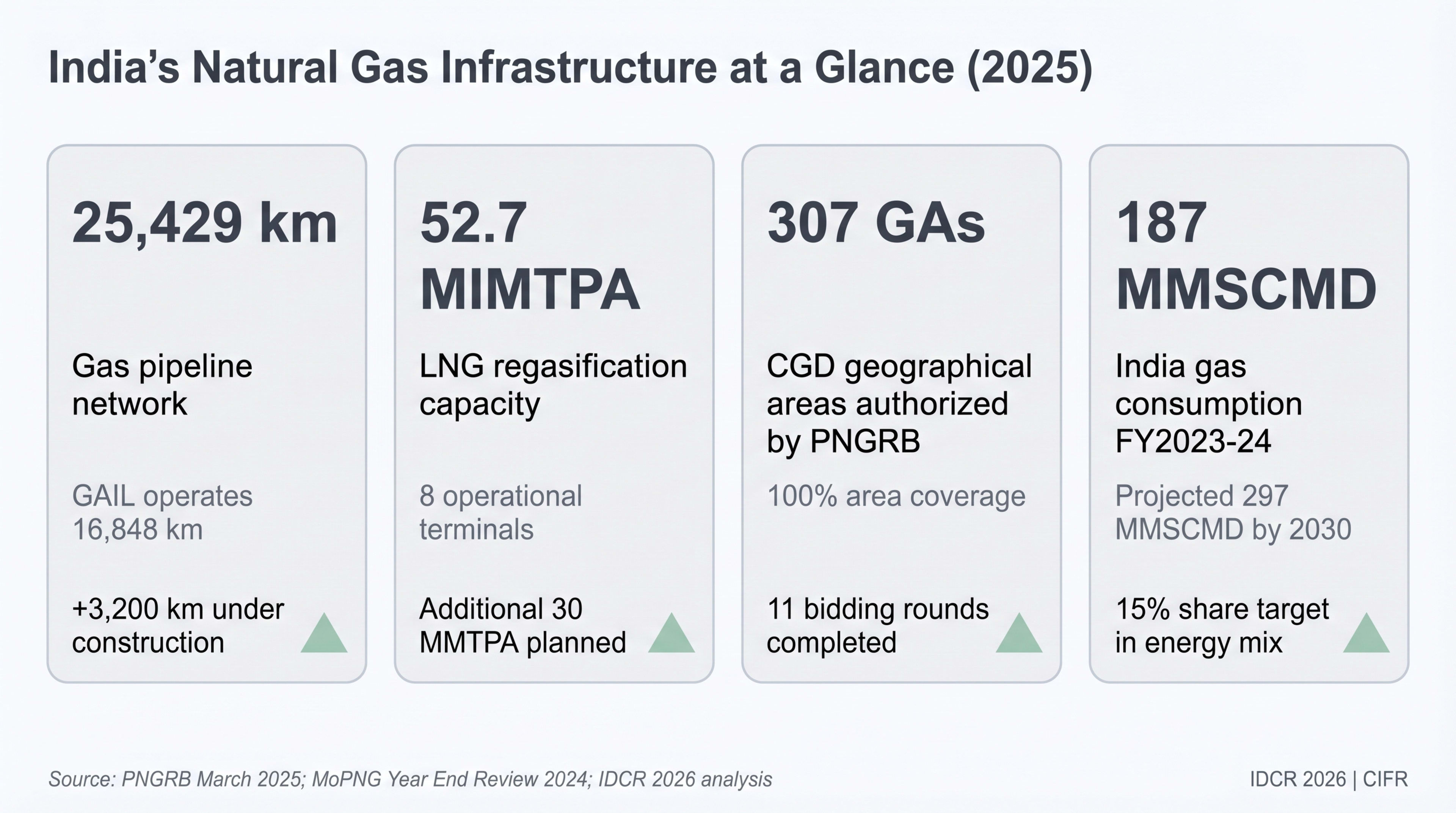
Gas pipeline network
end-Jun 2025; doubled in five years
Gas vs diesel cost edge
₹8–10 vs ₹14–18 per kWh
Cross-context: baseload coal exposure at /coal · long-term clean transition at /green-hydrogen · LNG / Hormuz risk framing at /energy-security.
India's Data Centres Run on 200,000+ Litres of Diesel Per Facility
Every data centre in India maintains diesel generators as its primary backup power source. A typical 50 MW facility operates 10–15 diesel gensets (each 2–2.5 MW) with 200,000–500,000 litres of on-site diesel storage.
During routine testing (mandatory monthly under Uptime Institute Tier III/IV standards), emergency grid outages, and planned maintenance windows, these generators run an estimated 200–500 hours per year.
A 50 MW facility consumes approximately 1.5–3 million litres of diesel annually, costing INR 12–25 crore ($1.5–3M) in fuel alone and emitting 4,000–7,500 tonnes of CO2.
Across India's 1.5 GW of operational DC capacity, aggregate diesel consumption reaches 300–500 million litres per year—approximately $500M in annual fuel spend. By 2030, as the sector expands to 9 GW, annual consumption could reach 2–3 billion litres without intervention. Transition costs and emissions reductions offer compelling economic and environmental rationales.
Source: IDCR 2026 estimates based on operator surveys; CPCB emission factors; diesel pricing as of March 2026 (~ INR 88/litre commercial)
Keep reading — free, takes 30 seconds
Natural Gas and the Backup Power Transition continues with 1,161 words and 18 figures.